

On this page
Most of India's internet connections are on a mobile network. TRAI's yearly performance indicators for 2025-26 show that 94.18% of internet subscriptions were mobile wireless, and the average wireless data subscriber used 25.51 GB a month. Averages hide a lot: the same report counts 48.31 internet subscribers per 100 people in rural areas, against 126.80 in urban areas. If your signal drops every evening or your pack runs out by the 20th, this plan is for you.
How much data does an online class use?
The biggest saving is to stop receiving video you do not need. Zoom's bandwidth guide recommends 60-80 kbps for audio and 50-75 kbps for screen sharing only. For a group video call, which is what most classes are, it recommends 1.8 Mbps download for 720p and 3.0 Mbps download for 1080p.
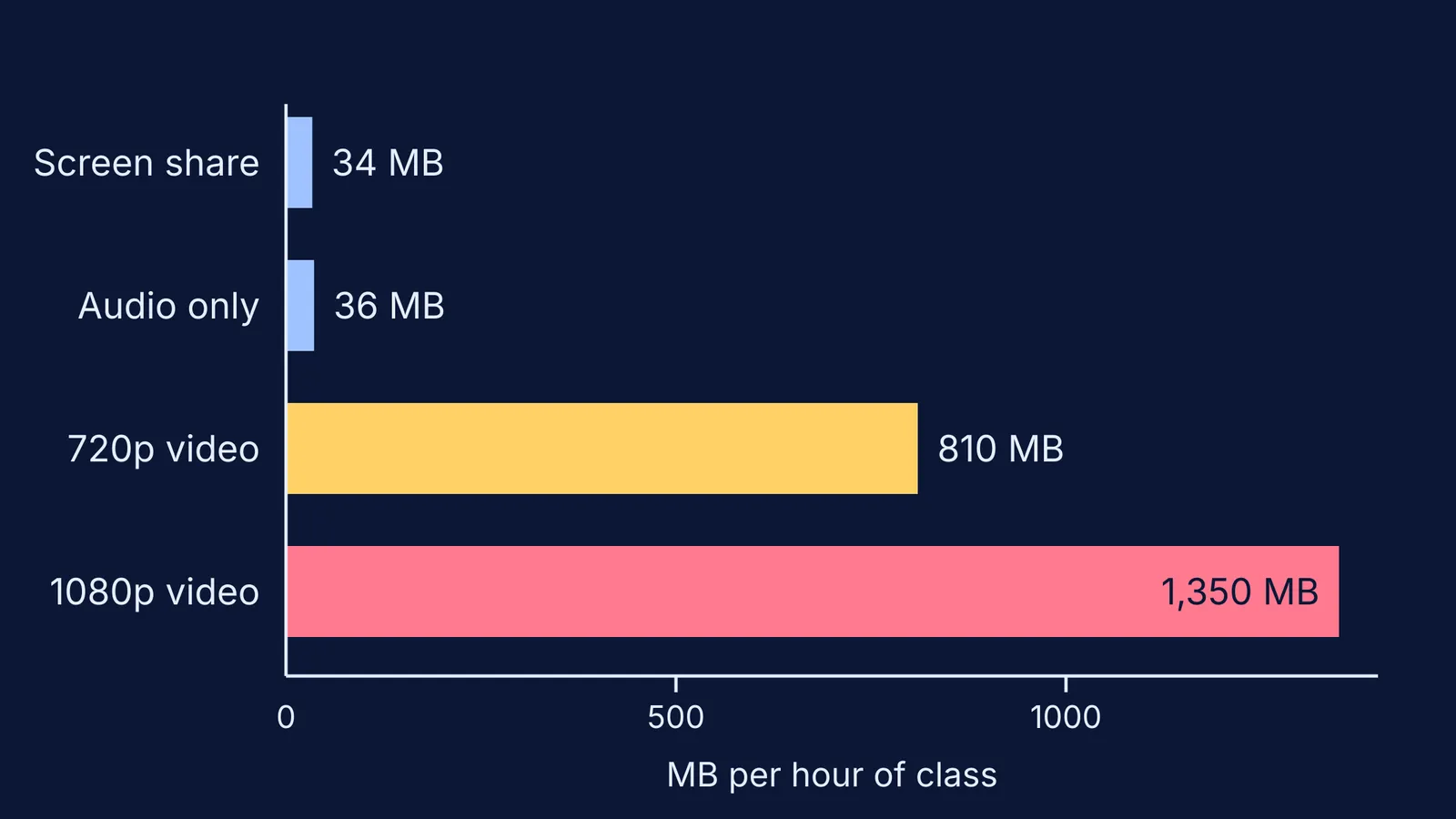
Turn those rates into one hour of class (multiply by 3,600 seconds, divide by 8 bits per byte), using the top of each range:
Screen share only: about 34 MB an hour
Audio only: about 36 MB an hour
720p group video: about 810 MB an hour
1080p group video: about 1,350 MB an hour
These are recommended rates, not a meter reading. Real calls vary with the app, the number of cameras on and how much moves on screen. Even so, by Zoom's figures an hour of 720p group video needs more than twenty times the data of an hour of audio.
How do I attend live classes on a weak connection?
Join with your camera off, and tell the teacher once at the start so it does not seem rude.
If the app offers it, switch off incoming video or choose audio only.
When the teacher shares the board, the screen share is the part that matters. Hide the teacher's face video and keep the board.
Write notes as you listen instead of planning to rewatch, and ask for the slides or board photos after class.
A message you can send before the first class: "Sir/Ma'am, my network is weak in the evenings, so I will keep my camera off and stay on audio. If I miss something, I will ask in the chat. Could you share the board notes after class?"
If the slow connection is your hostel Wi-Fi rather than mobile data, our guide on studying online when hostel WiFi is slow covers that case.
Which lessons can I download and study offline?
Download on Wi-Fi (school, a library, a relative's home) and the lesson costs no mobile data when you watch it.
DIKSHA, the national school learning platform, lets you store and share content offline and scan the QR codes in your textbooks to find learning material on that topic.
PM eVIDYA describes SWAYAM Prabha TV channels you can watch through DD, Dish TV and the Jio TV app, with 12 dedicated channels proposed, one for each class from 1 to 12. It also plans radio and podcasts, with radio aimed at children in remote areas who are not online. A lesson on TV uses none of your phone data.
On YouTube, the Data saver quality setting gives "Lower picture quality, but videos may start faster". For a whiteboard lecture, try the lowest setting at which you can still read the writing, and make it your default.
Power cuts are the other half of the problem; this backup plan for online classes during power cuts helps families prepare for both.
How do I make a weekly data budget?
Suppose 10 GB a week is left for study after the rest of the family's use. Here is one week, using the per-hour figures worked out from Zoom's recommended bandwidth above:
Live classes: five one-hour classes on audio, about 5 x 36 MB = 180 MB. The same five on 720p group video would be about 4 GB.
Recorded lectures: four hours, downloaded on Wi-Fi, so 0 MB of mobile data.
Two classes where you need to see the board: two hours of 720p, about 1.6 GB.
Questions, practice and looking things up: set aside 1 GB.
That comes to about 2.8 GB, leaving room for a bad week. Every Sunday, open your phone's data-usage screen, see which apps used what, and adjust next week's plan.
Where should my online minutes go?
When data is short, spend it on the questions you are stuck on. Fermi's AI tutor works out what you already know and builds a plan for the session, so you sit down to a clear next step. If the trouble is a wrong method in a numerical, the Fermi Problem Library has worked problems with a step-by-step solver that explains the reasoning rather than printing an answer.
On a small screen, these tips for studying with an AI tutor on a phone help you keep the work readable.
This week, switch your next live class to audio and check your data screen on Sunday.


