

On this page
Power cuts are a regular disruption in many Indian homes. For a student in the middle of a live lecture or a timed mock test, a sudden drop in the Wi-Fi connection breaks their focus and wastes valuable study time.
When preparation for demanding exams like JEE or NEET relies entirely on digital resources, an unreliable power supply becomes a major source of stress. Building a solid backup plan does not mean rewiring the entire house. A few smart additions can ensure that your child's study session continues without skipping a beat.
Why do you lose internet during a power cut?
Modern study devices—laptops, tablets, and smartphones—have built-in batteries that can easily outlast a typical two-hour power cut. The weak link is almost always the home Wi-Fi router. When the local grid goes down, the router switches off immediately, severing the connection in the middle of a sentence or a timed quiz.
You might assume that your child can just switch to a mobile data hotspot. However, local cell towers sometimes lose power during broad area outages, forcing them to rely on their own backup generators which may fail or become congested. This slows mobile data to a crawl, making it impossible to maintain a stable video call or load a heavy interactive lesson. To keep the learning smooth, the home broadband connection needs to stay active.
What is the best power backup for online classes?
Building a reliable backup is simpler and cheaper than installing a heavy-duty inverter for the whole house. A few targeted devices can keep a digital study session going.
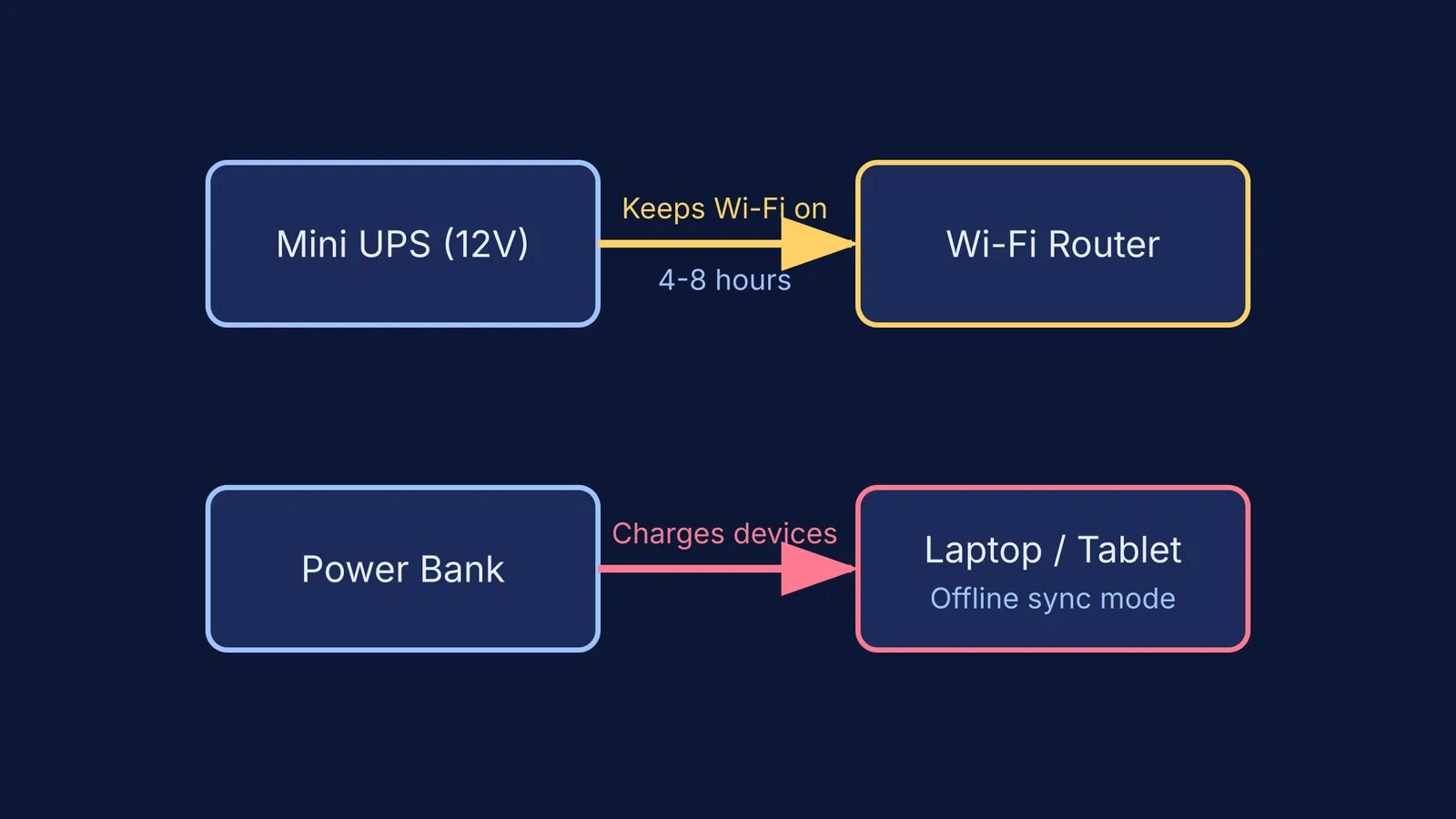
Mini UPS for the router: A router UPS is a small battery backup that sits between your wall socket and the Wi-Fi router. When the power cuts, it instantly takes over, keeping the internet on for 4 to 8 hours. Before buying, check the sticker on the back of your router to see whether it takes a 9V or 12V input.
Dedicated power bank: Keep a high-capacity (20,000mAh) power bank solely for your child's study devices. If they attend classes on a tablet or a phone, this ensures the screen stays brightly lit through a long evening cut.
Rechargeable lighting: An LED desk lamp with its own battery protects your child's eyes. You cannot read physical textbooks or work out maths problems on paper in the dim glow of a laptop screen alone.
How can students study without the internet?
Even with a UPS, the internet provider's local exchange might occasionally fail during a severe storm or prolonged blackout. Students should be ready to switch gears when the connection drops entirely, rather than treating it as a reason to stop studying.
Download in advance: Encourage your child to download lecture PDFs, recorded videos, and question banks while the connection is strong. Many educational platforms allow offline saving for exactly this reason.
Save progress automatically: If your child uses Fermi's AI tutor, progress, notes and everything generated along the way stay in the student's library. If the internet drops, nothing is lost, and they can pick up exactly where they left off when power returns.
Keep devices charged: Make it a family rule to plug in laptops and tablets as soon as they finish using them. A device should never be sitting idle with an empty battery.
Keep a physical workbook ready: Have a designated notebook for offline work. When the internet is completely unavailable, this is the perfect time to review formulas, practice drawing diagrams, or read a physical NCERT textbook.
Why does broken focus affect learning?
Beyond the lost minutes, internet downtime affects a student's momentum. Research shows that once focus is broken, it takes over 23 minutes to regain that deep state of concentration (Mark et al., 2008). If a power cut drops a student out of a live class, they often return flustered, having missed crucial context.
By removing these small, predictable interruptions, you take unnecessary panic out of exam preparation. A stable environment lets them focus entirely on understanding the material, rather than worrying about whether their router will survive the next hour.
For more ways to organise their learning environment, read our guide on setting up a good study space at home, or see how you can help them navigate digital learning by trying an AI tutor with your child.


