

On this page
Hostel WiFi and mobile networks in India both suffer from the same fundamental problem: evening congestion. If you are preparing for JEE or NEET from a hostel or PG, the hours between 7 PM and 11 PM are often the hardest time to watch a live class, stream a video, or even download a heavy PDF. When the internet grinds to a halt, it is easy to feel like your study session is ruined.
However, you do not need a perfect connection to study effectively. By understanding when the network is free and how much data your materials actually need, you can bypass the buffering screen entirely.
Why is hostel WiFi so slow at night?
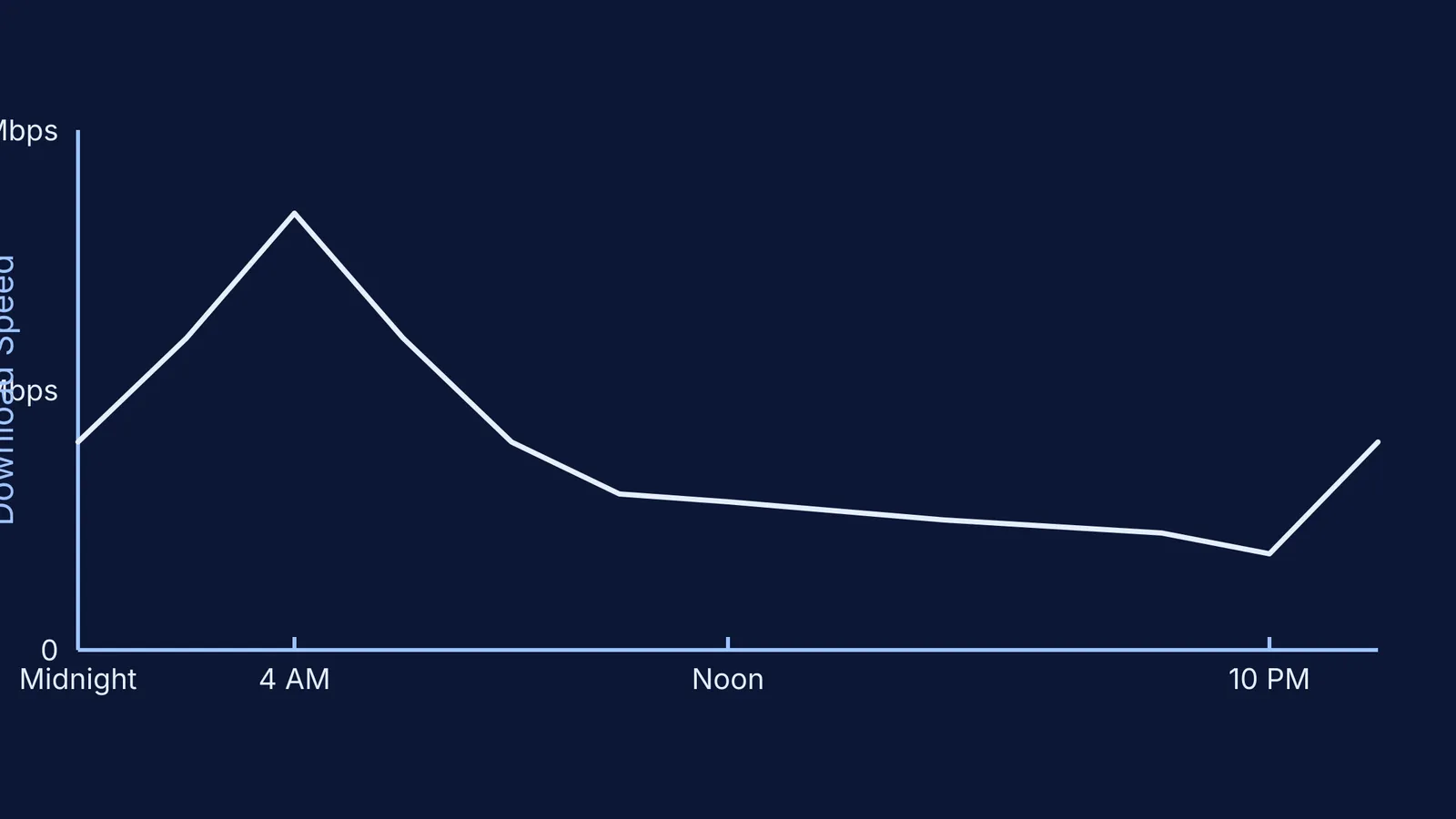
When everyone in your building returns from classes and turns on their devices, the available bandwidth is split into tiny fractions. This "rush hour" affects mobile networks just as heavily as broadband. During the day and evening, millions of active users erode network capacity. By 10 PM, download speeds hit their daily low, according to network traffic reports.
However, the opposite is true while the city sleeps. Data from Opensignal shows that at 4 AM, the network is largely empty, allowing for speeds that are 4.5 times faster than the evening slump. This gives you a predictable, high-speed window to get the heavy files you need without waiting.
How to manage data limits on video lectures
If you rely on a daily 1.5 GB or 2 GB mobile data plan, high-definition video will exhaust it long before your study session ends. A standard 720p YouTube lecture consumes roughly 1.5 GB of data per hour, according to Android Authority. Watching just one detailed physics derivation in high quality can leave you without internet for the rest of the day.
You can drastically cut this consumption by changing your streaming resolution. Since most exam prep videos consist of a teacher speaking next to static slides or a whiteboard, you do not actually need crisp, high-definition video. Dropping the quality to 360p reduces your data consumption to roughly 300 MB per hour, allowing you to watch four times as much content on the same daily plan, as noted by Android Authority.
Planning your off-peak downloads
Instead of fighting buffering wheels in the evening, the most reliable strategy is to shift your high-bandwidth tasks to the early morning. Before you go to sleep, decide exactly which video lectures, PDF notes and mock tests you need for the next day. If you wake up early, use the off-peak morning window to download everything you need in minutes.
By studying in a hostel with your materials pre-loaded on your device, your evening study block becomes entirely offline and interruption-free. You can focus your energy on solving complex problems and reading textbooks rather than waiting for a screen to load.
What if you get stuck offline?
Downloading lectures solves the video problem, but it leaves a gap if you need to ask a question. If you are working through tough mechanics or organic chemistry problems offline and hit a wall, you need a way to clear the doubt without waiting for the next live class.
This is where Fermi's AI tutor helps fill the gap. When you bring a physics or chemistry problem to it, the tutor teaches rather than simply printing an answer. It holds a line of reasoning across a session, notices where a student is stuck, and checks understanding as it goes.
If you need a complete breakdown of a tough topic, the Fermi Concept Library has every concept in physics, chemistry, biology, mathematics and computing, each with its own lesson and its place in the map.
Building a study routine that lasts means adapting your habits to your environment. By downloading your heavy materials early and using low-data, text-based tools for your active problem-solving, you can turn slow hostel internet from a daily frustration into a reason to stay completely focused on your work.


