

On this page
If you share a room with a brother or sister, you are far from alone. According to a Population Reference Bureau summary of Census 2011, about 92 million Indian households (37 percent) lived in one-room homes, and another 78 million (32 percent) lived in two-room homes.
You can't build a new room, but you can change how the one you share works. Four things do most of the work: agreed quiet hours, headphones used safely, a corner that is yours, and a sign everyone understands.
Why is it so hard to study with siblings in the room?
There are two problems: sound and interruptions.
Sound first. A 2018 Bayesian meta-analysis of 65 studies by Vasilev, Kirkby and Angele found that background noise, speech and music all have a small but reliable harmful effect on reading. Intelligible speech and music with lyrics were the most distracting, and the effect on reading comprehension did not generally differ between children and adults. So a sibling's phone call, or a song they are singing along to, is likely to cost you more than the steady hum of a fan.
Interruptions are the second problem. In a lab experiment with 48 participants, Gloria Mark and colleagues found that people who were interrupted during an email task finished it in less time with no drop in quality, but reported more stress, frustration, time pressure and effort. Being asked "where's the charger?" every ten minutes may not wreck your answers, but it can wear you out.
For more on the sound side, see our guide to studying in a noisy home.
How do you agree quiet hours with siblings?
A deal everyone helped make is easier to keep than a rule one person sets. Sit down together once, with a parent if possible, and agree three things: when the quiet blocks are, what "quiet" means, and what everyone gets in return.
Here is a script you can adapt:
"I have a test on Friday. Can we keep 6:30 to 7:20 and 7:35 to 8:25 quiet on school nights?"
"Quiet means no speaker, no calls in the room, and no questions unless it's urgent. You can still be here, reading, drawing or doing homework."
"In between, the room is yours. Music, chat, whatever you like. And on Sunday I'll keep quiet for your work."
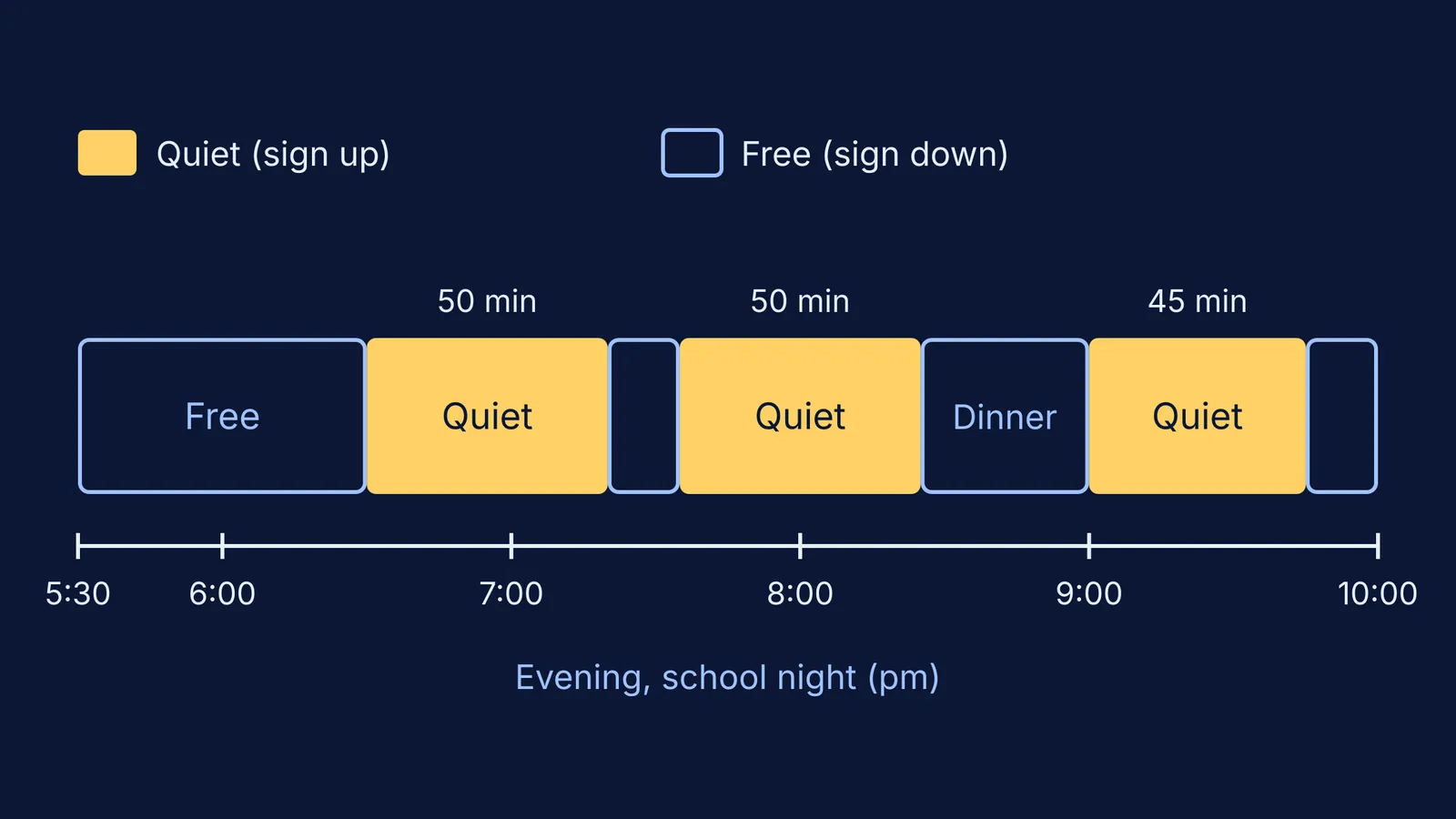
A worked example: Riya is in Class 11 and her brother Kabir is in Class 6. From 5:30 to 6:30 the room is free. Then come two 50-minute quiet blocks with a 15-minute break between them, dinner at 8:25, and one last 45-minute quiet block from 9:00, when Kabir reads before bed. Kabir gets the free hour and the break. Riya gets almost two and a half hours of protected time.
If a little brother or sister is the main source of disruption, our post on handling a younger sibling who disturbs study time has ideas for parents.
Do headphones help you study in a shared room?
They can, as long as you keep the volume sensible. The World Health Organization's safe listening guidance suggests setting personal devices to no more than 60 percent of maximum volume. It also recommends well-fitted, noise-cancelling headphones in noisy places, so you don't have to turn the sound up, and frequent breaks for your ears.
What you play matters too. Given the meta-analysis above, choose silence, steady noise or instrumental music over songs with words or a podcast. Even headphones with nothing playing can work as a signal to your siblings that you are busy.
How do you set up a study corner in a shared room?
Face a wall or window, not the bed or the door, so movement stays out of sight.
Keep only today's books and one notebook on the desk.
Put your phone in another room or across the room during quiet blocks.
Keep a slip of paper for stray thoughts and questions, a trick from our post on the distraction parking lot.
If you share one table, split it with tape or a row of books and agree whose side is whose.
What should a do-not-disturb sign say?
Keep it simple: a card with "Quiet till 7:20" on one side and "Free, come in" on the other, hung on the door or your chair. Write the end time, so your siblings know exactly how long they need to wait. Agree what counts as urgent (someone is hurt, a parent is calling) and save everything else for the break.
Quiet hours only help if you know what to do with them. If you sit down without a clear starting point, Fermi's AI tutor can work out what you already know and build a plan for the session, so you don't spend half the quiet block deciding what to do.
If arguments over space are causing real stress at home, talk to a parent, a teacher or a school counsellor, or call Tele MANAS on 14416, the government's toll-free, 24/7 tele-mental health helpline.


