

On this page
A common optics problem in JEE and NEET physics asks what happens to an image when a glass slab is placed between an object and a plane mirror. Does the image shift? By how much, and in which direction?
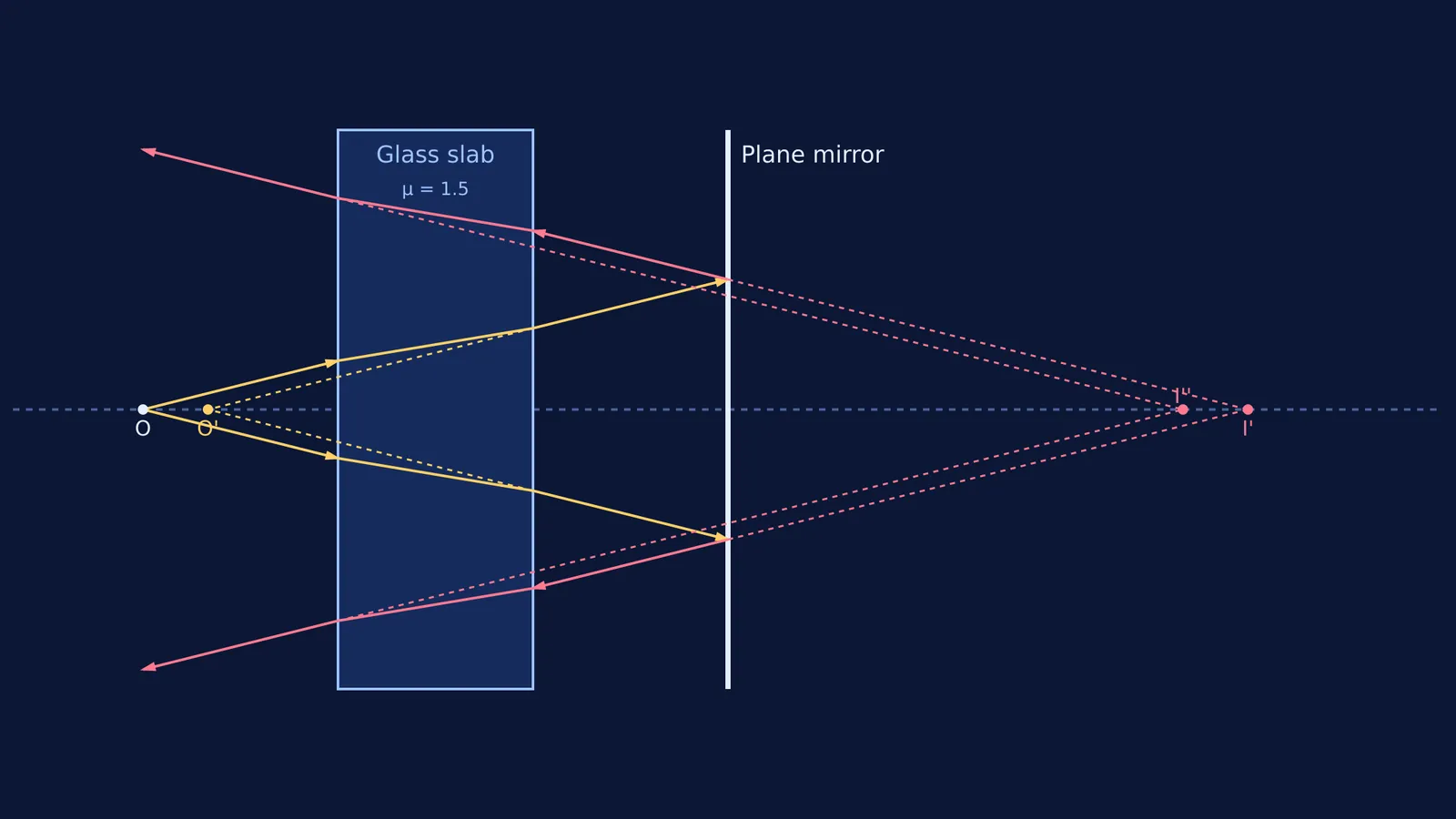
The short answer is that the final image moves closer to the mirror by 2t(1 - 1/μ), where t is the slab's thickness and μ is its refractive index. To see why the shift doubles, we have to follow the light on both legs of its journey.
What is the apparent shift of a glass slab?
Whenever you look at an object through a transparent medium with parallel faces, refraction at the two surfaces makes the object appear shifted from its real position. According to Snell's law, this apparent shift s produced by a slab is given by the formula:
s = t(1 - 1/μ)
A crucial rule to remember is that this shift always happens in the direction that the light is travelling.
How does the image shift towards the mirror?
Imagine an object placed at a distance d in front of a plane mirror. If we place a glass slab between them, the light leaving the object must travel through the slab to reach the mirror.
Because of the slab, the mirror does not "see" the object at its true distance d. Instead, the incident light is shifted towards the mirror by s = t(1 - 1/μ). The apparent object distance becomes d - s.
A plane mirror always forms an image at the exact same distance behind its reflective surface as the object is in front of it. So, the mirror forms an image at a distance d - s behind itself. Compared to where the image would be without the slab (at distance d), the image formed by the mirror has already shifted by s towards the mirror.
Where is the final image formed?
If you are standing in front of the mirror looking at this image, the light reflected by the mirror has to travel back through the glass slab to reach your eyes.
This is the crucial second step. The reflected light passes through the slab again, so it experiences another apparent shift. Since the light is now travelling from the mirror to you, the shift s is in the direction of the light—which means it is shifted towards you (and therefore closer to the mirror).
The image was already at d - s behind the mirror. This second shift moves it closer by another s. The final distance of the image from the mirror is:
(d - s) - s = d - 2s
By breaking the problem into two passes, we can see exactly what happened:
The slab shifts the object by t(1 - 1/μ) towards the mirror, and the image formed by the mirror moves by the same amount.
The return trip shifts the image again by t(1 - 1/μ).
The final image observed is shifted towards the mirror by a total of 2t(1 - 1/μ), based on the properties of a plane mirror.
What happens if the glass slab is moved?
A very common trick question in exams asks what happens to the final image if the glass slab is moved closer to or further away from the mirror.
Because the apparent shift s = t(1 - 1/μ) depends only on the thickness of the slab and its refractive index, it does not depend on the distance between the slab and the object, or the distance between the slab and the mirror. As long as the slab remains between the object and the mirror, the shift is constant. Therefore, moving the slab left or right has absolutely no effect on the position of the final image.
What if the mirror is a silvered glass slab?
Sometimes, instead of a separate slab and mirror, you are given a single glass slab whose back surface is silvered.
The most elegant way to solve this is to unfold the reflection. Light entering the front face travels a distance t to the mirror, reflects, and travels t back before exiting the front face.
Optically, this is equivalent to light travelling straight through a plain glass slab of double the thickness (2t). If an object is placed at a distance x from the front face of a silvered slab of thickness t:
Without refraction, the image would be at x + t behind the mirror, which is a distance of x + 2t from the front face.
Passing through our equivalent 2t slab produces a total apparent shift of S = 2t(1 - 1/μ) towards the observer.
The final distance of the image from the front face is (x + 2t) - 2t(1 - 1/μ).
If we expand this out, (x + 2t) - 2t + 2t/μ gives a final distance from the front face of exactly x + 2t/μ.
Optics problems often stack multiple concepts like this together. If you find it hard to keep track of virtual objects, shifts, and sign conventions, the Fermi Problem Library breaks down multi-step ray tracing problems. Rather than just giving you the final formula, Fermi's AI tutor works through each refraction and reflection with you, ensuring you understand where the light is going at every step.


