

On this page
When you look into a swimming pool, the bottom appears deceptively close. But what does a submerged fish see when looking up at a bird overhead?
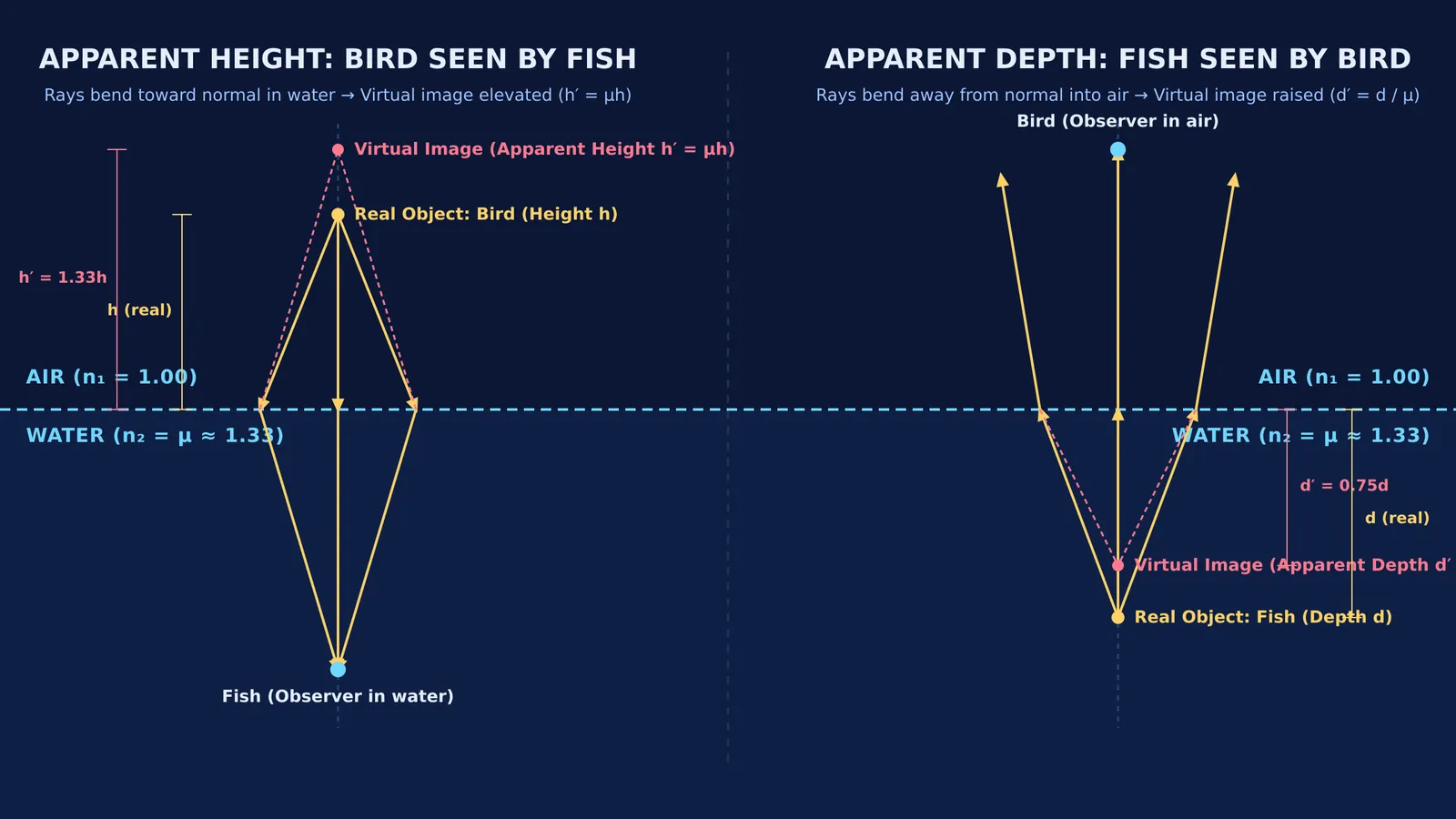
According to OpenStax University Physics Volume 3, image position across a flat boundary depends on the observer's medium. Light from the bird travels through air (n₁ ≈ 1.00) and enters water (n₂ = μ ≈ 1.33).
Under Willebrord Snell's law of refraction, light bends toward the normal in water. These refracted rays diverge less sharply. Tracing them backward projects a virtual image higher than the bird's actual position. A bird at height h appears at apparent height h' = μh, roughly 33% higher in fresh water.
How do you derive the apparent height formula?
To derive the formula, trace two rays from a bird at height h above the surface:
A normal ray strikes at incidence angle i = 0° and enters water undeflected.
An oblique ray strikes the surface at distance x from the normal, where tan i = x / h.
In water, the ray refracts at angle r toward the normal: sin i = μ sin r.
Projecting this refracted ray backward gives a virtual image at apparent height h', where tan r = x / h'.
Equating x gives h tan i = h' tan r. For paraxial rays near the vertical, tan i ≈ sin i and tan r ≈ sin r. Substituting Snell's law yields:
h' = h (sin i / sin r) = μh
As explained in our apparent depth and normal shift guide, the upward shift Δh is:
Δh = h' − h = (μ − 1)h
How does apparent height differ from apparent depth?
Refractive displacement is not reciprocal:
Object in air, observer in water: Rays bend toward the normal, lifting the virtual image away from the surface: h' = μh.
Object in water, observer in air: Rays bend away from the normal, pulling the virtual image closer: d' = d / μ.
If a bird hovers at height h while a fish swims beneath it at depth d:
Apparent distance seen by fish: S_fish = d + μh
Apparent distance seen by bird: S_bird = h + d / μ
Factoring out μ shows S_fish = μ × S_bird. To the fish, the air appears stretched by a factor of μ; to the bird, the water appears compressed. Our guide on ray optics sign mistakes helps avoid confusing μ with 1/μ.
How do archerfish correct for refraction in nature?
For predatory archerfish (*Toxotes*), optical displacement is an everyday hunting challenge. Archerfish knock down aerial insects by firing water jets from below.
Because light bends toward the normal, aerial prey appears higher and steeper than its true position. In Behavioral Ecology and Sociobiology, Lawrence M. Dill showed that archerfish (*Toxotes chatareus*) systematically compensate for refraction across diverse firing angles, rather than shooting only from directly beneath prey. Shooting from an angle avoids detection while the fish corrects for distortions in elevation and height.
Stefan Schuster showed in Current Biology that archerfish also learn to correct for optical magnification to judge absolute prey size. Furthermore, Svetlana Volotsky, Opher Donchin, and Ronen Segev demonstrated in eLife that archerfish maintain accuracy through motor adaptation in an egocentric frame of reference across repeated shots.
The Fermi Simulation Lab provides interactive simulations for the ideas that are easier to see than to read.
How do you calculate apparent distances and velocities in a worked example?
Using plane refraction formulas from OpenStax University Physics Volume 3, consider a classic problem:
A bird flies at height 12 m above a calm lake (μ = 4/3), while a fish swims directly beneath it at depth 9 m.
Apparent position of bird: To the fish, the bird appears at apparent height h' = μh = (4/3) × 12 m = 16 m. Total apparent distance is d + h' = 9 m + 16 m = 25 m.
Apparent position of fish: To the bird, the fish appears at apparent depth d' = d / μ = 9 m / (4/3) = 6.75 m. Total apparent distance is h + d' = 12 m + 6.75 m = 18.75 m.
Ratio check: S_fish / S_bird = 25 m / 18.75 m = 4/3 = μ, confirming theory.
Apparent velocity: If the bird dives vertically at 6 m/s, apparent velocity is v' = μ (dh/dt) = (4/3) × 6 m/s = 8 m/s, roughly 33% faster than true speed.
The Fermi Problem Library provides worked problems with a step-by-step solver that explains the reasoning rather than printing an answer.
What are the common exam traps in refraction problems?
When solving plane refraction problems, keep three rules in mind:
Track the observer: Multiply real distance by μ when viewing from a denser medium into a rarer medium; divide by μ when viewing from a rarer into a denser medium.
Handle layered media separately: For an object under multiple liquid layers, sum each shift individually as dᵢ / μᵢ or μᵢ × hᵢ. Never average refractive indices.
Differentiate for velocity: When an object in air moves vertically at speed v, its apparent speed to an observer in water is μv.
The Fermi Concept Library covers every concept in physics, chemistry, biology, mathematics and computing, each with its own lesson and its place in the map.


