On this page
Many students learn "negative acceleration means deceleration" and carry it into JEE Main kinematics. It works for a car braking on a straight road, but breaks the moment something turns around. A ball thrown straight up shows the fix.
What does the sign of acceleration actually tell you?
Acceleration is the rate at which velocity changes, and it is a vector, so its sign only tells you which way it points along the axis you picked (OpenStax University Physics Volume 1, section 3.3). Swap the direction you call positive and every sign flips, but the object does exactly the same thing.
That is why the same OpenStax section avoids the word "deceleration": it says the term "can cause confusion" because it "is not a vector and it does not point to a specific direction with respect to a coordinate system".
Speed, the size of velocity, has no sign. Whether speed grows or shrinks depends on how acceleration and velocity compare:
Same sign (both + or both −): the object speeds up.
Opposite signs: the object slows down.
Velocity zero: the object is momentarily at rest, and the acceleration decides which way it moves next.
Does negative acceleration always mean slowing down?
No. Near Earth's surface, with air resistance ignored, a falling object has a constant downward acceleration of about 9.8 m/s² (OpenStax University Physics Volume 1, section 3.5 Free fall). The same section points out that objects moving upward are also in free fall, and that with up taken as positive, a = −g = −9.8 m/s² for the whole flight.
So a ball dropping back towards your hand has negative acceleration and negative velocity. The signs match, so it is speeding up, not slowing down.
How does a ball thrown upward look on a velocity-time graph?
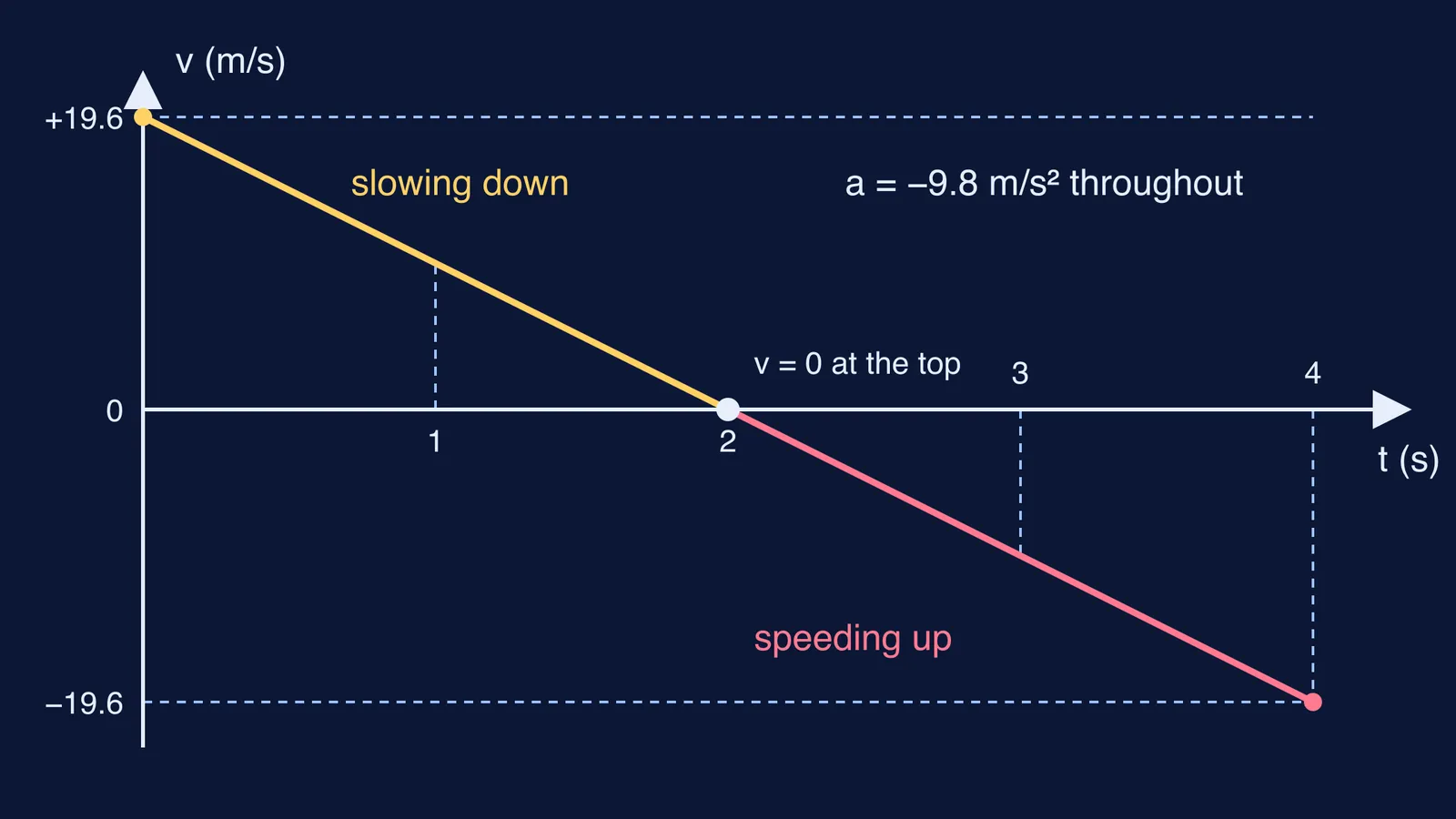
Throw a ball straight up at 19.6 m/s. Take up as positive, so u = +19.6 m/s and a = −9.8 m/s². Use v = u + at:
t = 0 s: v = +19.6 m/s. Moving up while a is negative: slowing down.
t = 1 s: v = +9.8 m/s. Signs still opposite: still slowing.
t = 2 s: v = 0. This is the top. Height reached = u²/2g = 19.6²/(2 × 9.8) = 19.6 m.
t = 3 s: v = −9.8 m/s. Now v and a are both negative: speeding up.
t = 4 s: v = −19.6 m/s. Back at the launch height, as fast as it was thrown, moving down.
Plot those points and you get one straight line from +19.6 m/s down to −19.6 m/s, as in the graph at the top of this post. Its slope is the acceleration, −9.8 m/s² (the free-fall value in OpenStax section 3.5), and it never changes. Yet the ball slows for the first 2 s and speeds up for the last 2 s.
You can read this off any v-t graph without algebra: a line heading towards the time axis means speed is falling, a line heading away means speed is rising, and the crossing point is where the object turns around. The same idea, stated as the angle between the velocity and acceleration vectors, works in two dimensions too: see speeding up or slowing down from the angle between v and a.
Now take down as positive. Every sign flips: u = −19.6 m/s and a = +9.8 m/s², so on the way up the ball has positive acceleration and is slowing down. Only your labels changed.
If you want to watch the turnaround happen rather than read about it, the Fermi Simulation Lab has interactive simulations for ideas that are easier to see than to read.
Why do so many students get this wrong?
Trouble with acceleration itself has been studied for decades. Trowbridge and McDermott investigated how students in introductory physics courses at the University of Washington understood acceleration, mainly through one-to-one interviews about simple motions the students watched (American Journal of Physics, 1981). When students failed to compare the accelerations of two motions correctly, the authors traced it to specific conceptual difficulties; the study centred on acceleration as the ratio Δv/Δt.
When a kinematics problem's signs keep going wrong, the Fermi Problem Library has worked problems with a step-by-step solver that explains the reasoning rather than printing an answer.
A 30-second sign check before any kinematics question
Write your positive direction in the margin, with an arrow.
Write the sign of the velocity and the sign of the acceleration.
Same signs: speeding up. Opposite signs: slowing down.
On a v-t graph: line moving towards the time axis means slowing, away from it means speeding up.
At a turning point, v = 0 but a is usually not zero.
For more practice with the same graph, try position-time and velocity-time graphs of a bouncing ball, then go the other way with how to find velocity from an acceleration-time graph.