On this page
You opened the mock result and the total had a minus sign in front of it. It feels like the worst outcome possible, but a negative score is the easiest one to diagnose. It shows a pattern in how you chose which questions to answer. It is not a verdict on how much you know.
How does a JEE mock score go negative?
JEE Main Paper 1 has 75 questions for 300 marks, with +4 for each correct answer and −1 for each wrong one, according to NTA's JEE (Main) 2027 Information Bulletin. The same bulletin says there is negative marking in both Section A (multiple choice) and Section B (numerical answers), so the numericals are not a free shot. Unanswered questions score 0.
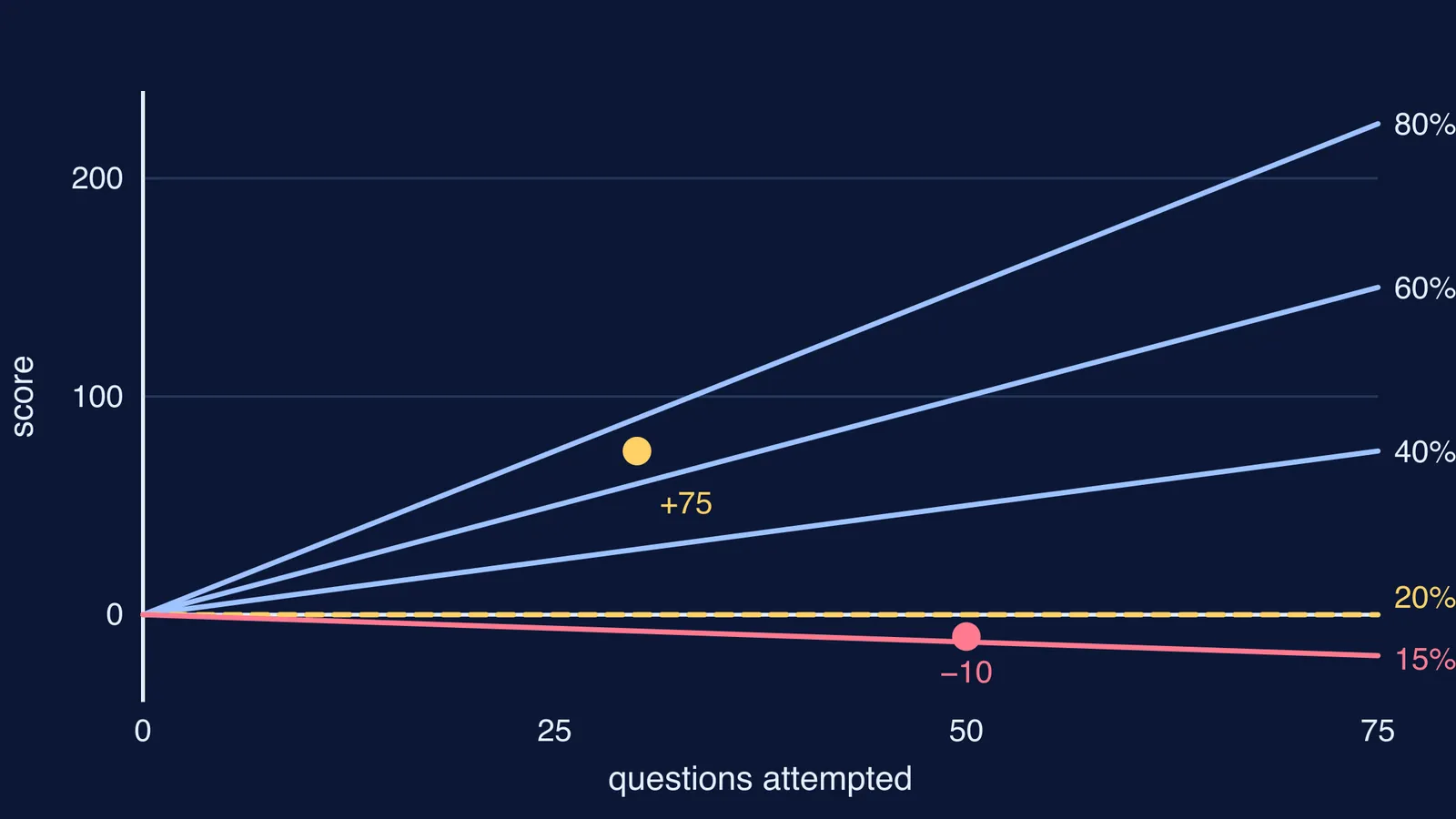
So your total is 4 × correct − wrong. It drops below zero when wrong answers outnumber correct ones by more than four to one.
Under +4/−1 marking the break-even accuracy is 20%: one right answer for every four wrong ones gives exactly zero.
Here is a typical negative mock:
Attempted: 50 questions
Correct: 8
Wrong: 42
Score: 4 × 8 − 42 = 32 − 42 = −10
Accuracy: 8 ÷ 50 = 16%
Is a negative mock score worse than guessing?
Usually, yes. On a question with four options, a blind guess is right one time in four, so under the same +4/−1 scheme it is worth on average 0.25 × 4 − 0.75 × 1 = +0.25 marks. Fifty blind guesses on four-option questions would average 12 or 13 correct, not 8. Numerical answers have no options, so a blind guess there almost never lands.
When you score below chance, your wrong answers were probably not random guesses. They often come from a confident wrong method: a formula used outside the conditions where it holds, a flipped sign convention, or an option picked because it looked right. Our guide on when to guess with negative marking explains when an informed guess pays off and when it doesn't.
NTA uses the same idea to break ties. For candidates level on total NTA score and on their Mathematics, Physics and Chemistry scores, the information bulletin ranks the one with the lower proportion of incorrect to correct answers higher.
How do you rebuild after a negative mock?
Use three rules. Treat the numbers as a starting plan and adjust them with your own data.
Attempt cap: 30 questions, 10 per subject. Answer a question only if you can say the first step of the method in one sentence before you look at the options. Leave everything else blank. A blank costs nothing.
Accuracy target: 70% or better. At a cap of 30, that means at least 21 correct.
Three-mock check. Raise the cap by 3 per subject only after three mocks in a row hit the target. If a mock falls below 60%, keep the cap where it is and review before the next one.
Here is how it could work out for the student above:
Mock 1 (cap 30): 21 correct and 9 wrong, so 84 − 9 = +75
Mocks 2 and 3 also clear 70%, so the cap rises to 39 (13 per subject)
Mock 4 (cap 39): 28 correct and 11 wrong, so 112 − 11 = +101
In this example, 20 fewer attempts took the score from −10 to +75. The 13 extra correct answers added 52 marks, and 33 fewer wrong answers saved another 33.
Between mocks, sort every wrong answer into one of three bins:
Concept gap: you didn't know the idea.
Wrong method: you knew the idea but set up the problem wrongly.
Slip: arithmetic, units or a misread question.
Our 60-minute mock review routine walks through this step by step. For wrong-method errors, work two or three similar problems in the Fermi Problem Library, where a step-by-step solver explains the reasoning rather than printing an answer. For concept gaps, read the lesson in the Fermi Concept Library before you attempt more questions on that topic.
What if it was your first mock, or you are the parent?
If this was your first full mock, a negative score often just means the syllabus isn't covered yet. Our post on a very low first mock score helps you set a realistic next target.
Parents, the first conversation matters more than the number. Try this:
"I saw the score. What did the paper show you about how you chose questions?"
"What is your attempt cap for the next mock?"
Then ask about accuracy, not rank, and skip comparisons with cousins or batchmates.
The Ministry of Health and Family Welfare's Tele MANAS launch announcement describes a toll-free, 24/7 helpline on 14416 where callers can choose their language.
Before your next mock, write your attempt cap at the top of your rough sheet and your accuracy beside it when you finish.