On this page
You can count the rational terms of (√2 + ∛3)¹⁰ without expanding it, and the same method works for a power of 100.
What is the general term of (√2 + ∛3)¹⁰?
NCERT's Class 11 chapter states the binomial theorem for any positive integer n as (a + b)ⁿ = ⁿC₀aⁿ + ⁿC₁aⁿ⁻¹b + … + ⁿCₙbⁿ (NCERT Class 11 Mathematics, Chapter 7). Once like terms are combined, the expansion has n + 1 terms (binomial theorem, Wikipedia), so (√2 + ∛3)¹⁰ has 11 terms.
The term with the second surd raised to the power r is Tᵣ₊₁ = ¹⁰Cᵣ · (√2)¹⁰⁻ʳ · (∛3)ʳ = ¹⁰Cᵣ · 2^((10 − r)/2) · 3^(r/3), with r running from 0 to 10.
When is a term of a surd binomial rational?
The coefficient ¹⁰Cᵣ is always a whole number, so only the exponents decide. A term is rational exactly when (10 − r)/2 and r/3 are both whole numbers.
Why must both be whole? Allowing negative exponents, every positive rational number has one unique prime factorisation (fundamental theorem of arithmetic, Wikipedia). Here a = (10 − r)/2 and b = r/3, so 6a and 6b are whole numbers. If 2ᵃ · 3ᵇ were a fraction m/k, raising both sides to the sixth power would give 2⁶ᵃ · 3⁶ᵇ = m⁶/k⁶. Every prime on the right has an exponent that is a multiple of 6, so 6a and 6b are multiples of 6, which makes a and b whole. One whole exponent is not enough: 3√2 is still irrational.
How many rational terms are in (√2 + ∛3)¹⁰?
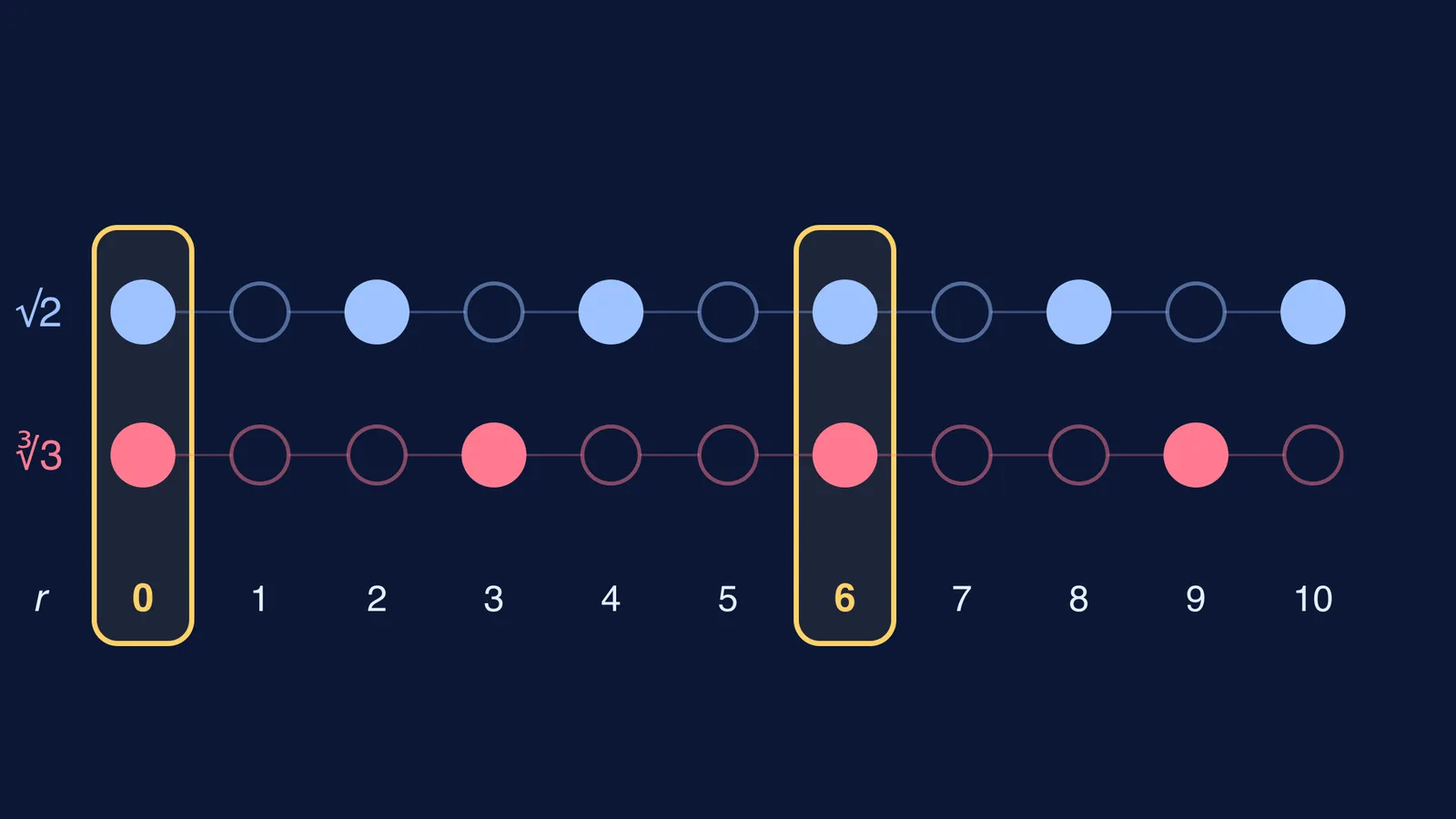
From √2: 10 − r must be even, so r is even: 0, 2, 4, 6, 8, 10.
From ∛3: r must be a multiple of 3: 0, 3, 6, 9.
Keep the values on both lists: r = 0 and r = 6.
So the expansion has 2 rational terms, and the other 11 − 2 = 9 are irrational.
Check them. At r = 0 the term is (√2)¹⁰ = 2⁵ = 32. At r = 6 it is ¹⁰C₆ · 2² · 3² = 210 · 4 · 9 = 7560. If a paper asks for the sum of the rational terms, it is 32 + 7560 = 7592.
What is the LCM shortcut for (√3 + ⁴√5)¹⁰⁰?
Here the general term is ¹⁰⁰Cᵣ · 3^((100 − r)/2) · 5^(r/4), and the expansion has 101 terms (binomial theorem, Wikipedia).
From ⁴√5: r must be a multiple of 4.
From √3: 100 − r, and so r, must be even.
Every multiple of 4 is already even, so together the two conditions say r is a multiple of LCM(2, 4) = 4. The values are 0, 4, 8, …, 100, which gives 100/4 + 1 = 26 rational terms. The other 101 − 26 = 75 terms are irrational.
When does the shortcut need a starting value? Change the power to 9. In (√2 + ∛3)⁹, 9 − r must be even, so r is odd, and r must also be a multiple of 3. That leaves r = 3 and r = 9, so again 2 rational terms: ⁹C₃ · 2³ · 3 = 2016 and 3³ = 27.
The general recipe: find the smallest r₀ that passes both tests, then go up in steps of L, the LCM of the two root indices. The count is ⌊(n − r₀)/L⌋ + 1. In the power-9 case, r₀ = 3 and L = 6, which gives ⌊6/6⌋ + 1 = 2. For (√3 + ⁴√5)¹⁰⁰, r₀ = 0 and L = 4, which gives 25 + 1 = 26.
Sometimes there is no r₀ at all. In (√3 + ⁴√5)⁹⁹, the √3 condition needs r to be odd and the ⁴√5 condition needs r to be a multiple of 4. No number is both, so the expansion has no rational terms.
What steps solve any rational-term question?
Write Tᵣ₊₁ with a fractional exponent on each prime base.
Ignore ⁿCᵣ; only the exponents matter.
Turn each exponent into a condition on r: n − r must be a multiple of the first root's index, and r a multiple of the second's.
Find the smallest r that passes both, then step by the LCM until you pass n.
Read the question again: rational terms, irrational terms, or their sum?
One trap: a minus sign, as in (√2 − ∛3)¹⁰, flips the signs of some terms but doesn't change which ones are rational.
If you can set up the conditions but keep getting the count wrong, the Fermi Problem Library has worked problems with a step-by-step solver that explains the reasoning rather than printing an answer.
More on this chapter: the general term, middle term and coefficients in the binomial theorem, the ratio test for the numerically greatest term, and why the integral part of (5 + 2√6)ⁿ is always odd.
Next time you see a surd binomial, write down two conditions on r before you write any terms.