

On this page
Say a question gives you (2 + 3x)^9 with x = 3/2 and asks for the numerically greatest term. Writing out all ten terms takes too long. Instead, compare each term with the one before it. While the ratio is above 1 the terms grow; once it drops below 1 they shrink. The greatest term is the last one before the turn.
You need the general term first: for (a + b)^n it is T(r+1) = nCr · a^(n−r) · b^r. If that feels shaky, our post on the general term, middle term and coefficients of the binomial theorem covers it.
How do you find the numerically greatest term?
Divide one term by the one before it. Most of the factorials cancel, because consecutive binomial coefficients satisfy nCr = ((n − r + 1)/r) · nC(r−1), a recurrence stated in the Wikipedia entry on binomial coefficients. So:
|T(r+1) / T(r)| = ((n − r + 1) / r) · |b/a|
"Numerically greatest" means largest absolute value, so you use |b/a| and the signs drop out. Put the actual value of x into b, then:
Write k = |b/a| as a plain number.
Solve ((n − r + 1)/r) · k ≥ 1 for r. This gives r ≤ m, with m = (n + 1)k / (1 + k).
If m is not a whole number, the greatest term is T(⌊m⌋ + 1), where ⌊m⌋ means the whole-number part of m.
If m is a whole number, T(m) and T(m + 1) are equal, and both are greatest.
Worked example: for (2 + 3x)^9 at x = 3/2, a = 2 and b = 9/2, so k = 9/4. Then m = 10 · (9/4) / (13/4) = 90/13 ≈ 6.92. That is not a whole number, so T7 is the greatest term. Check it: T7/T6 = (4/6)(9/4) = 1.5, so the terms are still rising, and T8/T7 = (3/7)(9/4) = 27/28, so they have started to fall. T7 = 9C6 · 2^3 · (9/2)^6 = 11160261/2.
When are there two equal greatest terms?
Two terms tie when m comes out as a whole number. Then T(m+1)/T(m) is exactly 1.
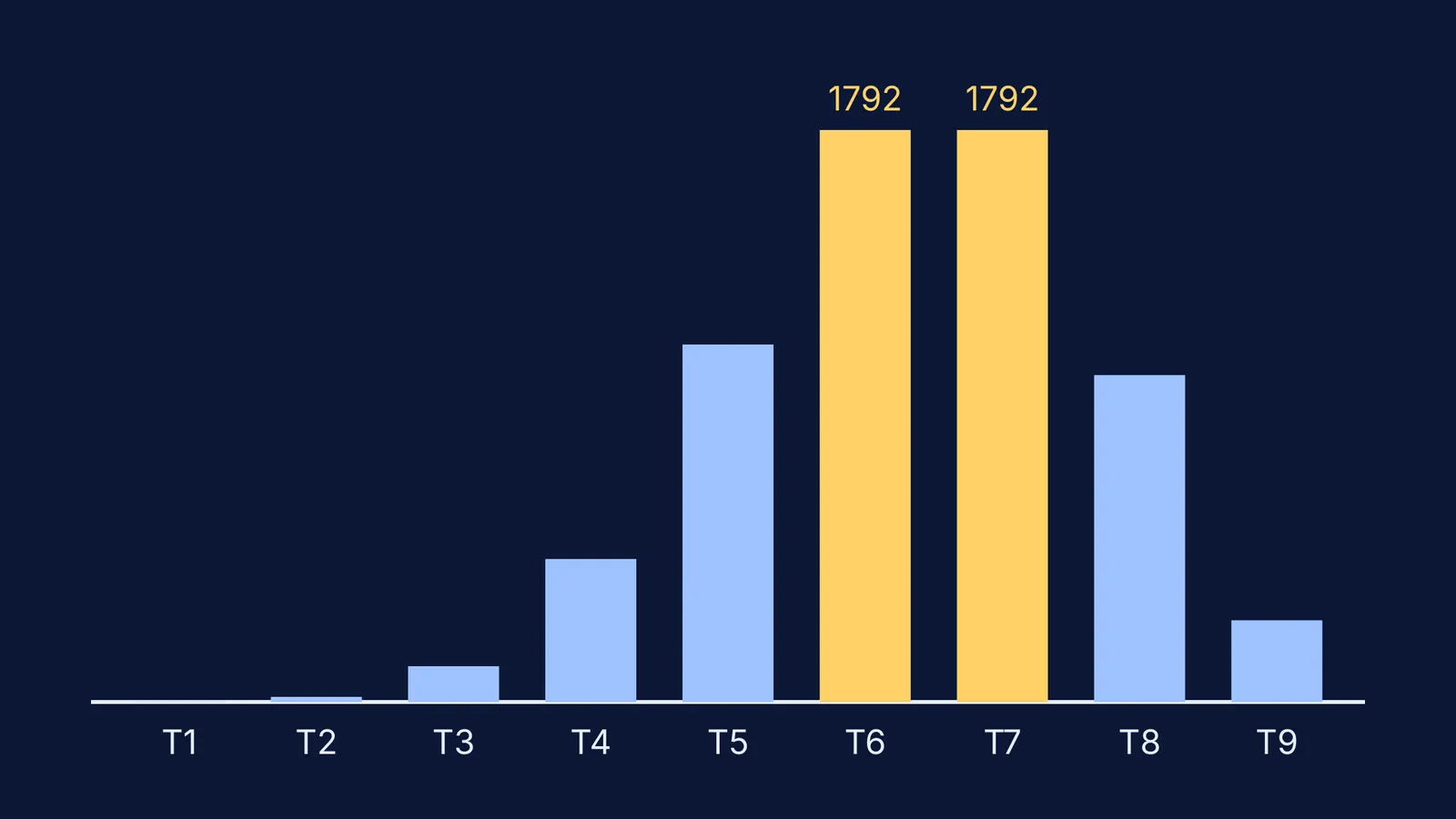
Take (1 + 2x)^8 at x = 1. Here k = 2, so m = 9 · 2 / 3 = 6. T6 = 8C5 · 2^5 = 56 · 32 = 1792 and T7 = 8C6 · 2^6 = 28 · 64 = 1792. Every other term is smaller, as the chart at the top of this post shows.
Now change the sign: (1 − 2x)^8 at x = 1. k is still 2, so T6 and T7 are still the numerically greatest terms. But T6 = −1792 and T7 = +1792. If a question asks for the greatest term without the word "numerically", only T7 counts.
Probability uses the same idea. For a binomial distribution, the most likely number of successes is usually ⌊(n + 1)p⌋, with two modes when (n + 1)p is a whole number from 1 to n. That is the formula for m with a = 1 − p and b = p.
Is the greatest coefficient the same as the greatest term?
No. Questions use three different ideas:
Greatest binomial coefficient: the largest nCr on its own. Set k = 1, so m = (n + 1)/2. For even n it is nC(n/2), the single middle coefficient. For odd n the two middle coefficients tie.
Greatest coefficient: the largest coefficient of a power of x, using the numbers in a and b. Run the ratio test as if x = 1.
Greatest term: this depends on the actual value of x, so it can change when x changes.
Take (1 + 2x)^8 again. The greatest binomial coefficient is 8C4 = 70, in T5. The greatest coefficient is 1792, shared by x^5 and x^6. At x = 1 the greatest terms are T6 = T7 = 1792, matching the greatest coefficient only because every power of x is then 1. At x = 1/2 every factor (2x)^r equals 1, so the terms are just 8Cr and T5 = 70 is the greatest. Same expansion, different x, different answer.
How should you practise greatest-term questions?
Do five ratio-test questions, one with each kind of k: a whole number, a fraction, a value that gives a whole-number m, a negative b, and k = 1.
Check each answer by working out the term on each side of it.
Then try related types: sums of binomial coefficients such as C0 + C1 + … and remainder and divisibility problems.
If you keep landing on the wrong term, k was usually set up wrongly. The Fermi Problem Library has worked problems with a step-by-step solver that explains the reasoning rather than printing an answer, so you can see which step went wrong.


