

On this page
You are given an acceleration-time graph and asked for the velocity at t = 10 s. The graph only tells you how much the velocity changed; you supply the rest.
What does the area under an acceleration-time graph tell you?
On an acceleration-time graph, the area under the curve equals the change in velocity, as Glenn Elert's Physics Hypertextbook page on motion graphs puts it. The units confirm it: (m/s²) × s = m/s.
In calculus form, velocity is the integral of acceleration, v(t) = ∫a(t) dt + C₁, and the constant C₁ is fixed by the initial velocity, as OpenStax University Physics Volume 1 shows. That constant is why the graph alone is not enough.
The area is also signed. OpenStax Calculus Volume 1 defines net signed area as the area above the axis minus the area below it. On an a-t graph, area below the time axis lowers the velocity.
So the whole method fits in one line:
v = u + (area above the t-axis) − (area below the t-axis)
How do you find velocity from an acceleration-time graph, step by step?
Write down the initial velocity u, with its sign. "Starts from rest" means u = 0. If the question gives no starting velocity, you can only find the change in velocity.
Split the graph at every corner and at every point where it crosses the time axis.
Find each piece's area with plain geometry: rectangle (base × height), triangle (½ × base × height), trapezium (½ × sum of parallel sides × base).
Give each piece a sign: + above the axis, − below it.
Add the signed areas up to the time you need, then add u.
To sketch the v-t graph too, keep a running total: each one is the velocity at that instant.
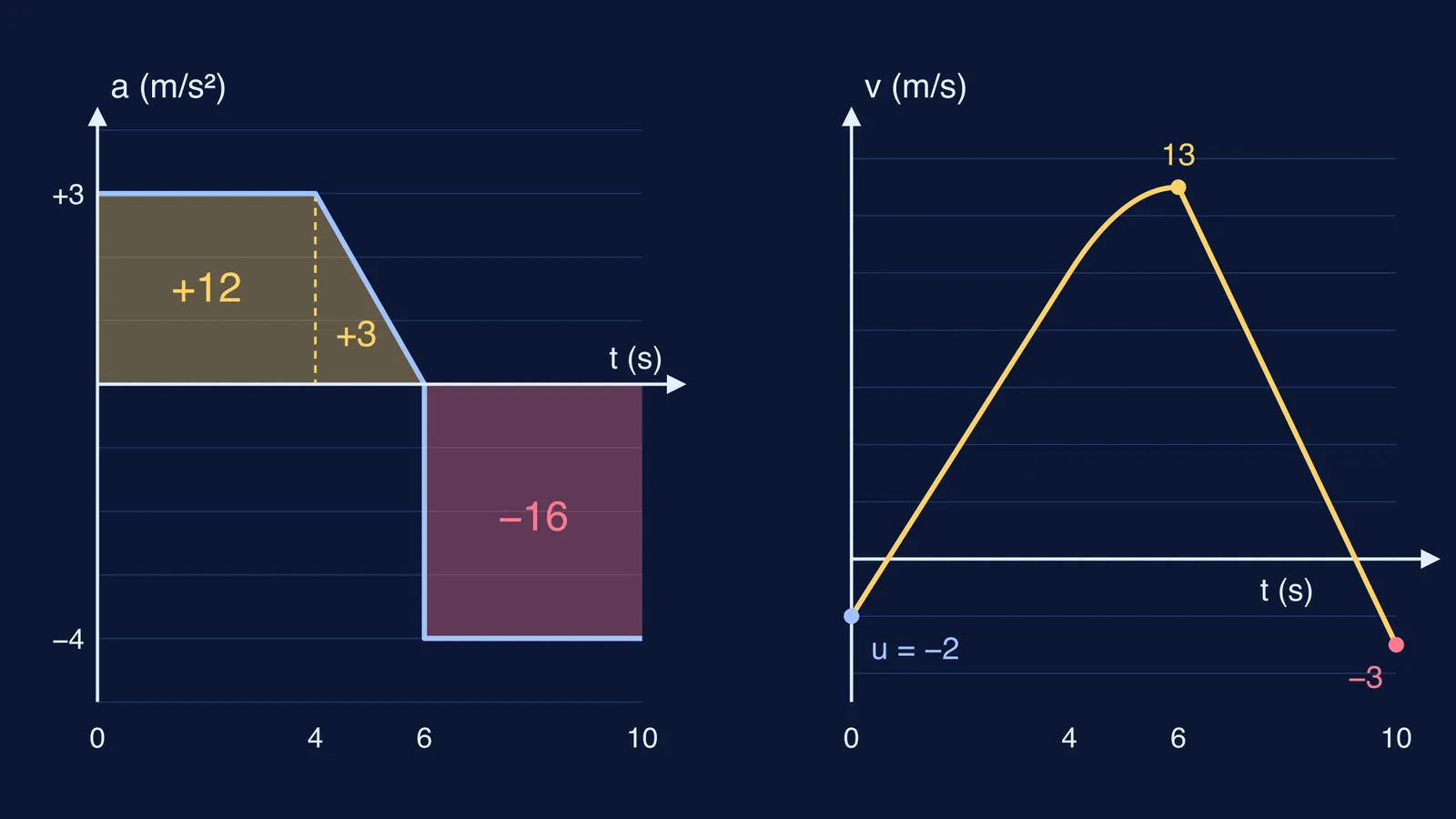
Worked example: what is the velocity at t = 10 s?
A body moves along a straight line with initial velocity u = −2 m/s, so it starts off moving backwards. Its acceleration is:
+3 m/s² from t = 0 to 4 s
falling steadily from +3 m/s² to 0 between t = 4 s and 6 s
−4 m/s² from t = 6 s to 10 s
Work through it with a running total:
0 to 4 s, rectangle: 4 × 3 = +12 m/s. Velocity at 4 s = −2 + 12 = 10 m/s.
4 to 6 s, triangle: ½ × 2 × 3 = +3 m/s. Velocity at 6 s = 10 + 3 = 13 m/s.
6 to 10 s, rectangle below the axis: 4 × (−4) = −16 m/s. Velocity at 10 s = 13 − 16 = −3 m/s.
The answer is −3 m/s: a speed of 3 m/s in the negative direction. A student who ignores signs adds 12 + 3 + 16 = 31, adds u to get 29 m/s, and gets it wrong. The diagram at the top of this post draws this example.
The velocity is also zero twice: at t = 2/3 s and at t = 9.25 s. The body turns around there, which matters if the next part asks for distance. Our guide to distance travelled when velocity changes sign shows how to split the interval at those points.
Where do students lose marks on a-t graph questions?
Reporting the area as the velocity. The area is the change in velocity; add u.
Missing a negative u. "Moving left" or "thrown downward" often hides a sign.
Adding the size of an area below the axis instead of subtracting it.
Reading "acceleration is zero" as "velocity is zero". Zero acceleration means the velocity stays constant, not that the body has stopped.
Using v = u + at where a changes. That equation holds only for constant acceleration; otherwise, use the area.
For the v-t version of the signed-area rule, read why area below the time axis is negative displacement. For a general method that works on any graph question, see how to read and solve physics graph questions.
What should you practise next?
Redo the example with u = +5 m/s instead of −2 m/s. Every velocity shifts up by 7 m/s and the final answer becomes +4 m/s: the areas stay the same, only the starting point moves. Then try a graph whose sloping line crosses the time axis, where you must find the crossing time before splitting the area.
If a particular question keeps going wrong, the Fermi Problem Library has worked problems with a step-by-step solver that explains the reasoning rather than printing an answer, so you can see exactly where a sign slipped. If area as accumulated change still feels shaky, the Fermi Concept Library gives every concept in physics and mathematics its own lesson.


