On this page
A classic exam question: given v and a, or a position r(t), is the particle speeding up or slowing down? A common slip is to look at the sign of the acceleration alone. The test that always works is the angle between v and a, read from one dot product.
How do you tell if a particle is speeding up or slowing down?
Speed is the magnitude of velocity, |v|. Only the part of a that lies along v changes the speed; the part perpendicular to v only turns the velocity.
OpenStax University Physics defines tangential acceleration as the time rate of change of the magnitude of the velocity, a_T = d|v|/dt (OpenStax University Physics, section 4.4). OpenStax Calculus gives the tangential component of acceleration as (v · a)/|v| (OpenStax Calculus Volume 3, section 3.4).
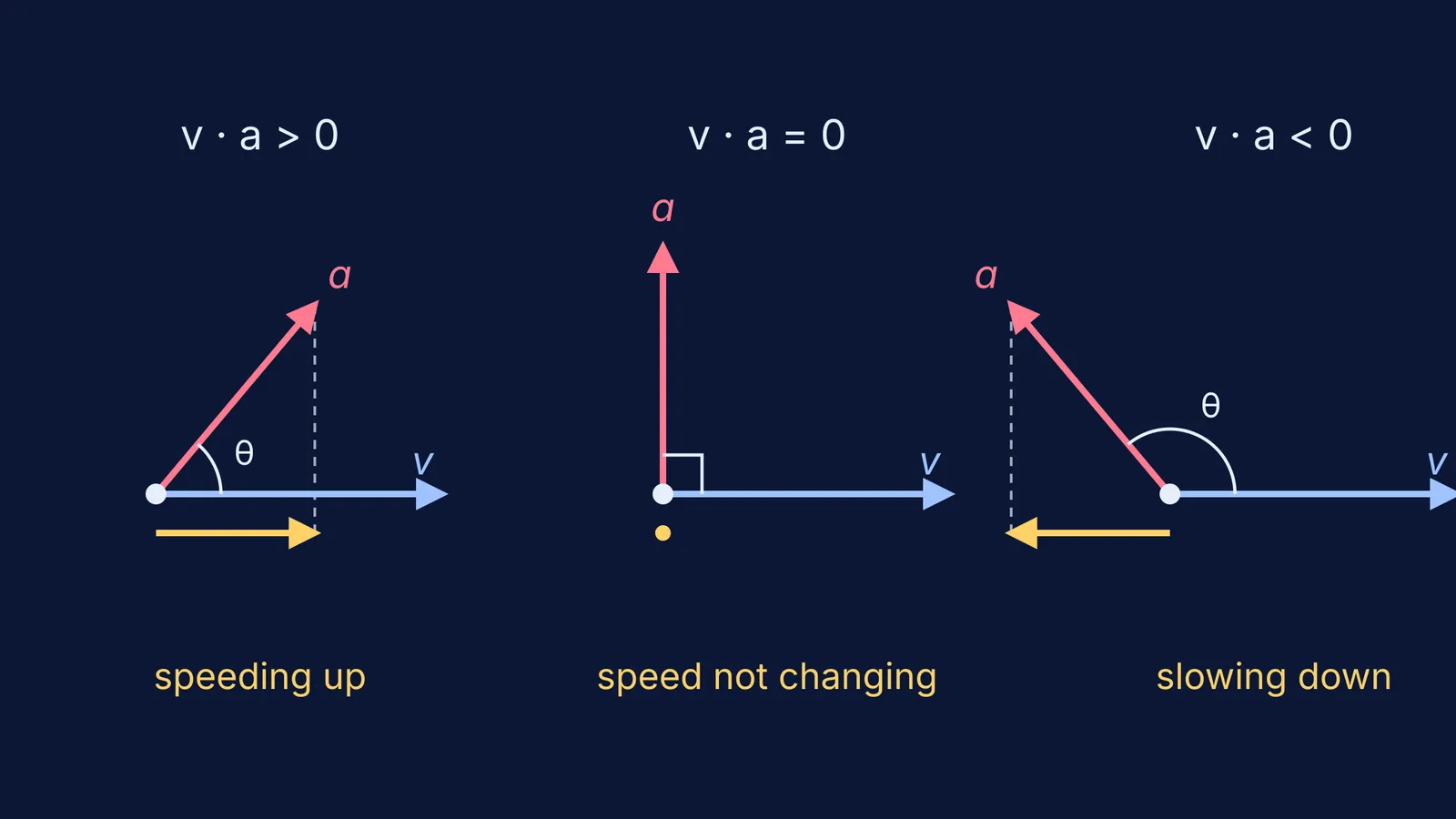
Together, d|v|/dt = (v · a)/|v| = |a| cos θ, where θ is the angle between v and a. Since |v| is positive whenever the particle is moving, the sign of v · a is the sign of the change in speed:
Acute angle (θ < 90°), v · a > 0: the particle is speeding up.
Obtuse angle (θ > 90°), v · a < 0: the particle is slowing down.
Right angle (θ = 90°), v · a = 0: the speed is not changing at that instant.
Shaky on dot products? See our guide on finding the angle between vectors using the dot product.
Does a right angle between velocity and acceleration mean constant speed?
Only if the angle stays 90°. A right angle at one instant means only that the speed is not changing at that instant.
In uniform circular motion, the acceleration points toward the centre of the circle, at right angles to the direction of motion (OpenStax University Physics, section 4.4). Because v · a = 0 at every instant, the speed really is constant, while the direction keeps turning.
At the top of a projectile's path, gravity points straight down and the velocity is horizontal, so the angle is 90° for just that instant. The speed is at its minimum there, not constant. Related reads: when projectile velocity is perpendicular to the initial velocity and when an accelerating car skids on a circular track.
Worked example: is this particle speeding up?
Both examples use d|v|/dt = (v · a)/|v| from OpenStax Calculus Volume 3.
Example 1, vectors given at one instant: v = (3i + 4j) m/s and a = (2i - j) m/s².
Dot product: v · a = (3)(2) + (4)(-1) = 6 - 4 = 2. Positive, so the particle is speeding up.
Rate of change of speed: |v| = 5 m/s, so d|v|/dt = 2/5 = 0.4 m/s².
Angle: |a| = √5 ≈ 2.24 m/s², so cos θ = 2/(5 × 2.24) ≈ 0.18 and θ ≈ 80°. Acute, but only just: most of the acceleration is turning the particle.
Example 2, a projectile before and after the top: a ball is thrown at 20 m/s at 30° above the horizontal; take g = 10 m/s². Then v = (17.3, 10 - 10t) m/s and a = (0, -10) m/s².
v · a = -10(10 - 10t) = 100t - 100.
For t < 1 s, v · a < 0: the angle is obtuse and the ball is slowing down.
At t = 1 s, v · a = 0: the ball is at the top, moving horizontally at 17.3 m/s, its lowest speed.
For t > 1 s, v · a > 0: the angle is acute and the ball speeds up on the way down.
What should you check in an exam question?
Write v and a as components at the instant asked. If you are given r(t), differentiate once for v and twice for a, then substitute t.
Compute v · a and look only at its sign: positive means speeding up, negative means slowing down.
If it is zero, ask whether it stays zero (uniform circular motion: constant speed) or is zero for only one instant (top of a projectile: maximum or minimum speed).
If the question asks for the rate of change of speed, divide v · a by |v|.
If you keep losing marks on the method rather than the arithmetic, the Fermi Problem Library has worked problems with a step-by-step solver that explains the reasoning rather than printing an answer. For a refresher on vectors and dot products, the Fermi Concept Library gives each concept its own lesson and its place in the map.
Try the checklist on your next kinematics question: one dot product, one sign, one answer.