On this page
Most cows have one calf a year. Multiple ovulation embryo transfer, or MOET, is how breeders get many calves from one outstanding cow, and it appears in the NCERT Class 12 biology chapter on food production.
What is MOET technology in cattle?
MOET is a herd-improvement programme in which a cow is given hormones with FSH-like activity so that she produces 6–8 eggs in one cycle instead of the usual one, according to the NCERT Class 12 Biology chapter Strategies for Enhancement in Food Production (2022–23 edition). The same passage says the fertilised eggs are recovered at the 8–32 cell stage, without surgery, and transferred to surrogate mothers. It adds that the method has been shown to work in cattle, sheep, rabbits, buffaloes and mares.
What are the steps of MOET in cattle?
Choose the donor. Pick a cow with the trait you want more of, such as high milk yield.
Superovulate her. Injections of FSH-like hormone make many follicles mature at once. This is superovulation.
Time her heat. A prostaglandin (PGF2α) injection ends her current cycle so she comes into heat (oestrus) on schedule.
Mate or inseminate. Use an elite bull, or artificial insemination with a top bull's semen.
Flush the embryos. About a week later, the early embryos are washed out of the uterus without surgery.
Transfer to surrogates. Each good embryo goes into a recipient cow whose cycle has been matched to the donor's.
Repeat. The genetic mother is free for another round of superovulation.
The prostaglandin step and recipient matching come from the Mississippi State University Extension guide to embryo transfer; the rest follows the NCERT text.
What does a real MOET timeline look like?
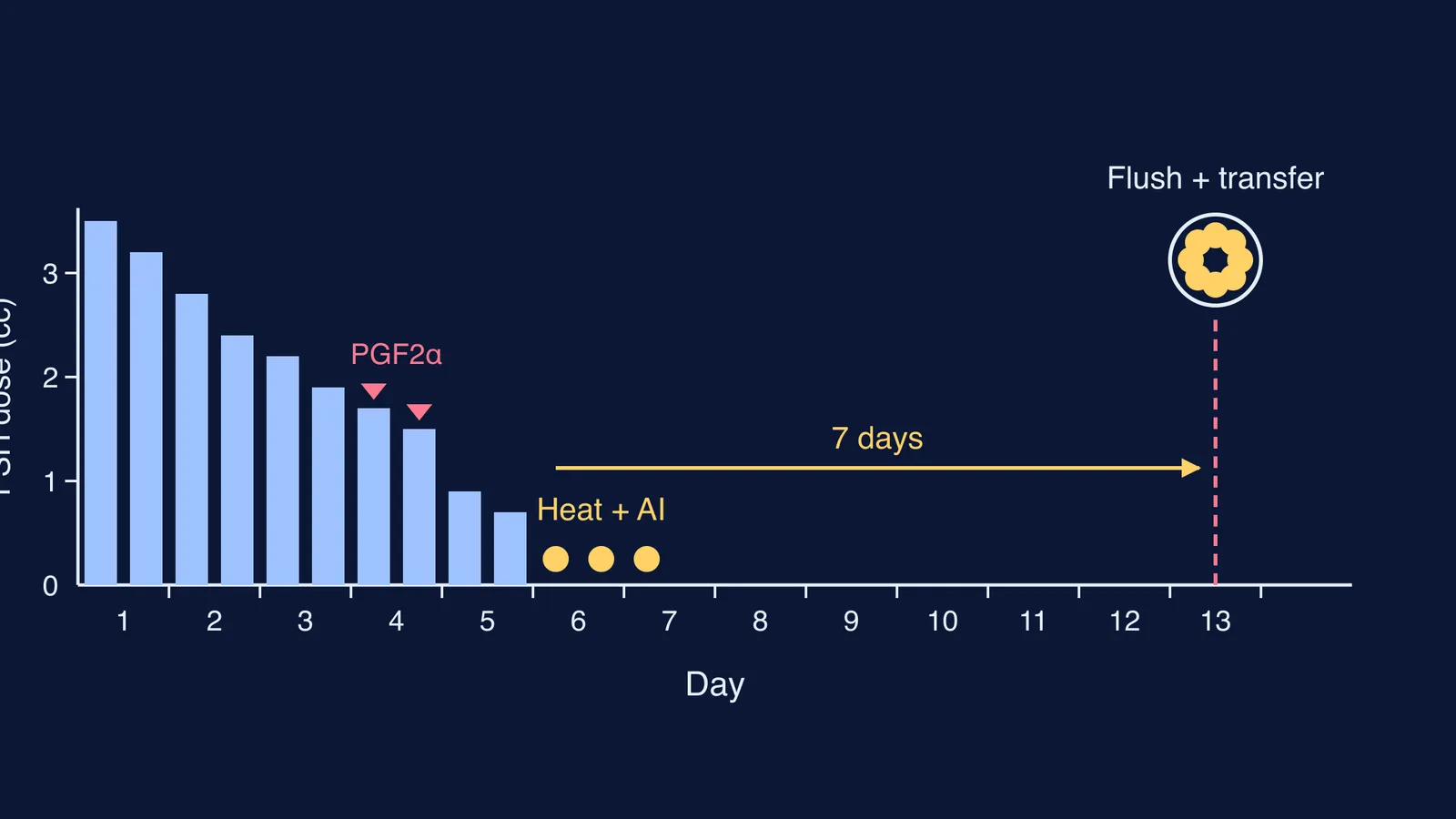
The diagram at the top plots the example superovulation protocol in the Mississippi State University Extension guide (publication P2681). FSH is injected morning and evening for five days, in doses that fall from 3.5 cc to 0.7 cc, and prostaglandin F2α is added on day 4. The donor should come into heat on the morning of day 6 and is inseminated that morning, that evening and the morning of day 7. The embryos are flushed 7 days after heat. Fresh embryos go straight into recipients that are on day 7 of their own cycle.
A case report published in 2018 describes a 2010 programme at the Gatton Dairy Unit in Australia, where four Holstein Friesian donors and eleven recipients went through MOET. Only two donors produced embryos: 13 embryos and unfertilised ova in all, of which 84.6% were good enough to transfer. Five of the eight cows that received embryos became pregnant, a 62.5% pregnancy rate (Malaysian Journal of Veterinary Research).
Why does MOET speed up herd improvement?
Here is a worked example from the extension guide's averages. Most breeding cows produce one calf a year. One flush gives around eight transferable embryos on average, though some cows give fewer and others 30 or more, and fresh embryos give pregnancy rates of about 65% (Mississippi State University Extension). So an average flush gives 8 × 0.65 ≈ 5 pregnancies, all carried by ordinary cows, while the top cow is ready to go again.
The second gain is time. In a 1983 modelling study, F. W. Nicholas and C. Smith looked at dairy MOET schemes using embryo transfer from 1-year-old females (a generation interval of 1.8 years) or from females after one lactation (3.7 years). They found that, although selection is less accurate than in conventional progeny testing, the annual rate of genetic improvement can be increased, "and even doubled" (Nicholas and Smith, Animal Science, 1983).
India is chasing the same goal with a related method, bovine IVF, where eggs are fertilised in a lab. In a release posted on 29 July 2025, the government said the Rashtriya Gokul Mission had 23 IVF labs running and 2,361 calves born (PIB, Ministry of Fisheries, Animal Husbandry and Dairying).
How do you write MOET in an exam answer?
Use this five-point frame, built from the NCERT passage:
Definition: a programme for herd improvement.
Hormone: FSH-like activity, causing superovulation, 6–8 eggs per cycle instead of one.
Fertilisation: an elite bull or artificial insemination.
Recovery: 8–32 cell stage, non-surgical, into surrogate mothers; the genetic mother can be superovulated again.
Use: high milk-yielding females and lean-meat bulls bred to increase herd size in a short time.
Do not mix up MOET and IVF: in MOET, fertilisation happens inside the donor cow; in IVF, in a dish. Our guide to IVF, ZIFT, GIFT and ICSI covers the human techniques, and inbreeding, out-crossing and cross-breeding in animals covers the methods that come before MOET. NCERT has rearranged its Class 12 Biology book since the 2022–23 edition, so check which chapters your board or exam lists this year.
If the hormone side feels shaky, start with how FSH and LH work, then open the Fermi Concept Library, which has a lesson for every concept in biology and shows where it sits in the map. If you are not sure where to begin revising this chapter, Fermi's AI tutor can work out what you already know and build a plan for the session.