On this page
Questions like which is bigger, √2 or ∛3, or e^π or π^e, all come back to one function: x^(1/x). Once you know where it peaks, a whole family of comparison questions in Class 12 calculus and JEE practice takes a few lines instead of a page of arithmetic.
What is the maximum value of x^(1/x)?
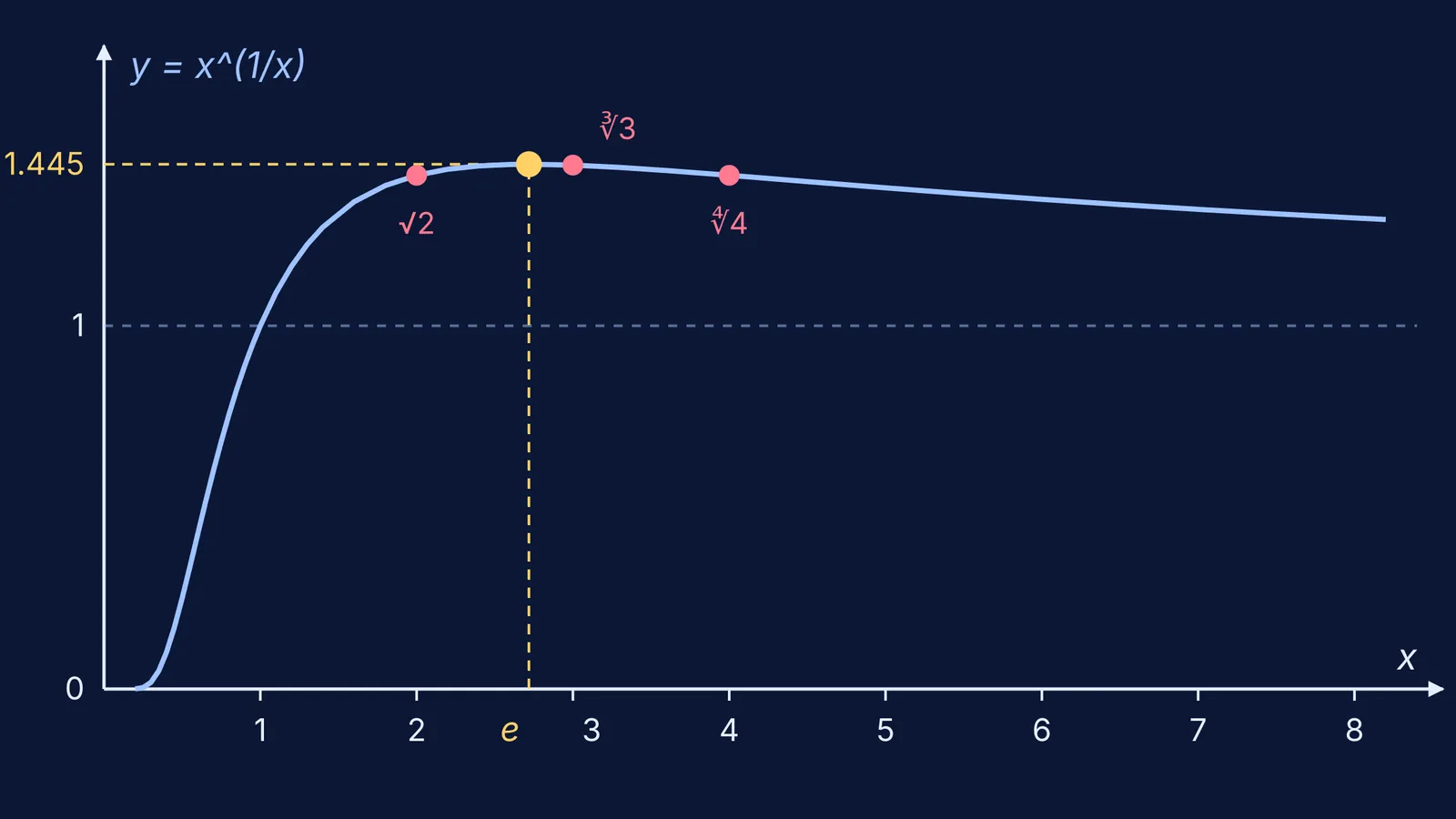
Finding the positive x that makes x^(1/x) as large as possible is known as Steiner's problem, and the answer is x = e, where the function takes the value e^(1/e) = 1.444667861... (Wolfram MathWorld, Steiner's problem).
The constant e is approximately 2.718281828 (Wikipedia, e (mathematical constant))). So the peak sits just left of 3. To the left of the peak the curve drops towards 0; to the right it falls slowly towards 1, because (ln x)/x tends to 0 as x grows.
How do you find the maximum of x^(1/x) step by step?
Let y = x^(1/x) with x > 0. Since y is always positive, you can take natural logs: ln y = (ln x)/x.
The logarithm is an increasing function, so y is largest exactly where ln y is largest. Call g(x) = (ln x)/x and maximise g instead.
Use the quotient rule: g'(x) = (x · (1/x) − ln x · 1)/x² = (1 − ln x)/x².
Because x² > 0, the sign of g'(x) is the sign of 1 − ln x. It is zero only when ln x = 1, that is, x = e.
Check the sign change. For 0 < x < e, ln x < 1, so g' > 0 and g is rising. For x > e, ln x > 1, so g' < 0 and g is falling. A change from + to − means a maximum.
Find the value: g(e) = (ln e)/e = 1/e, so the maximum of y is e^(1/e) ≈ 1.4447.
Step 5 is the first derivative test, explained slowly in our post on the first derivative test and sign changes. The second derivative agrees: g''(x) = (2 ln x − 3)/x³, which is −1/e³ < 0 at x = e.
If logarithmic differentiation or the quotient rule is the step that trips you up, the Fermi Concept Library gives each concept in mathematics its own lesson, so you can fill that gap before coming back to this problem.
How do you compare 2^(1/2) and 3^(1/3)?
Here is the trap. The function rises up to e and falls after it. Since 2 is below e and 3 is above it, the shape of the curve alone does not tell you which value is higher.
There are two clean ways to settle it.
Raise both to the 6th power. (√2)^6 = 2³ = 8 and (∛3)^6 = 3² = 9. Since 9 > 8, ∛3 > √2.
Swap 2 for a partner on the same side. Note that 2^(1/2) = 4^(1/4), because 4^(1/4) = (2²)^(1/4) = 2^(1/2). Now 3 and 4 are both above e, where the function is decreasing, so the smaller input wins: 3^(1/3) > 4^(1/4) = 2^(1/2).
Which is bigger, a^b or b^a?
For positive a and b, take the (ab)-th root of both sides: a^b compared with b^a is the same as a^(1/a) compared with b^(1/b). That puts every such question on the x^(1/x) curve. Use this three-question check:
Can I rewrite both numbers in the form a^(1/a)? If they look like a^b and b^a, take the (ab)-th root.
Are a and b on the same side of e? If both are at least e, the smaller number gives the larger value. If both are at most e, the larger number gives the larger value.
Are they on opposite sides? Look for an equal partner on the same side (as 2 pairs with 4) or raise both to a common power.
Worked example: which is bigger, 100^101 or 101^100? Both 100 and 101 are above e, so 100^(1/100) > 101^(1/101). Raise both sides to the power 100 × 101 and you get 100^101 > 101^100. No calculator needed.
The classic version, e^π against π^e, works the same way because e itself is the peak; our post on comparing e^π and π^e with monotonicity walks through it. For other tricks with huge exponents, see how to compare large powers.
Where to practise next
Try these yourself: compare 5^(1/5) with 7^(1/7), then 2^(1/2) with 5^(1/5), then 3^40 with 40^3. Each needs one of the three questions above. If you reach a step and are not sure why it works, the Fermi Problem Library has worked problems with a step-by-step solver that explains the reasoning rather than printing an answer.