

On this page
With a calculator, the winner is clear. Euler's number e is roughly 2.718 and π is roughly 3.141. Raising e to the power of π gives about 23.14. Reversing them to raise π to the power of e gives roughly 22.46.
Exams like JEE Advanced do not allow calculators. You must know which is greater and prove it analytically. Comparing numbers raised to strange powers seems impossible, but calculus turns it into a routine curve-sketching problem.
How does (ln x) / x solve the problem?
To compare e^π and π^e, you first need a way to bring those awkward exponents down to earth. Exponents are difficult to work with directly when the bases are also different.
Because the natural logarithm (ln) is a strictly increasing function, taking the logarithm preserves the order of the numbers. The larger number will always have the larger logarithm. If we take the natural logarithm of both numbers, we can bring the powers down using the rule ln(a^b) = b ln a:
ln(e^π) = π ln e
ln(π^e) = e ln π
We want to know if π ln e is greater than e ln π. To make this easier to graph, we group the e terms on one side and the π terms on the other. Dividing both sides by the positive number e × π changes the question. We are now asking whether (ln e) / e is greater than (ln π) / π.
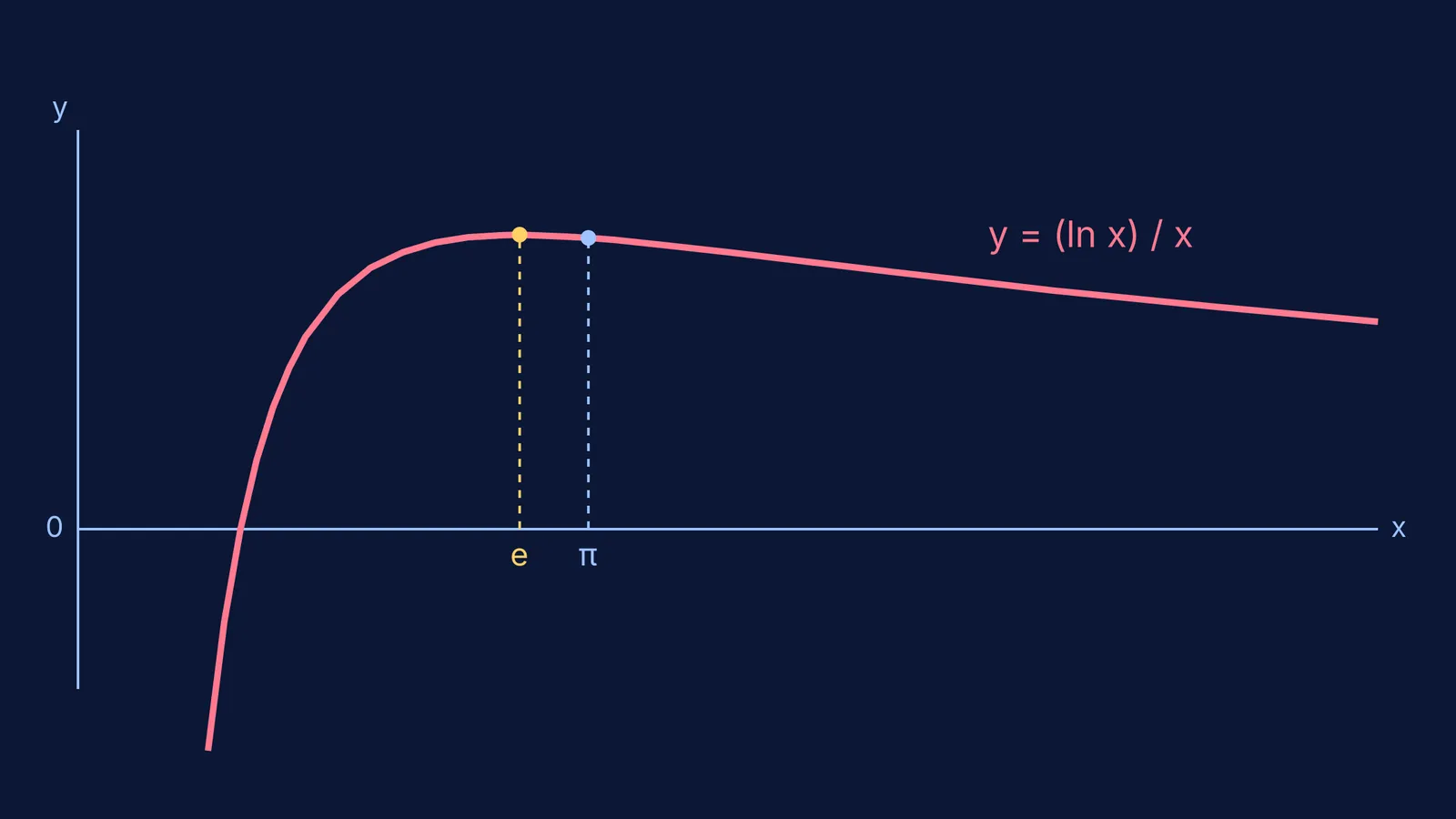
This is why we study the function f(x) = (ln x) / x. If we can draw this curve and find its peak, we can just look at the graph to see whether x = e or x = π gives a higher value. Instead of comparing two isolated numbers, we are looking at a continuous line.
How do you find the maximum of (ln x) / x?
To find where the curve peaks, we take its derivative. The derivative tells us the slope of the curve at any point x. Using the quotient rule, the derivative of f(x) = (ln x) / x is: f'(x) = [x(1/x) - (ln x)(1)] / x² = (1 - ln x) / x²
To find the turning point, we set the derivative to zero. Since x² is always positive for any x > 0, the fraction is zero only when the numerator is zero: 1 - ln x = 0 x = e
The curve's slope is exactly zero at x = e. To confirm this is a peak, we check the slopes around it. For a smaller number (like x = 2), ln x is less than 1, making the numerator positive and the curve rise. For a larger number (like x = 3), ln x is greater than 1, making the numerator negative and the curve fall.
Because the function rises steadily until x = e and falls steadily forever after it, x = e is the absolute maximum of the whole function.
What does this mean for e^π and π^e?
We now have all the pieces to solve the puzzle. Because x = e is the absolute highest point on the curve, the value of the function at e must be strictly greater than its value at π, which lies on the downward slope to the right.
f(e) > f(π) (ln e) / e > (ln π) / π
Multiplying both sides by e × π clears the denominators: π ln e > e ln π
Bringing the coefficients inside the logarithms gives ln(e^π) > ln(π^e). Since logarithms preserve the order of numbers, we can drop them to find our final answer: e^π > π^e
How do you apply this to other numbers?
This trick is not just for e and π. It gives us a universal rule for exponential comparisons. Because x = e is the absolute maximum of (ln x) / x, the number e wins against any other positive number x in this specific arrangement.
You can test this yourself with numbers that are easy to compute. If x = 2, we are comparing e² (about 7.38) and 2^e (about 6.58). If x = 10, we are comparing e^10 (about 22026) and 10^e (about 522). In every single case, e takes the lead.
Finding the right function to test is half the battle in competitive exams. The Fermi Problem Library has a step-by-step solver that explains the reasoning behind setting up functions like this for monotonicity tests. Seeing the underlying pattern is why some JEE aspirants plateau despite studying every day. If you need time for these harder proofs, start by learning how to build a study routine that lasts longer than a week.


