

On this page
You might meet this question in JEE practice, an olympiad sheet or a puzzle book: which is bigger, 2^300 or 3^200? Neither fits on a calculator. Three tools settle almost every question like this: a common exponent, logarithms, and bounding.
How do you compare 2^300 and 3^200 without a calculator?
Look for a common exponent. Both 300 and 200 are multiples of 100, so use the rule (a^m)^n = a^(mn), the same rule from exponents and powers in Class 8.
2^300 = (2^3)^100 = 8^100
3^200 = (3^2)^100 = 9^100
The exponents now match, so the bigger base wins: since 9 > 8, 3^200 is larger.
This method works when the exponents share a large common factor; take their HCF. It fails for 100^101 against 101^100, where the HCF of 101 and 100 is 1.
How do logarithms help compare powers?
Logarithms turn powers into products: log(a^n) = n log a. Because log10 grows as its input grows, the power with the bigger log is the bigger number. Base 10 gives you a bonus: a whole number N has floor(log10 N) + 1 digits.
The value of log10 2 is 0.30103 to five places (OEIS A007524).
The value of log10 3 is 0.47712 to five places (OEIS A114490).
Now the comparison is two multiplications:
log10(2^300) = 300 × 0.30103 = 90.309, so 2^300 has 91 digits.
log10(3^200) = 200 × 0.47712 = 95.424, so 3^200 has 96 digits.
The difference in logs is about 5.1, so 3^200 is roughly 10^5.1 times 2^300: about 1.3 lakh times bigger. If you want the backstory of base-10 tables, read how Henry Briggs gave us common logarithms.
Which is bigger, 100^101 or 101^100?
This is where bounding beats both methods above. Divide the two numbers and look at the ratio:
101^100 / 100^100 = (1 + 1/100)^100
Expand with the binomial theorem. The k-th term is C(100, k)/100^k, and each such term is at most 1/k!. So:
(1 + 1/100)^100 ≤ 1 + 1 + 1/2! + 1/3! + 1/4! + ...
Each 1/k! is at most 1/2^(k-1), so the sum is less than 1 + 1 + 1/2 + 1/4 + 1/8 + ... = 3.
So 101^100 < 3 × 100^100, which is far less than 100 × 100^100 = 100^101.
Therefore 100^101 is bigger. The sum in step 1 is the series for e, and (1 + 1/n)^n approaches e ≈ 2.71828 as n grows (Wikipedia: e)). Since (1.01)^100 is also at least 2 (the first two binomial terms), 100^101 is between 33 and 50 times 101^100.
Is there a general rule for a^b versus b^a?
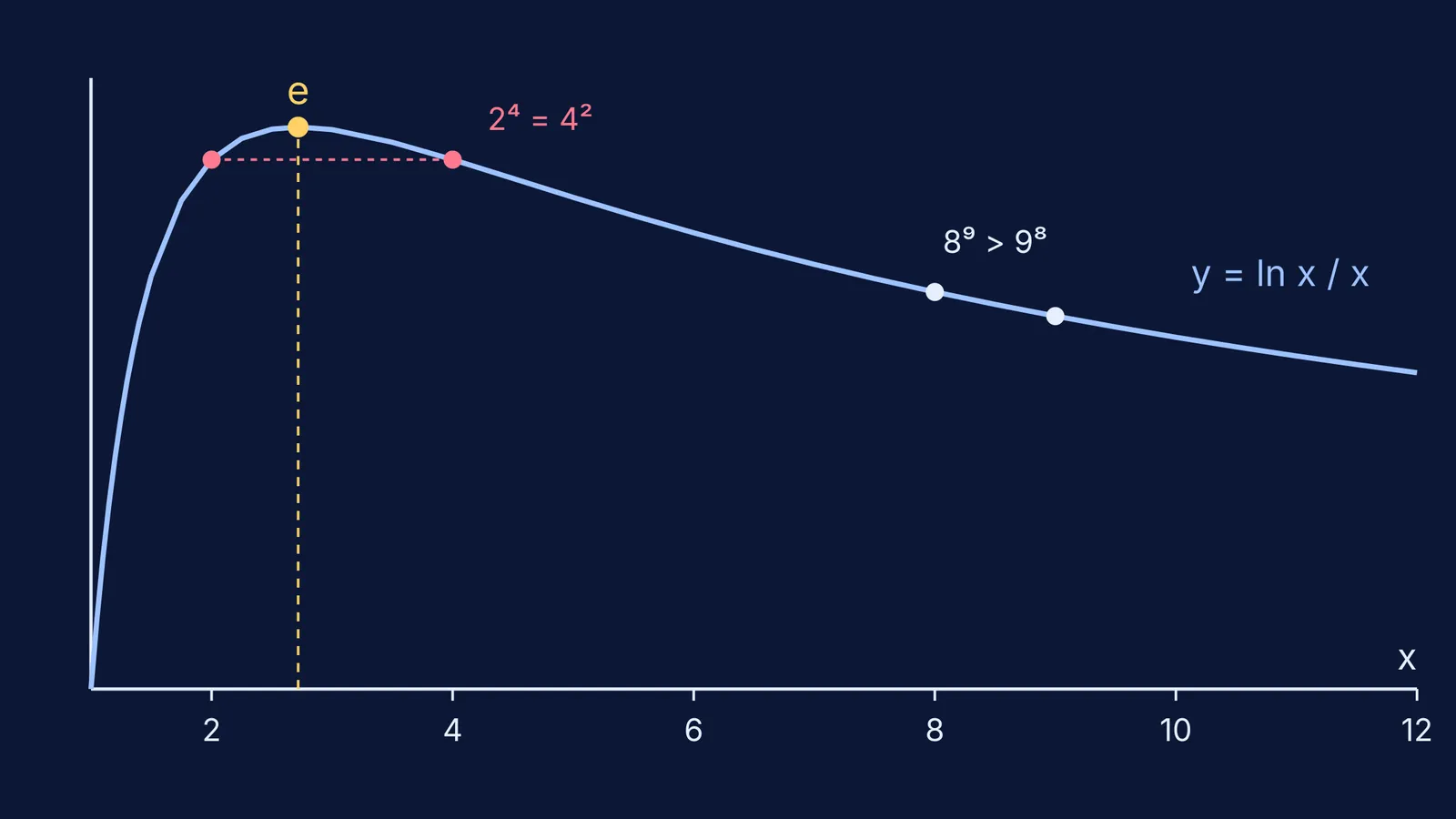
Yes. Take natural logs of both and divide by ab: a^b > b^a exactly when (ln a)/a > (ln b)/b. The function x^(1/x), and so ln x / x, reaches its maximum at x = e, a problem Jakob Steiner posed and solved in 1850 (Wikipedia: Steiner's calculus problem).
Past e the curve only falls, so for two bases both bigger than e, the smaller base wins. That gives 100^101 > 101^100, 8^9 > 9^8 and 3^4 > 4^3 (81 against 64) in one line each. Across e anything can happen: 2^3 < 3^2, and 2^4 = 4^2 because 2 and 4 sit at the same height on the curve.
What if the numbers are awkward, like 31^11 and 17^14?
Swap each base for a nearby round number, pointing each bound the safe way:
31 < 32 = 2^5, so 31^11 < 2^55.
17 > 16 = 2^4, so 17^14 > 2^56.
2^55 < 2^56, so 31^11 < 17^14.
The same idea gives 2^10 = 1024 > 1000, so 2^100 > 10^30. If your bounds cross over instead of staying in order, they were too loose; switch to logarithms.
A checklist for any which-is-bigger question
Do the exponents share a large common factor? Use a common exponent.
Is it a^b against b^a? Use the ln x / x rule.
Are the bases close to powers of 2, 3 or 10? Bound with round numbers.
Does the ratio look like (1 + 1/n)^n? It is always less than 3.
Nothing fits? Take log10 with 0.30103 and 0.47712 and compare.
If you keep picking the wrong tool, the Fermi Problem Library has worked problems with a step-by-step solver that explains the reasoning rather than printing an answer. To shore up the log and exponent rules underneath, each has its own lesson in the Fermi Concept Library.
Try it now: decide whether 2^1000 or 10^300 is bigger, using item 3 and then item 5.


