On this page
Lonar lake sits in a near-circular bowl in Buldhana district, Maharashtra. The bowl is a crater blasted out by a meteorite, in rock that was itself made by volcanoes. That pairing is rare on Earth.
How was Lonar lake formed?
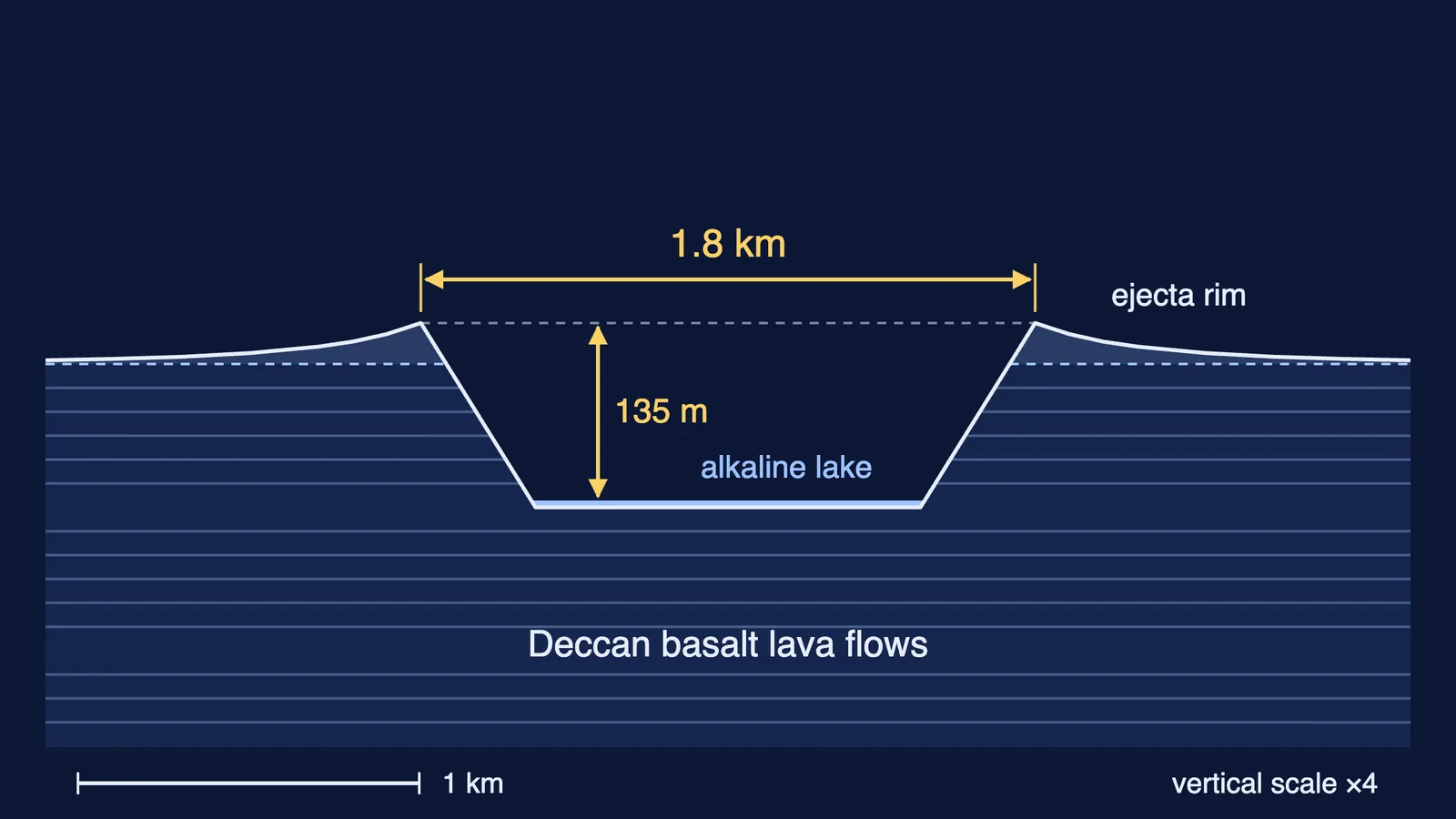
The crater was cut into the Deccan Traps, layers of basalt lava about 66 million years old, and it is 1.88 km across, according to a 2011 study in Geology by Jourdan and colleagues. The same study calls it one of the very few craters on Earth made directly in basaltic lava flows.
A study of the lake by CSIR-National Geophysical Research Institute scientists gives the shape in numbers (Reddy and colleagues, Current Science, 2015). The crater is about 1.8 km wide and about 135 m deep measured from the rim. About 30 m of thrown-out rock, called ejecta, forms the rim. Up to six lava flows can be seen in the walls. The lake on the floor covers about 1 sq km and has no surface outlet.
So a body from space struck the basalt plateau, the shock blasted out rock and piled it into a raised rim, and rain and springs later fed the lake on the floor. For how the plateau itself was built, read our explainer on the Deccan Traps and the dinosaurs.
How do we know a meteorite made it, not a volcano?
A round hole in volcanic country could be an old vent. The proof came in 1973, when Fredriksson and colleagues reported in Science shock-metamorphosed material from drill holes and trenches at Lonar. Drill holes through the floor brought up breccia with shatter cones and fragments containing maskelynite (feldspar turned to glass by shock). Trenches on the rim held fragments in which plagioclase had melted and frothed, plus bombs and spherules of melted rock. They also noted that Lonar's glass spherules have close look-alikes among the Apollo Moon samples.
Here is the checklist a geologist runs, with what Lonar shows:
Shock minerals: crystals changed by pressures a volcano cannot reach. Lonar has maskelynite.
Shatter cones: cone-shaped fracture patterns in the rock. Found in breccia under the floor.
Impact melt: glass bombs and spherules thrown onto the rim. Found in trenches on the rim.
An ejecta rim: thrown-out rock piled around the crater. About 30 m of it, per the 2015 Current Science study.
How old is Lonar crater?
Here the methods disagree. Argon dating of four melt-rock samples gave 570,000 ± 47,000 years (Jourdan and colleagues, 2011). In 2014, a team measured beryllium-10 and aluminium-26 made by cosmic rays in exposed rock, plus a radiocarbon age of soil from before the impact, and got 37,500 ± 5,000 years (Nakamura and colleagues, Geochemistry, Geophysics, Geosystems). They suggested the argon age may be too old because the impact glass inherited argon from older rock. The 2011 team had argued the opposite: their melt rock showed no sign of inherited argon, and earlier non-isotopic ages of about 12,000 to 62,000 years came from rocks thought to have been altered.
Worked example: do the two ages agree?
Argon range: 523,000 to 617,000 years.
Exposure range: 32,500 to 42,500 years.
The ranges do not overlap; the gap is 523,000 − 42,500 = 480,500 years.
When two measurements miss each other by far more than their error bars, random scatter is an unlikely explanation; something systematic is probably skewing at least one. So the published ages put Lonar's birth somewhere between about 37,500 and 570,000 years ago, and the question is open. Either way it is young next to its rock: even the older age is under 1% of the basalt's 66 million years.
Why is Lonar lake water so alkaline?
The 2015 Current Science study reports a pH of 10 to 10.5 and says the alkalinity comes from high sodium with low magnesium and calcium (Reddy and colleagues). Sodium carbonate from the lake was once used to make soda. Because no stream drains the lake, salts stay behind as water evaporates, an explanation the paper traces to an early visitor to the lake. A year of measurements, compared with older data, showed that the lake's level and chemistry are controlled by local rainfall and evaporation.
Check what pH 10 means with the definition pH = −log[H⁺]:
At pH 10, [H⁺] = 10⁻¹⁰ mol/L.
Neutral water at pH 7 has 10⁻⁷ mol/L, so Lonar has 1,000 times less H⁺.
Since [H⁺][OH⁻] = 10⁻¹⁴ at 25 °C, [OH⁻] = 10⁻⁴ mol/L.
Compare it with our pH chart of common substances from stomach acid to bleach. If logarithms are the sticking point, the Fermi Concept Library covers every concept in physics, chemistry, biology, mathematics and computing, so you can fill that gap before the next chapter.
How can you see a crater form for yourself?
You can model the rim and ejecta at home with a tray of flour and a few balls; our guide to drop height and crater size turns it into a proper experiment. For ideas that are easier to see than read, the Fermi Simulation Lab has interactive simulations you can change and rerun.
Next time Lonar comes up in class, you have the evidence, the numbers and the open question.