On this page
Loktak Lake in Manipur has islands that float. Locals call them phumdis, and the largest carries a whole national park. Here is what they are, the physics of why they float, and why they are under strain.
What are phumdis in Loktak Lake?
Phumdis are floating mats made of a mixed mass of soil, vegetation and organic matter at various stages of decomposition, according to a study of the lake in the Water and Environment Journal. The same study calls Loktak the largest freshwater wetland in north-eastern India, about 38 km from Imphal.
Phumdis cover nearly 50% of the lake, according to the same Water and Environment Journal study. A later issue brief from the Observer Research Foundation puts their share at about two-thirds.
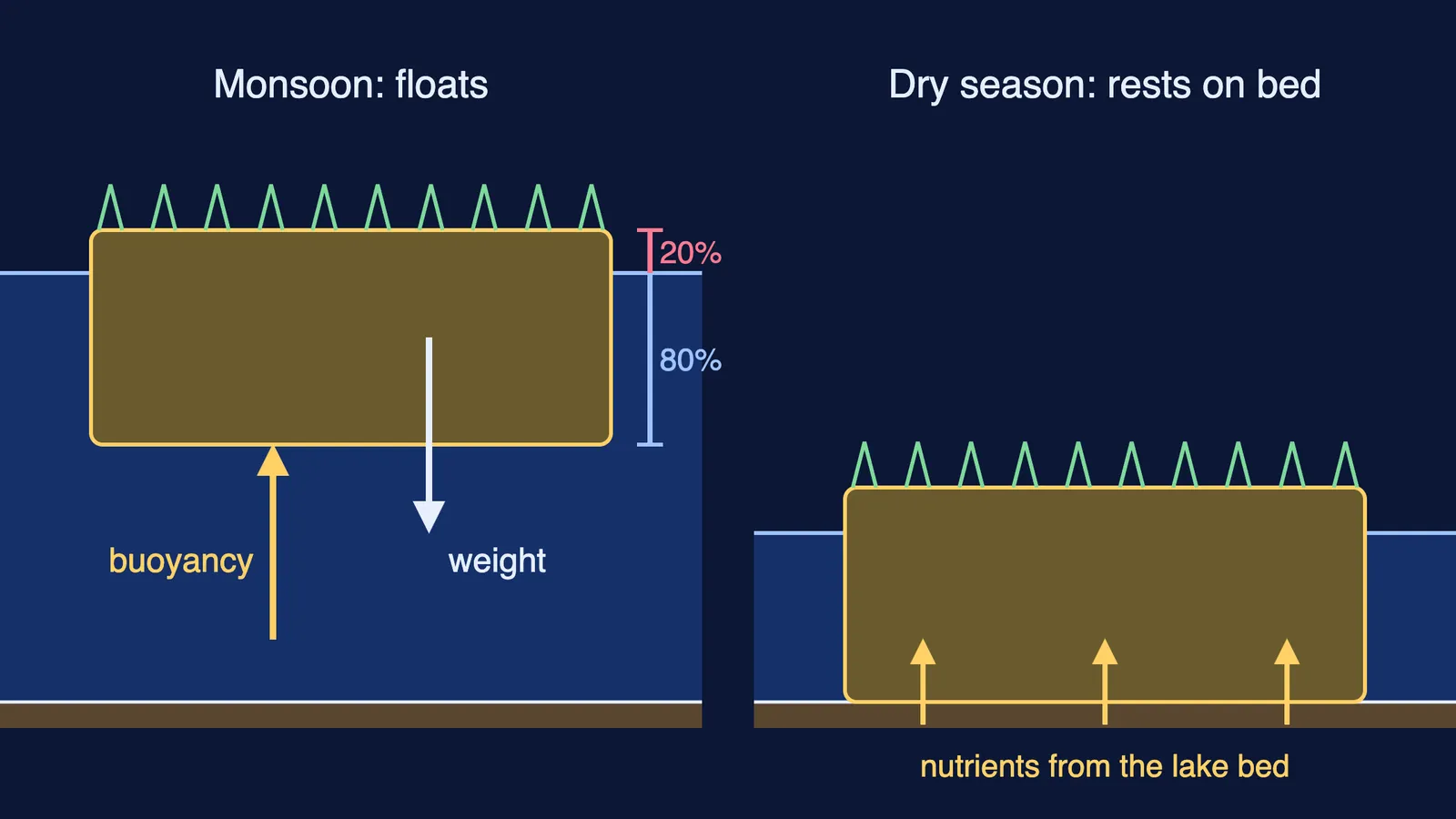
A phumdi ranges from a few centimetres to about two metres thick, and only about 20% of that thickness sits above the water, as the Wikipedia article on phumdis summarises.
Why do phumdis float?
Phumdis float for the same reason a log or an iceberg does. Archimedes' principle says a floating object sinks until the water it pushes aside weighs as much as the object itself. A porous mat of roots, decaying leaves and spongy soil has an average density below water's, so it settles mostly underwater with a thin layer on top. For where that upward push comes from, see our explainer on whether buoyant force changes with depth.
The fraction above water tells you the density. Treat the mat as an even slab. If about 20% of the thickness is above the surface, as the Wikipedia article on phumdis says, 80% is below, so the mat's average density is about 0.8 times that of water, roughly 800 kg per cubic metre for fresh water at about 1,000 kg per cubic metre.
Here is a worked example you can check. Take a phumdi 1.5 m thick and look at one square metre of it.
Underwater part: 80% of 1.5 m is 1.2 m. Above water: 0.3 m.
Mass of that square metre: 1.5 cubic metres times 800 kg per cubic metre is 1,200 kg.
Now put a 100 kg load on that square metre. To hold it up, the mat must push aside another 100 kg of water, which is 0.1 cubic metres. Spread over one square metre, the mat sinks 0.1 m.
The top now stands 0.2 m above the water instead of 0.3 m.
Repeat it for a thin mat, 0.5 m thick. It stands only 0.1 m above the water, so the same 100 kg load pushes its surface right down to the waterline. This is why thinning matters: a thinner mat carries less before its surface goes under.
Floating and sinking are easier to see than to read, and the Fermi Simulation Lab has interactive simulations for ideas like this.
What is Keibul Lamjao, the floating national park?
The southern portion of Loktak holds one continuous phumdi that forms Keibul Lamjao National Park, about 40 square km in area, according to the Observer Research Foundation brief. Because the park's ground is a floating mat, Keibul Lamjao bills itself as the only floating national park in the world, as Discover magazine reports.
The park is the last natural refuge of the endangered sangai, also called the Eld's deer or dancing deer. Mongabay India reported in 2018 that only 260 remained, according to the forest department, though wildlife biologists it cited put the number of adult breeding animals below 100. The park was created in 1977 to conserve them.
How do phumdis change with the seasons, and what went wrong?
Traditionally, phumdis floated during the monsoon and, in the dry season, sank to rest on the lake bed and soaked up its nutrients, as Mongabay India describes.
The Ithai barrage, operating since 1983, keeps water stored in the lake, so the islands now float throughout the year. Mongabay India quotes Rajiv Kangabam of Assam Agricultural University, lead author of a 2018 study of the lake, who says this has prevented nutrient uptake by the islands and reduced their thickness. The Observer Research Foundation brief adds that thinning of the phumdi threatens the sangai's survival.
Across the lake as a whole, phumdis have also spread. The Water and Environment Journal study found phumdi area grew between 1989 and 2002, and named the barrage, athaphum fishing, pollution and settlements on phumdis among the causes.
How can you remember this for an exam?
Definition: floating mats of soil, vegetation and decaying organic matter.
Physics: average density below water's; about one-fifth of the thickness above water.
Place: Loktak Lake, Manipur; Keibul Lamjao, billed as the only floating national park.
Species: the sangai, or dancing deer.
Threat: the Ithai barrage keeps water high, so mats stop resting on the bed and thin out.
To see how Loktak fits the bigger picture of what wetlands do, read why wetlands matter as filters, flood buffers and bird homes, then compare it with another Indian lake in why Chilika Lake is brackish and how a new mouth revived it.