On this page
Chilika, on the Odisha coast, is a lagoon, and its saltiness is a contest between rivers and tides. In the dry season its water runs from fresh near one river mouth to saltier than the ocean in the channel to the sea.
Why is Chilika Lake brackish?
Brackish water is a mix of fresh water and sea water. Chilika gets both. The Chilika Development Authority (CDA) says 52 rivers and rivulets drain into the lagoon, and a narrow channel joins it to the Bay of Bengal.
A 2024 data report names the Daya, Bhargavi and Nuna, three tributaries of the Mahanadi, as key freshwater sources; sea water is exchanged mainly through the outer channel, plus the Palur canal (Patra et al., Frontiers in Marine Science, 2024).
For scale, the ocean's average salinity is about 35 parts per thousand, according to NOAA.
How does a lagoon like Chilika form?
A coastal lagoon is shallow water cut off from the sea by a strip of sand, with one or a few narrow openings. Waves hitting the coast at an angle carry sand along the shore (littoral drift), building the barrier and moving the opening. The CDA notes that Chilika's inlet mouth constantly changes position because of littoral drift.
Per the same CDA page, Chilika is pear-shaped and about 64.5 km long, with a 32 km outer channel to the sea. The northern sector, the largest part, is less than 50 cm deep; the deepest point, 3.7 m, is in the central sector.
How does Chilika's salinity change with the seasons?
The CDA describes the yearly cycle: from December to June, high tides drive salt water in through the channel; when the rains come, the rivers push the sea water back out. Those rivers also carry silt (see why rivers turn brown in the monsoon), and the CDA counts siltation among the main causes of the lagoon's decline.
Citing earlier work, Patra and colleagues put the fresh water from the 52 western streams at about 3.1 million cubic metres a day before the monsoon and 166.8 million during it, roughly 54 times as much (Frontiers in Marine Science, 2024).
A summary of the new-mouth project, coordinated by Prof. R. Sundaravadivelu with the CDA, records that in the dry period Chilika runs from 0 ppt near the Daya river mouth to 42 ppt in the outlet channel. It lists evaporation among the factors: it removes water and leaves salt behind, helping the channel end up saltier than the sea.
What did the 2000 new mouth change?
By the 1990s the link to the sea was choking. The CDA lists siltation, a shrinking water area, a choked inlet and a shifting mouth, with falling salinity, declining fisheries and spreading freshwater invasive species.
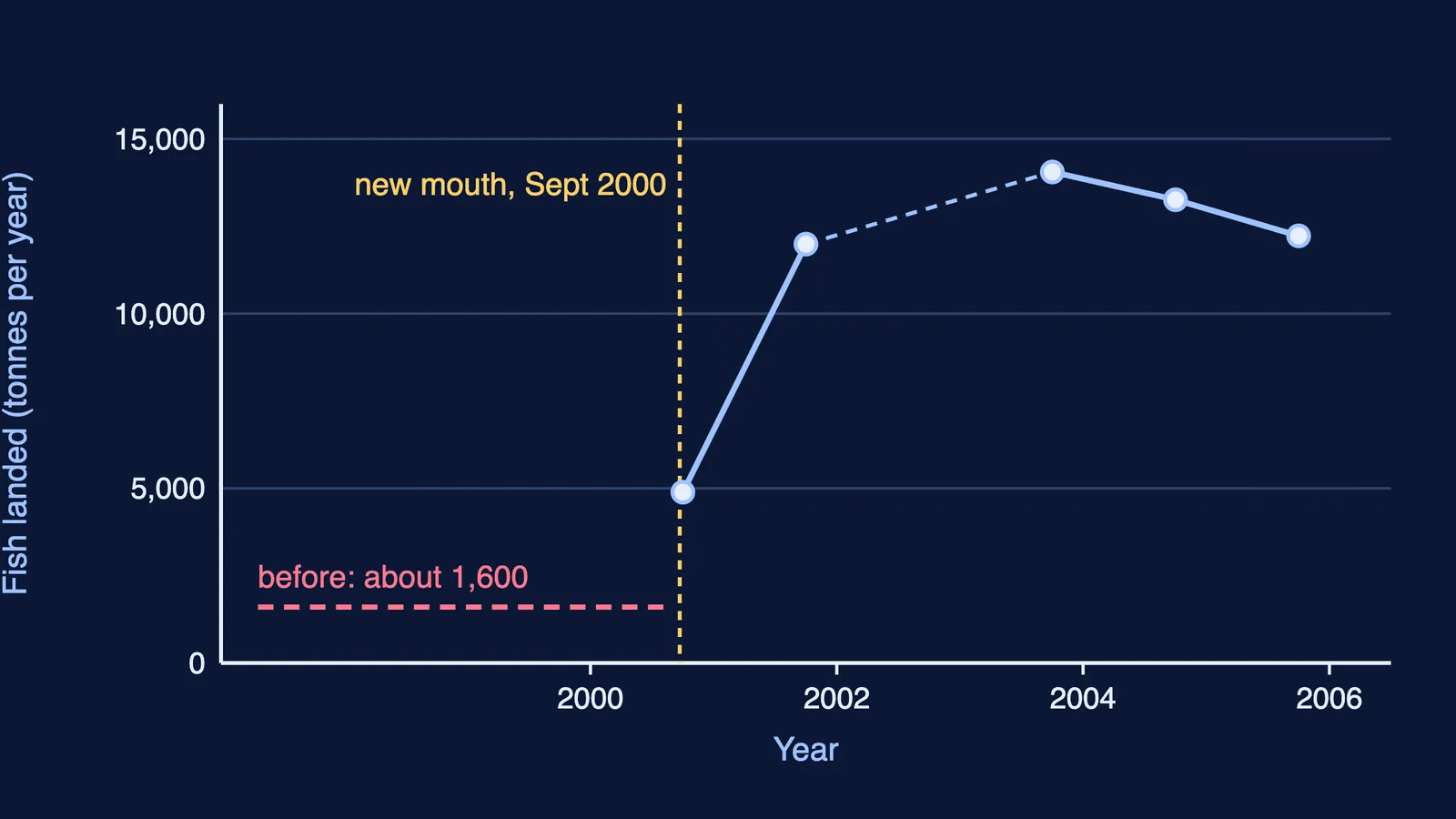
After model studies by CWPRS Pune, an artificial mouth was opened on 23 September 2000, cutting the outflow channel by 18 km. A shorter route meant more tidal exchange, and the CDA reports the desired improvement in salinity.
The CDA's figures show fish landings had fallen to an average of about 1,600 tonnes a year; they reached 4,889 tonnes in 2000-01 and 14,053 in 2003-04. In 2002 Chilika was removed from the Ramsar Convention's Montreux Record of threatened wetlands, the first site in Asia to be removed.
Why do Irrawaddy dolphins live in Chilika?
The Irrawaddy dolphin (Orcaella brevirostris) is endangered, and Chilika is one of its homes. In February 2018 the CDA's first annual monitoring survey sighted 155 dolphins, with the population believed to be 145 to 160, Mongabay India reported. CDA chief executive Susanta Nanda said they had once kept mainly to the outer channel but had spread into the southern and central sectors.
A 2025 Wildlife Institute of India thesis by Sakshi, Vishnupriya Kolipakam and G.V. Gopi estimated 24 to 32 individuals by mark-recapture. It found the highest prey catches in the salty outer channel and the fresher northern sector, suggesting better feeding there. A sighting count and a statistical estimate answer different questions, so check the method before comparing numbers. For how animals cope with shifting salt, see osmoregulation in freshwater and marine fish.
Try it: how salty is a river-and-sea mix?
When waters mix, the salt is conserved, so the salinity of the mix is total salt divided by total mass.
Take 1 kg of sea water at 35 ppt. It holds 35 g of salt.
Add 2 kg of river water at 0 ppt. No salt is added.
Mix: 35 g in 3 kg is about 11.7 ppt. That is brackish.
Summer: evaporate 0.2 kg from 1 kg of 35 ppt water. Now 35 g sits in 0.8 kg, about 43.8 ppt, saltier than the sea.
If concentration and dilution feel slippery, the Fermi Concept Library has a lesson for every concept in physics, chemistry, biology, mathematics and computing, and the Fermi Problem Library has a step-by-step solver that explains the reasoning.
Read Chilika on the map as a balance: 52 rivers on one side, the Bay of Bengal on the other, and an 18 km shortcut that tipped it back toward the sea.