On this page
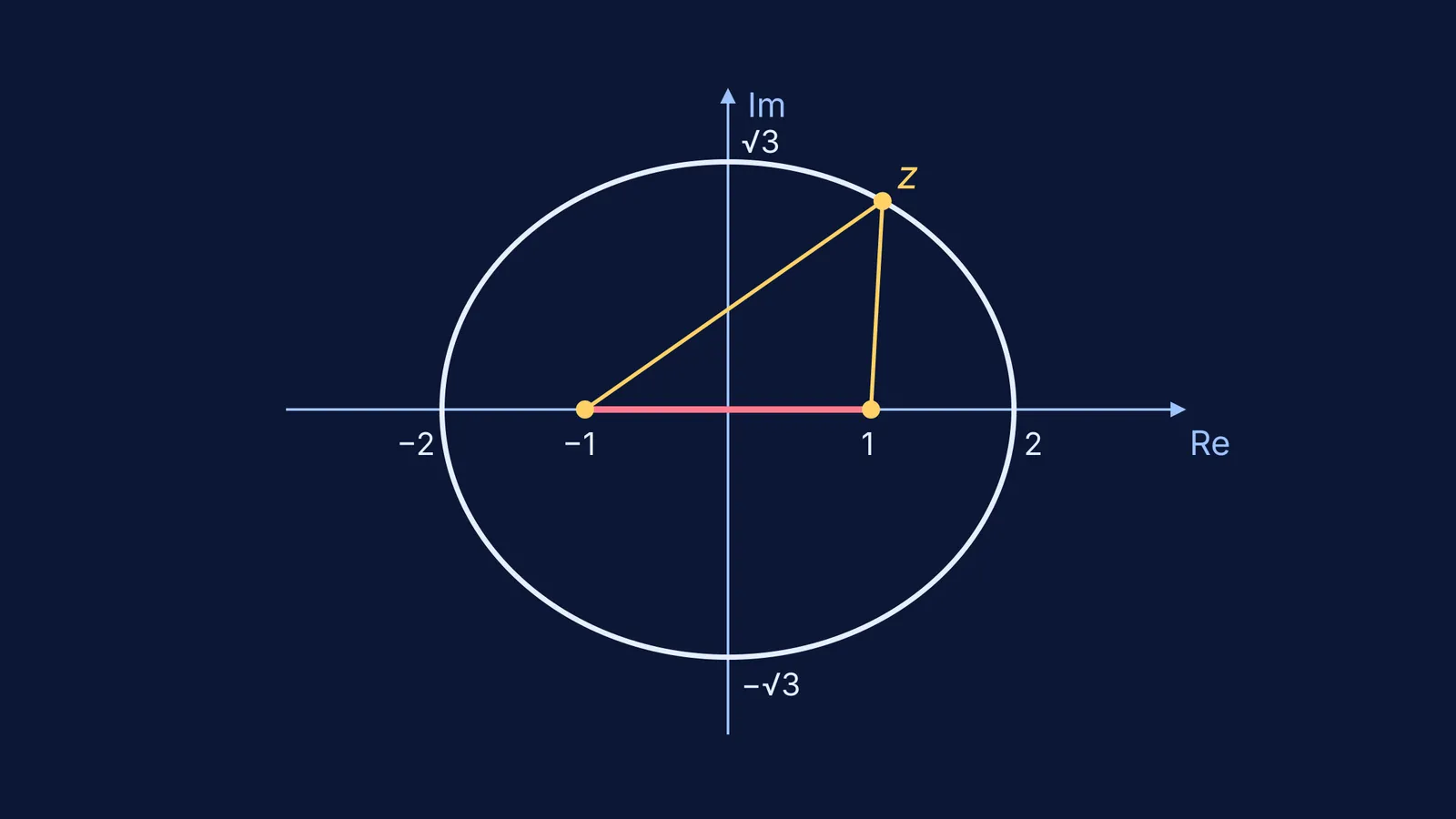
Read |z − 1| as the distance from the point z to the point 1 on the Argand plane, and |z + 1| as the distance from z to −1. The equation then says one thing: z moves so that its two distances to the fixed points 1 and −1 always add up to 4. That is the textbook definition of an ellipse.
Why is |z − 1| + |z + 1| = 4 an ellipse?
The NCERT Class 11 Mathematics chapter on conic sections (Section 10.5, Definition 4) says an ellipse is the set of all points in a plane, the sum of whose distances from two fixed points is a constant. The two fixed points are the foci.
Match the pieces:
Foci: the points 1 and −1, that is (1, 0) and (−1, 0).
The constant sum is the length of the major axis, 2a, so 2a = 4 and a = 2.
The centre is the midpoint of the foci, the origin, so c = 1.
The same NCERT section shows that a, b and c are linked by a² = b² + c². So b² = 4 − 1 = 3, and the locus is x²/4 + y²/3 = 1.
The eccentricity is e = c/a = 1/2, using NCERT's definition in Section 10.5.2. Our post on what eccentricity tells you about the shape of a conic explains what that number says.
How do you get x²/4 + y²/3 = 1 by algebra?
Put z = x + iy. Then |z − 1| = √((x − 1)² + y²) and |z + 1| = √((x + 1)² + y²).
Isolate one root: √((x − 1)² + y²) = 4 − √((x + 1)² + y²).
Square both sides: (x − 1)² + y² = 16 − 8√((x + 1)² + y²) + (x + 1)² + y².
The y² terms cancel, and (x − 1)² − (x + 1)² = −4x. So −4x − 16 = −8√((x + 1)² + y²), which gives √((x + 1)² + y²) = 2 + x/2.
Square again: x² + 2x + 1 + y² = 4 + 2x + x²/4.
Tidy up: (3/4)x² + y² = 3. Divide by 3 to get x²/4 + y²/3 = 1.
Check two points. At z = 2 the distances are 1 and 3; at z = i√3 each is 2. Both sums are 4, and both points satisfy x²/4 + y²/3 = 1.
When is the locus only a segment, or empty?
The definition hides a condition. NCERT adds a note that the constant sum is always greater than the distance between the two foci. Here the foci are 2 apart, so the comparison is with 2.
For the general form |z − z₁| + |z − z₂| = k, let d = |z₁ − z₂| be the distance between the fixed points.
k > d: an ellipse with foci z₁ and z₂. Our question has k = 4 and d = 2, so it is an ellipse.
k = d: only the line segment joining z₁ and z₂. For |z − 1| + |z + 1| = 2, only the real numbers from −1 to 1 work.
k < d: no points at all. The triangle inequality gives |z − 1| + |z + 1| ≥ |(z − 1) − (z + 1)| = 2, so |z − 1| + |z + 1| = 1 has an empty locus.
How do you solve any two-modulus locus question?
Rewrite each |z − w| as "distance from z to the point w" and mark both points.
Ask whether the distances are equal, added or subtracted. Equal gives the perpendicular bisector; sum gives an ellipse; difference gives a hyperbola.
Compare the constant with the distance between the points, so the segment and empty cases do not catch you.
Read off a and c, find b from a² = b² + c², then check one point on the curve.
For where that relation comes from, see why c² equals a² − b² for an ellipse. For the single-modulus cousin, |z − z₀| = r, see the equation of a circle in complex form.
When the algebra goes wrong, the Fermi Problem Library has worked problems with a step-by-step solver that explains the reasoning rather than printing an answer. If the gap is the idea of foci itself, the Fermi Concept Library gives each mathematics concept its own lesson and its place in the map.
Try it now: find the locus of |z − 2i| + |z + 2i| = 6. (Foci on the imaginary axis, a = 3, c = 2, b² = 5, so x²/5 + y²/9 = 1.)