

On this page
Coordinate geometry gives you (x − a)² + (y − b)² = r². Complex numbers give you something shorter: |z − z₀| = r. JEE questions expect you to move between this, the Cartesian form and the expanded zz̄ form without losing a sign.
Why is |z − z₀| = r a circle?
In the Argand plane, the modulus |x + iy| = √(x² + y²) is the distance from the point (x, y) to the origin (NCERT Mathematics Class 11, Chapter 4).
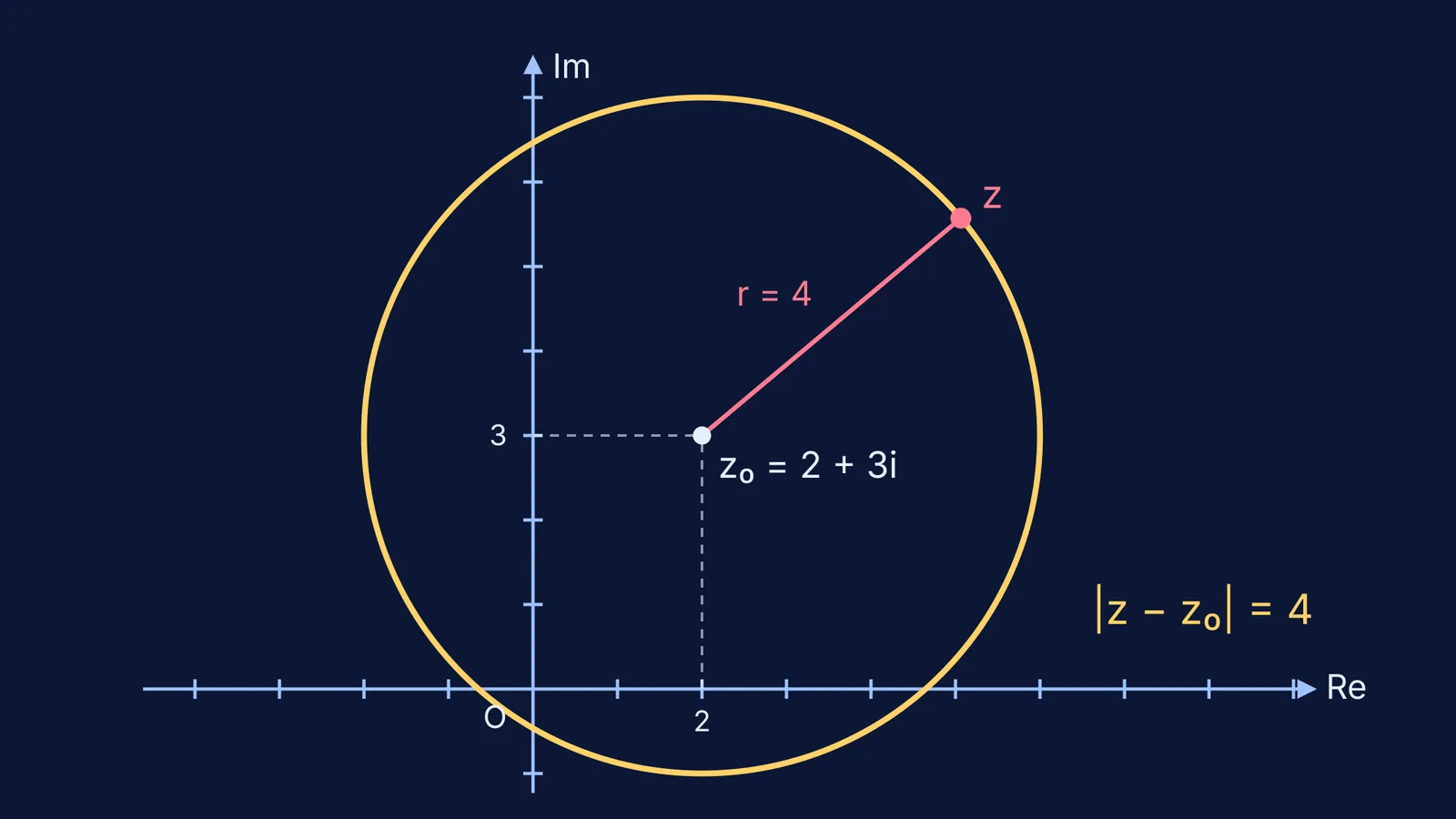
Subtracting complex numbers subtracts coordinates, so |z − z₀| is the distance between z and z₀. The circle with centre z₀ and radius r is exactly the set of z with |z − z₀| = r.
In parametric form, any point on it is z = z₀ + re^(iθ) (Wikipedia, Circle: complex plane); if that notation is new, see our guide to writing a complex number in polar and Euler form.
How do you expand |z − z₀| = r into the zz̄ form?
The key identity is z z̄ = |z|² for every complex number z, and the conjugate of a difference is the difference of the conjugates (NCERT Mathematics Class 11, Chapter 4).
Square both sides: |z − z₀|² = r².
Replace the squared modulus with a product: (z − z₀)(z̄ − z̄₀) = r².
Multiply out: zz̄ − z z̄₀ − z₀ z̄ + z₀z̄₀ = r².
Use z₀z̄₀ = |z₀|² and move r² across: zz̄ − z₀z̄ − z̄₀z + |z₀|² − r² = 0.
Notice the cross-pairing: z goes with the conjugate of the centre, z̄ with the centre itself. This is the easiest place to slip.
The more general equation pzz̄ + gz + ḡz̄ = q, with p and q real, is called a generalised circle: it is either a true circle or a straight line (Wikipedia, Circle). The line case is p = 0, when the zz̄ term vanishes. So divide through until the coefficient of zz̄ is 1 before reading off the centre.
Worked example 1: from centre and radius to zz̄
Find the circle with centre 2 + 3i and radius 4 in zz̄ form.
z₀ = 2 + 3i, so z̄₀ = 2 − 3i.
|z₀|² = 2² + 3² = 13, and r² = 16.
Substitute: zz̄ − (2 + 3i)z̄ − (2 − 3i)z + 13 − 16 = 0.
Answer: zz̄ − (2 + 3i)z̄ − (2 − 3i)z − 3 = 0.
Cartesian check: with z = x + iy, zz̄ = x² + y², and the two conjugate middle terms add to −2 Re[(2 − 3i)(x + iy)] = −(4x + 6y). That gives x² + y² − 4x − 6y − 3 = 0, or (x − 2)² + (y − 3)² = 16.
Worked example 2: reading the centre and radius back
Find the centre and radius of zz̄ − (1 − i)z − (1 + i)z̄ − 7 = 0.
The coefficient of zz̄ is already 1, so match with zz̄ − z̄₀z − z₀z̄ + |z₀|² − r² = 0.
The coefficient of z̄ is −(1 + i), so z₀ = 1 + i; the coefficient of z is its conjugate, which confirms the match.
|z₀|² − r² = −7 and |z₀|² = 2, so r² = 9.
Centre 1 + i, radius 3.
Cartesian check: (x − 1)² + (y − 1)² = 9.
What are the common mistakes with the complex circle equation?
Swapping the pairs. Writing −z₀z instead of −z̄₀z. The coefficients of z and z̄ must be conjugates of each other.
A non-real constant. |z₀|² − r² is always real; a complex constant means an algebra slip.
Forgetting to normalise. In 2zz̄ + … = 0, divide by 2 first.
Ignoring the radius condition. If |α|² − k is negative, there is no circle; if it is zero, the "circle" is a single point.
Flipping the centre's sign. In zz̄ + ᾱz + αz̄ + k = 0 the centre is −α, not α.
The same conjugate reasoning drives the condition for a complex number to be purely real or purely imaginary and showing that (z − 1)/(z + 1) is purely imaginary on the unit circle.
How should you practise this?
Expand five centre-and-radius pairs into zz̄ form.
Reverse five zz̄ equations back to centre and radius.
Convert every answer to Cartesian form and compare. When a step goes wrong, it is usually the conjugate pairing.
For more practice, the Fermi Problem Library has worked problems with a step-by-step solver that explains the reasoning rather than printing an answer. If modulus and conjugate still feel loose, the Fermi Concept Library gives each concept its own lesson.


