

On this page
When you see a problem asking you to prove that a complex expression is purely imaginary, the secret often lies in its conjugate. A number w is purely imaginary if and only if w + w̄ = 0, which is the same as saying w̄ = −w.
If the problem tells you that z lies on the unit circle, you have a powerful tool at your disposal: the modulus |z| = 1. This simple fact unlocks both an algebraic proof and a beautiful geometric picture.
How do you prove (z − 1)/(z + 1) is imaginary when |z| = 1?
Let the expression be w = (z − 1)/(z + 1). To show that w is purely imaginary, we need to prove that its conjugate w̄ is equal to −w.
Because the modulus |z| is 1, the squared modulus |z|² is also 1. A key property of complex numbers is that a number multiplied by its conjugate equals its squared modulus (a technique explained in our guide on using z z̄ = |z|² to simplify complex number problems).
Since |z|² = 1, we can write z z̄ = 1, which rearranging gives z̄ = 1/z. This substitution is the engine of the proof.
Let us find the conjugate of the whole expression w:
Take the conjugate of the top and bottom: w̄ = (z̄ − 1) / (z̄ + 1).
Substitute z̄ = 1/z: w̄ = (1/z − 1) / (1/z + 1).
Multiply the numerator and the denominator by z to clear the fractions: w̄ = (1 − z) / (1 + z).
Factor out a negative sign from the top: w̄ = −(z − 1) / (z + 1).
This leaves us with w̄ = −w. Since a number that equals the negative of its conjugate has a real part of zero, the ratio (z − 1)/(z + 1) is purely imaginary.
If you are stuck on similar substitution steps in a homework problem, the Fermi Problem Library will walk you through the algebra line by line.
What if you solve it by putting z = x + iy?
While the conjugate method is elegant, you can also solve it algebraically by setting z = x + iy. Because z is on the unit circle, we know that x² + y² = 1.
If you substitute z = x + iy into (z − 1)/(z + 1), you get: ((x − 1) + iy) / ((x + 1) + iy)
To clear the complex number from the denominator, multiply the top and bottom by the conjugate of the denominator, which is (x + 1) − iy.
Expanding the numerator gives: (x − 1)(x + 1) + y² + i(y(x + 1) − y(x − 1))
The real part of the numerator is x² − 1 + y². Since x² + y² = 1, this real part becomes 1 − 1 = 0. Because the real part vanishes, the entire expression reduces to just the imaginary part, confirming that the ratio is purely imaginary. For more on this approach, see our guide to solving equations in complex numbers by putting z = x + iy.
What is the geometric meaning of (z − 1)/(z + 1)?
The algebra tells us the answer is purely imaginary, but drawing the complex plane shows us why.
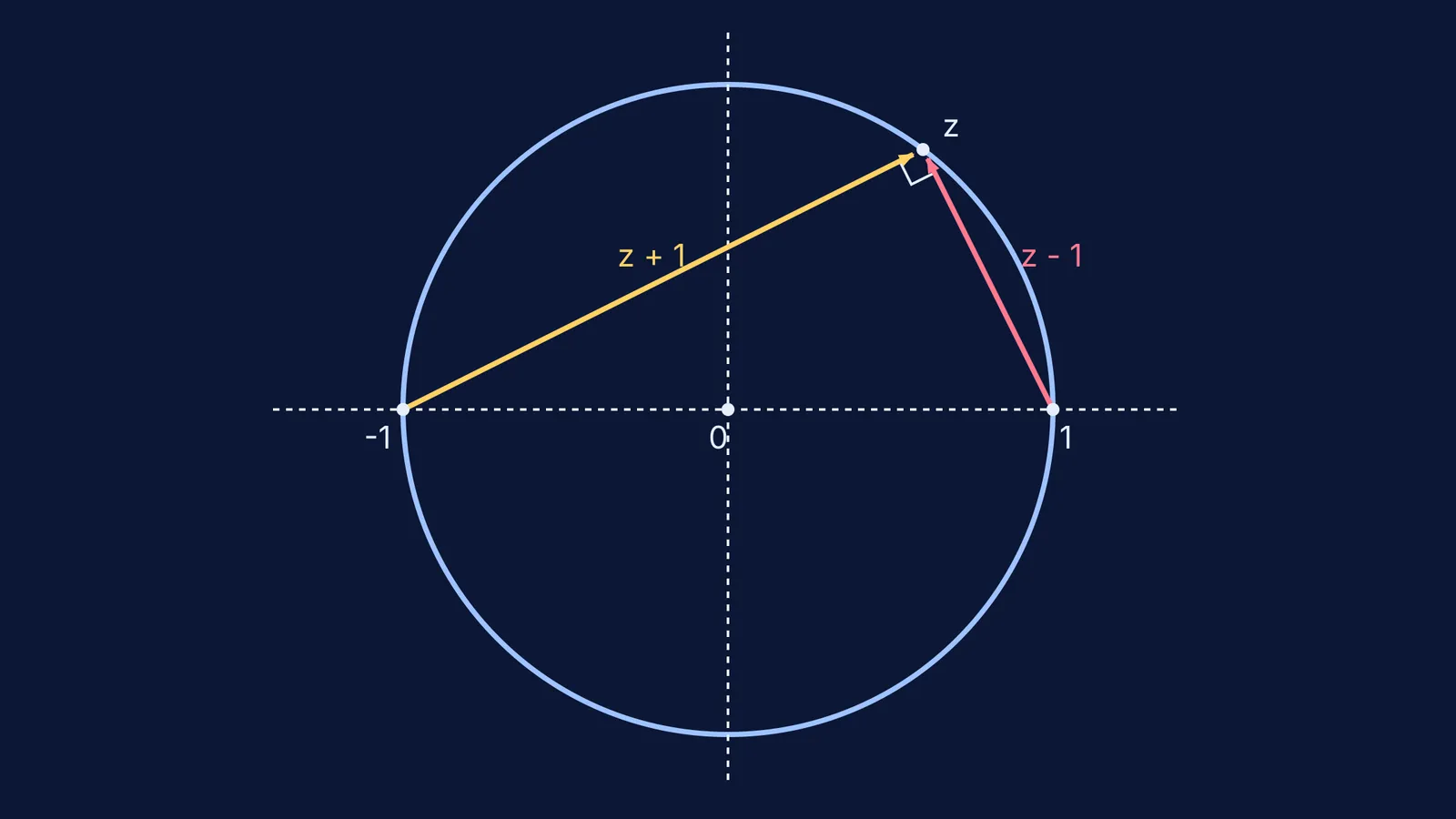
Any complex number z on the unit circle has a distance of 1 from the origin. The numbers 1 and −1 also sit on this circle, at opposite ends of the real axis. The straight line connecting −1 and 1 is a diameter of the circle.
The expression (z − 1)/(z + 1) is a ratio of two complex numbers, which represent two vectors in the complex plane:
The numerator, z − 1, is the vector pointing from 1 to z.
The denominator, z + 1, is the vector pointing from −1 to z.
When you divide two complex numbers, you subtract their angles (arguments). For a refresher on how angles work, see our post on finding arg z in each quadrant. Geometrically, this subtraction gives the angle between the two vectors meeting at the point z.
In geometry, Thales's theorem states that if A, B, and C are distinct points on a circle where the line AC is a diameter, then the angle ∠ABC is a right angle.
Because 1 and −1 form a diameter, the angle they make with any point z on the circle is exactly 90° (or π/2 radians). Since the angle of our ratio is ±π/2, the result must sit on the imaginary axis.
By tying the modulus condition |z| = 1 to the geometry of the circle, the abstract algebra becomes a picture you can sketch in seconds. Exploring these visual connections is exactly what the Fermi Concept Library is built for.


