On this page
Every JEE and board chemistry student meets this puzzle in the s-block chapter. Lithium holds its outer electron more tightly than any other alkali metal, yet in water it is the strongest reducing agent of the group. The way out is to split E° into the energy steps behind it.
Why is lithium the strongest reducing agent if its ionisation enthalpy is highest?
A reducing agent gives away electrons, and the more negative its standard reduction potential (E°), the more readily it does so in water. Standard tables list E° for Li⁺/Li as −3.040 V, Na⁺/Na as −2.713 V, K⁺/K as −2.93 V, Rb⁺/Rb as −2.98 V and Cs⁺/Cs as −2.92 V (LibreTexts table of standard reduction potentials). Lithium's value is the most negative.
Ionisation enthalpy describes only an isolated gaseous atom losing an electron. E° describes a solid metal becoming an ion in water, and ionisation is just one step of that journey.
How do you break E° into sublimation, ionisation and hydration?
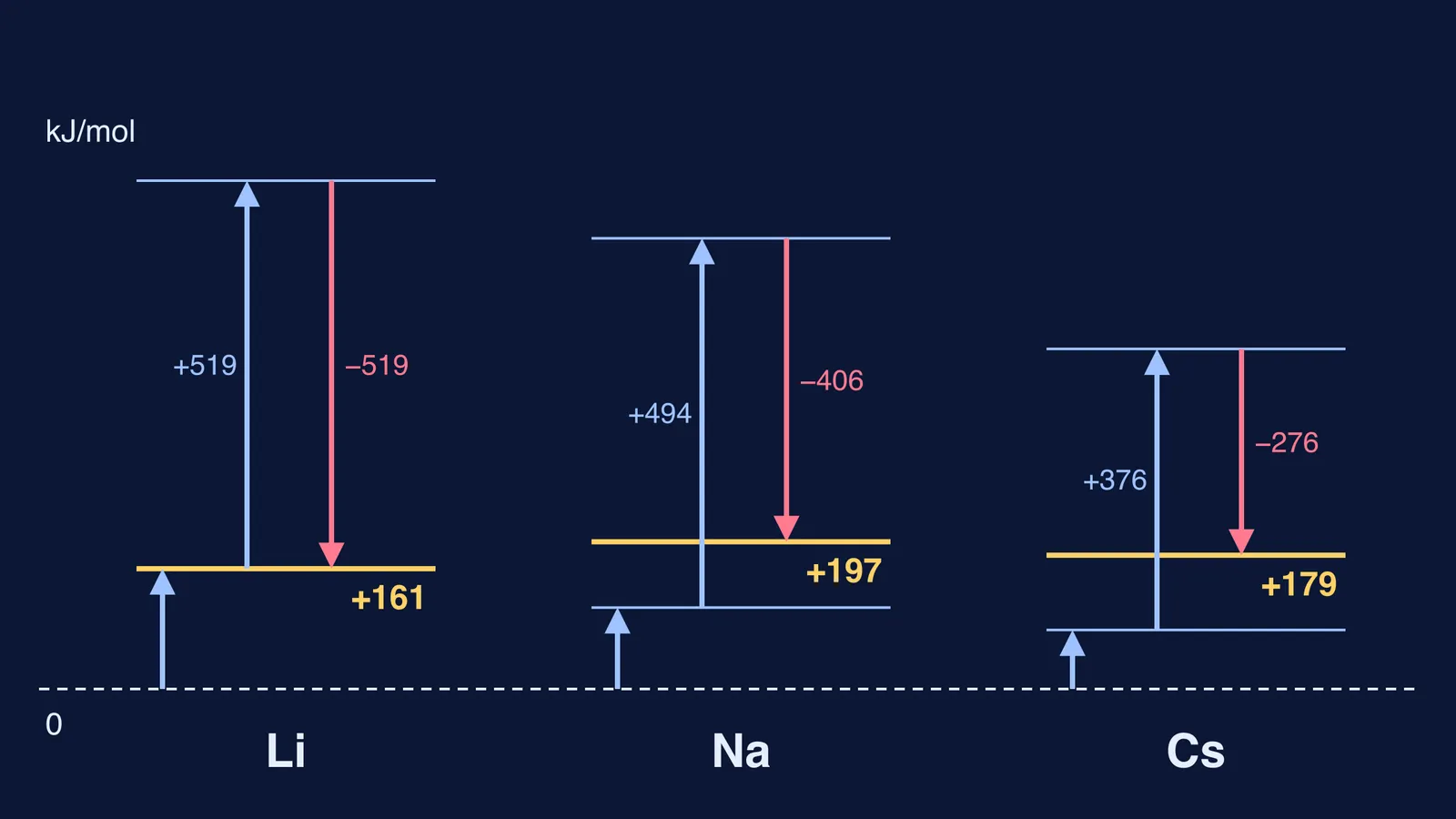
Use Hess's law to imagine an indirect route from M(s) to M⁺(aq). The route is bookkeeping, not the real mechanism, as Jim Clark points out on Chemguide's page on group 1 metals reacting with water. Chemguide's values, all in kJ/mol:
Sublimation (atomisation), M(s) → M(g): Li +161, Na +109, Cs +79.
Ionisation, M(g) → M⁺(g): Li +519, Na +494, Cs +376.
Hydration, M⁺(g) → M⁺(aq): Li −519, Na −406, Cs −276.
Now add each column.
Lithium: 161 + 519 − 519 = +161 kJ/mol.
Sodium: 109 + 494 − 406 = +197 kJ/mol.
Caesium: 79 + 376 − 276 = +179 kJ/mol.
Lithium pays the most to make its gaseous ion, 680 kJ/mol against 455 kJ/mol for caesium. But it gets almost all of the ionisation cost back when water molecules crowd around the tiny Li⁺ ion. The smaller the net cost of M(s) → M⁺(aq), the more easily the metal gives up its electron in water, and lithium's net cost is the smallest in the group. The other half of the reaction, turning water into hydrogen and hydroxide, is about −382 kJ/mol for every metal on the same Chemguide page, so it does not change the ranking.
A caution for strong students
This cycle uses enthalpy, but E° is tied to free energy (ΔG° = −nFE°), which also includes entropy. So the enthalpy sums get lithium right but not the full order of the others. On Chemguide's figures, caesium (+179 kJ/mol) looks easier than potassium (+186) and rubidium (+187). The measured E° values put it the other way: rubidium −2.98 V, potassium −2.93 V, caesium −2.92 V. If a question asks for the order, quote the E° values; use the cycle to explain lithium.
The same tight hydration shell explains why the lithium ion has the lowest ionic mobility in water.
Why does lithium react with water more slowly than sodium?
A more negative E° is about energy, not speed. Chemguide describes lithium floating and fizzing gently, its reaction generating heat "too slowly" for the metal to melt, while sodium melts into a silvery ball that dashes across the surface.
On Chemguide's estimates, lithium's full reaction with water releases the most heat in the group, about −222 kJ/mol against −184 kJ/mol for sodium. It simply releases it more slowly. Clark's explanation is that lithium needs the largest energy input, atomisation plus ionisation, to form its ion, and that this raises the activation energy, so the reaction is slower.
Thermodynamics tells you how far a reaction wants to go; kinetics tells you how fast.
What should you write in a board or JEE answer?
A four-step answer:
State it: lithium has the most negative E° among the alkali metals, −3.04 V on the standard potentials table, so it is the strongest reducing agent in aqueous solution.
Name the three steps: E° depends on sublimation enthalpy, ionisation enthalpy and hydration enthalpy.
Give the reason: Li⁺ is the smallest ion, so it has the highest hydration enthalpy, which makes up for its high ionisation enthalpy.
Add the contrast if asked: in the gas phase, with no water to hydrate the ion, caesium loses its electron most easily because its ionisation enthalpy is the lowest.
If one step of the cycle feels shaky, the Fermi Concept Library covers every concept in chemistry, each with its own lesson and its place in the map, so you can go back to enthalpy or electrode potential first. To practise numericals that mix E° and energy cycles, the Fermi Problem Library has worked problems with a step-by-step solver that explains the reasoning rather than printing an answer.
Next, read the four electrochemistry numerical mistakes that cost students marks, and why absolute electrode potential cannot be measured, which is why every E° here is quoted against the hydrogen electrode.