On this page
Clip a voltmeter to a zinc rod standing in zinc sulphate solution and you will get a number, but it is not the zinc electrode's potential. The problem is the circuit: there is no way to touch a half-cell without building a second one.
Why can't the absolute electrode potential be measured?
A voltmeter has two terminals and reads the potential difference between them. One lead clips onto the zinc. The other must reach the solution, which means dipping in another conductor. The moment it touches the electrolyte, it forms its own interface with its own potential jump. You have made a second electrode.
So the meter reads the zinc interface minus the probe interface, and you know neither. Section 2.2.1 of the NCERT Class 12 Chemistry textbook, Unit 2 says it directly: "The potential of individual half-cell cannot be measured. We can measure only the difference between the two half-cell potentials that gives the emf of the cell."
A 2008 paper in the Journal of the American Chemical Society makes the same point: absolute potentials of isolated half-cells in solution are not measurable, so half-cell potentials are measured relative to other half-cells (Donald and colleagues, 2008).
What does the standard hydrogen electrode do?
If only differences can be measured, you need an agreed zero, the way heights are measured from sea level. Chemists chose the standard hydrogen electrode (SHE).
The SHE is a platinum electrode coated with platinum black, dipped in 1 M hydrogen ion solution with pure hydrogen gas at 1 bar bubbling through it, and by convention it is assigned zero potential at all temperatures (NCERT, section 2.2.1).
Nothing makes hydrogen truly zero; it is a shared choice.
Worked example: how zinc and copper get their numbers
This is the procedure NCERT uses, and you can reproduce it in an exam (NCERT, section 2.2.1).
Build a cell with the SHE on the left (anode) and the electrode you want on the right: Pt | H2(g, 1 bar) | H+(aq, 1 M) || Cu2+(aq, 1 M) | Cu.
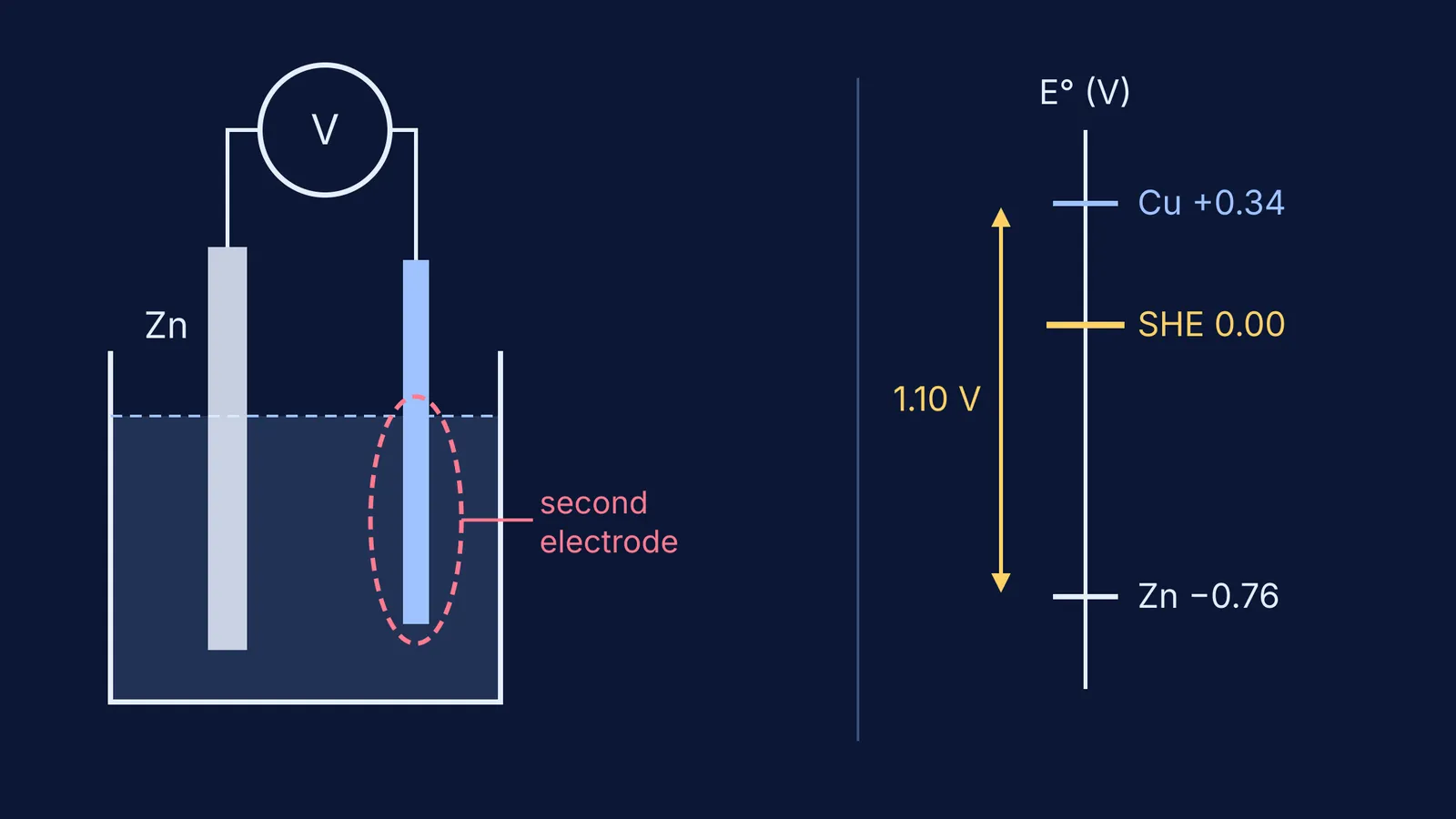
Measure the emf. For copper it is 0.34 V.
Use E°cell = E°right − E°left. Since E°left is 0 for the SHE, E°(Cu2+/Cu) = +0.34 V.
Repeat with zinc on the right. The emf is −0.76 V, so E°(Zn2+/Zn) = −0.76 V.
Combine the two into a Daniell cell: E°cell = 0.34 − (−0.76) = 1.10 V.
In step 5 the SHE dropped out. Suppose the zero were moved so that every electrode potential went up by 4 V. Copper becomes 4.34 V, zinc becomes 3.24 V, and the Daniell cell is still 4.34 − 3.24 = 1.10 V. A cell emf, and anything you calculate from it such as ΔG° = −nFE°cell, depends only on differences, so the choice of zero never changes a physical answer.
The sign still tells you something real. As NCERT explains, copper's positive value means Cu2+ ions are reduced more easily than H+ ions, and zinc's negative value means hydrogen ions can oxidise zinc. For how this ladder relates to the reactivity series from Class 10, see activity series vs electrochemical series.
Is there an absolute value at all?
In principle, yes, but not one you can read off a voltmeter. It is defined against a free electron and has to be estimated indirectly, for example by combining gas-phase experiments with theory.
The IUPAC recommendation by S. Trasatti gives +4.44 V for the absolute potential of the SHE versus a free electron (Trasatti, Pure and Applied Chemistry, 1986; value as reported by Donald and colleagues, 2008). That 2008 study, which reduced charged water nanodrops in the gas phase, obtained 4.2 ± 0.4 V, lists other estimates up to +4.73 V, and notes there is no general consensus on the best way to obtain the value.
For boards and JEE, every table you use is on the SHE scale.
How should you answer this in an exam?
A three-point answer:
A voltmeter measures a potential difference, so it needs two electrodes.
Connecting any conductor to the solution creates a second electrode with its own unknown potential, so only the emf of a complete cell can be measured.
Potentials are therefore measured against a reference, the standard hydrogen electrode, which is assigned 0 V by convention.
Two slips to avoid: writing that the SHE "has" zero potential as if it were measured (it is assigned zero), and leaving out 1 bar H2 and 1 M H+ when you describe it (NCERT, section 2.2.1).
The cell in step 1 also needs a salt bridge; see why a galvanic cell needs a salt bridge, and why KCl. When concentrations are not 1 M, the SHE scale carries over through the Nernst equation, which we derive from Gibbs free energy.
If reference points still feel slippery, the Fermi Concept Library gives every chemistry concept its own lesson and its place in the map. And when a cell problem goes wrong at the sign step, the Fermi Problem Library has worked problems with a step-by-step solver that explains the reasoning rather than printing an answer.