

On this page
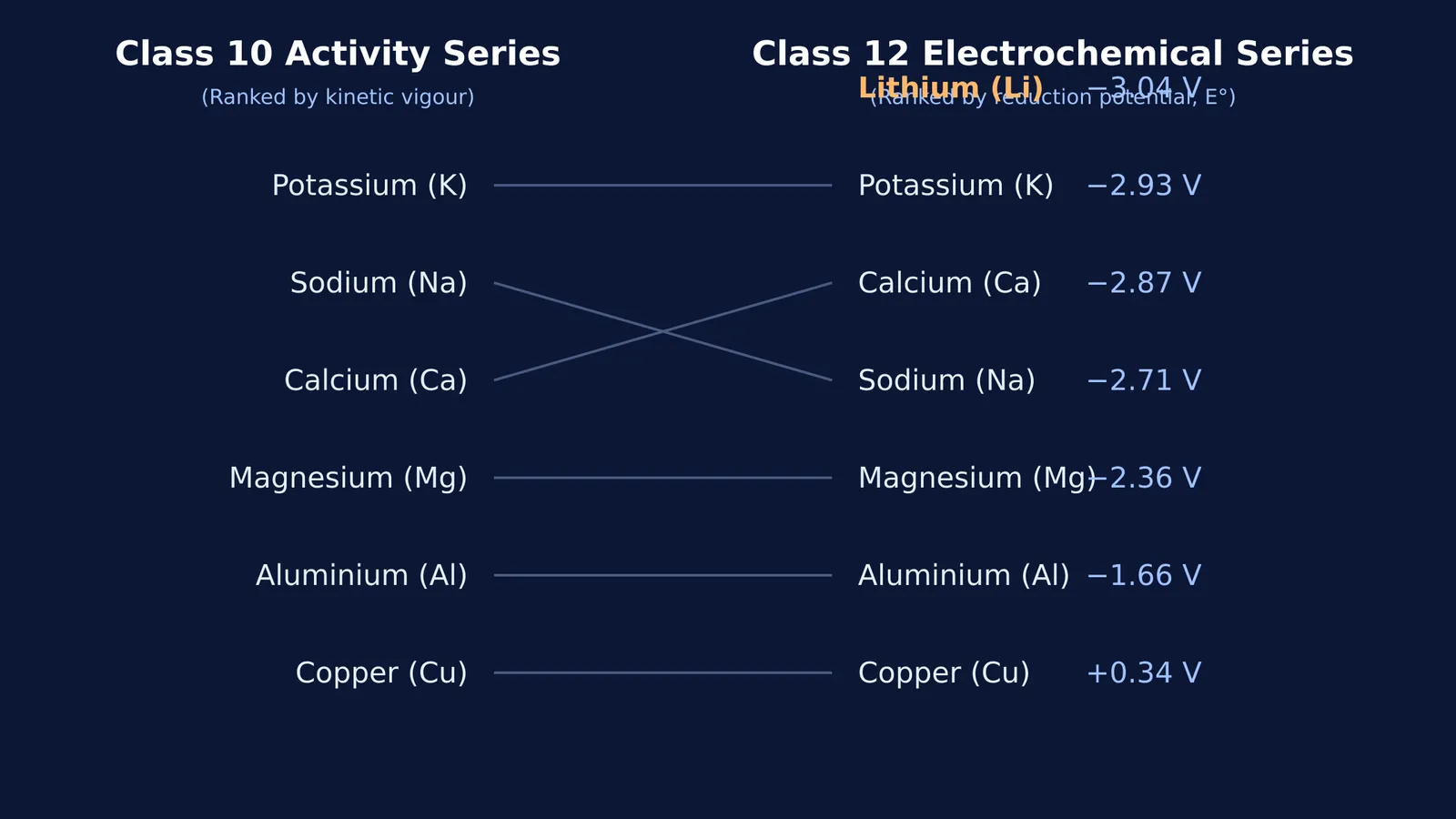
When you first learn about metals in Class 10, you are introduced to the activity series (or reactivity series). It is a straightforward list that tells you which metal can displace another. Potassium sits at the top, followed by sodium, calcium and magnesium.
But when you open your Class 12 chemistry textbook to study electrochemistry, the table looks different. The electrochemical series lists standard reduction potentials, and lithium suddenly appears at the very top, while potassium drops down. If potassium reacts so violently with water, why does lithium beat it in the electrochemical series?
The answer lies in what the two series are actually measuring: kinetics versus thermodynamics.
What is the difference between activity series and electrochemical series?
The activity series you learn in Class 10 is built on kinetics—how fast and vigorously a metal reacts. If you drop a piece of potassium into water, it catches fire instantly. The series is derived from these direct experimental observations of metals reacting with water, oxygen and dilute acids in the NCERT Class 10 curriculum. It tells you *if* a reaction will happen and how obvious it will be.
The electrochemical series in Class 12 is built on thermodynamics. It ranks elements quantitatively by their standard reduction potential (E°), measured at 298 K and 1 M concentration according to standard tables. This number tells you exactly how much energy is involved when an element gains or loses electrons in an aqueous solution. It does not care whether the reaction takes one second or one year to finish; it only measures the total energy change from start to finish.
If you are struggling to map Class 10 observations to Class 12 equations, the Fermi Concept Library covers every concept in chemistry to help clear up the gap.
Why is potassium at the top in Class 10?
Potassium is placed at the top of the Class 10 reactivity series because it has a very low ionization energy and a low melting point. When it hits water, it loses its outer electron easily, and the heat generated quickly melts the metal, exposing more surface area. This creates a runaway kinetic effect: a fast, explosive reaction that is impossible to miss.
Sodium and calcium follow because they are slightly harder to ionize or have higher melting points, making their visible reactions less violent.
Why is lithium the strongest reducing agent in Class 12?
In the electrochemical series, a strong reducing agent has a highly negative standard reduction potential. Lithium holds the record with an E° of −3.04 V, while potassium sits below it at −2.93 V on the reduction potential table.
To understand why, you have to look at the entire journey of the atom turning into an ion in water. When measuring standard reduction potential, scientists are effectively measuring the total energy change for the half-reaction where a metal ion gains an electron. The more negative this value, the more the solid metal wants to be oxidized and act as a reducing agent. This total energy change depends on three steps from the Born-Haber cycle:
Sublimation energy: Turning the solid metal into a gas. Lithium and potassium both require energy here, though lithium requires more.
Ionization energy: Removing an electron from the gaseous atom to make an ion. Lithium's outer electron is closer to its nucleus, so it has a higher ionization energy than potassium.
Hydration enthalpy: Surrounding the gaseous ion with water molecules to make it aqueous. This step *releases* energy.
Because the lithium ion is incredibly small, it has a very high charge density. When it enters water, its concentrated positive charge pulls in polar water molecules with immense force. This interaction releases a massive amount of hydration energy.
This final energy payoff is so large that it overcomes the higher initial energy costs of sublimation and ionization. Thermodynamically, lithium's cycle releases more overall energy than potassium's when oxidizing in water, earning it the top spot as the strongest reducing agent.
Where do the two series agree?
While the top of the series flips, the bottom remains consistent. Metals like copper, silver and gold sit at the bottom of the Class 10 activity series because they do not react with dilute acids.
In the electrochemical series, this translates to positive standard reduction potentials. Copper has an E° of +0.34 V and silver sits at +0.80 V based on the standard reference. Because their potentials are positive relative to hydrogen (0.00 V), they will not spontaneously reduce hydrogen ions to hydrogen gas. The thermodynamics perfectly match the Class 10 test-tube observations.
For a deeper dive into how these positive potentials dictate industrial purification, see our guide on the electrolytic refining of copper.
A framework for exam questions
When a question asks you to compare metals, look at the context to decide which logic to apply. You can practice applying this framework using the Fermi Problem Library, a step-by-step solver that explains the reasoning rather than just printing an answer.
Use the Class 10 Activity Series if the question asks about the physical vigour of a reaction, safety in storage (like keeping sodium under oil), or basic displacement reactions without concentration values.
Use the Class 12 Electrochemical Series if the question asks for cell EMF, identifying the strongest reducing agent in aqueous solution, E° values of 3d metals, or determining spontaneity using cell EMF to Gibbs energy calculations.
If asked "Why is lithium a stronger reducing agent than potassium?", the mandatory keyword in your answer is "hydration enthalpy".
By keeping kinetics and thermodynamics separate, you can bridge the gap between what you see in a beaker and what you calculate on paper.


