On this page
Chapter 5 of NCERT Class 11 Mathematics rests on a handful of terms, and one mixed-up term can turn correct algebra into a wrong answer. Below, each term gets a plain definition from the NCERT chapter on linear inequalities, a worked example and the mix-up to watch for.
What do strict and slack inequalities mean?
Inequality. NCERT defines an inequality as two real numbers or two algebraic expressions related by the symbol <, >, ≤ or ≥ (NCERT Class 11, Chapter 5). For example, 3 < 5 is a numerical inequality and x ≥ 3 is a literal inequality.
Strict inequality. An inequality that uses < or > is strict, so the boundary value is not allowed. For example, x < 5 does not include 5.
Slack inequality. An inequality that uses ≤ or ≥ is slack, so the boundary value is allowed. For example, x ≤ 5 includes 5.
Common mix-up: "at least" and "at most" are slack (≥ and ≤), while "more than" and "less than" are strict. NCERT's Example 7 asks for the minimum marks needed for an average of at least 60, so it writes ≥ 60 and gets x ≥ 70 marks.
Linear inequality. ax + b < 0 is linear in one variable when a ≠ 0; ax + by < c is linear in two variables when a ≠ 0 and b ≠ 0.
How do you solve a linear inequality and write its solution set?
Solution and solution set. A solution is a value of the variable that makes the inequality a true statement, and the set of all such values is the solution set (NCERT Class 11, Chapter 5). In NCERT's opening example, Ravi has ₹200 and rice costs ₹30 a packet, so 30x < 200; counting whole packets, the solution set is {0, 1, 2, 3, 4, 5, 6}.
Reversing the sign. You may add or subtract the same number on both sides, and multiply or divide both sides by a positive number, without changing the sign; multiplying or dividing by a negative number reverses it.
Worked example (NCERT Example 3), solve 4x + 3 < 6x + 7:
Subtract 6x and 3 from both sides: −2x < 4.
Divide by −2 and flip the sign: x > −2.
Write the solution set: (−2, ∞).
Common mix-up: forgetting the flip gives x < −2, the opposite set. Check one number: x = 0 gives 3 < 7, true, and 0 is in (−2, ∞).
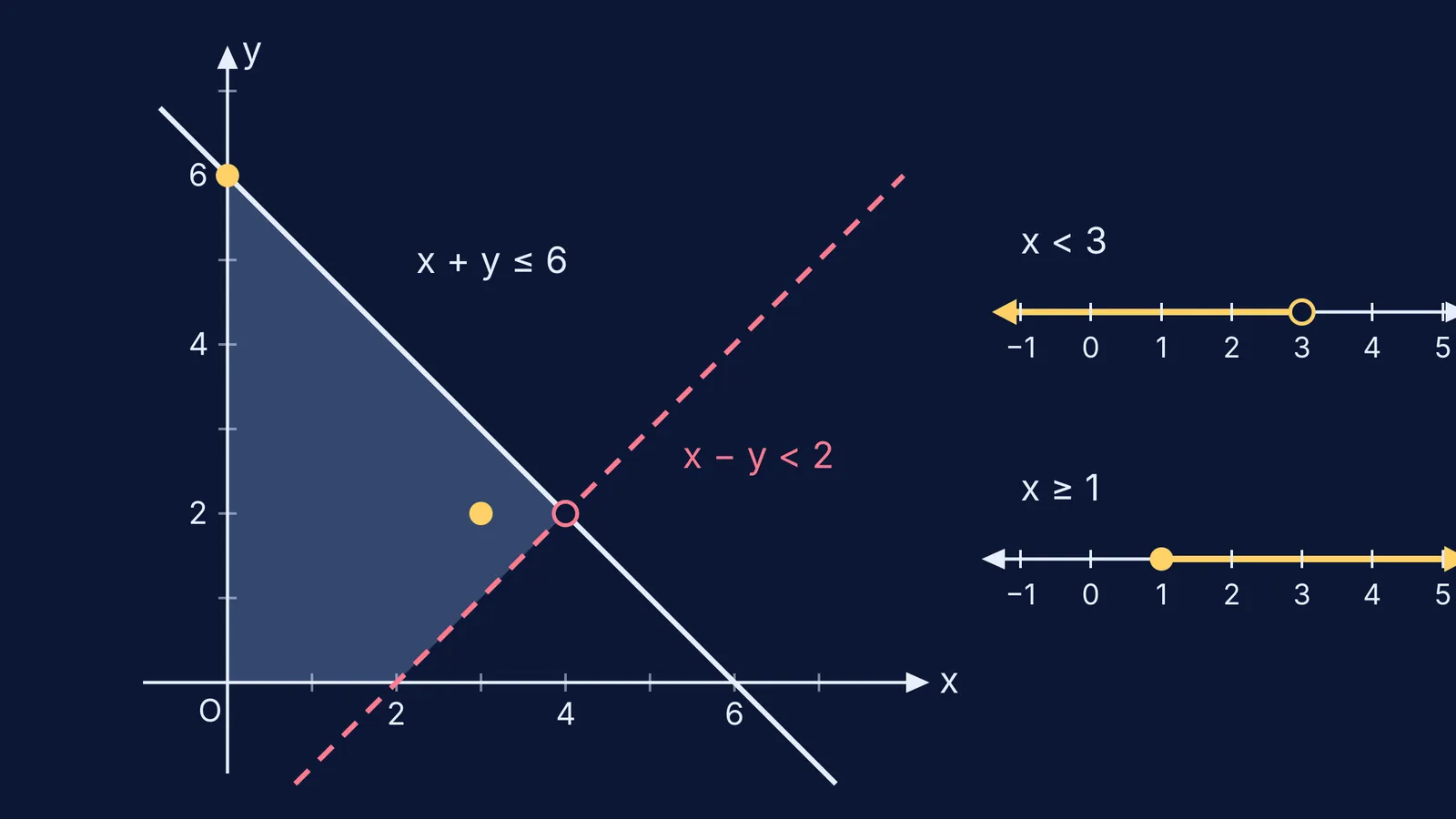
Open and closed circle. On a number line, NCERT marks x < a or x > a with a hollow circle at a, and x ≤ a or x ≥ a with a dark circle. Hollow means "not included", like a round bracket; dark means "included", like a square bracket.
What is the difference between an open and a closed half-plane?
A line ax + by = c splits the plane into two half-planes. A strict linear inequality specifies an open half-plane, and a non-strict (slack) one specifies a closed half-plane, which is the open half-plane together with its boundary line (Half-space, Wikipedia). In our diagram at the top, the excluded boundary is dashed and the included one is solid.
Common mix-up: shading the wrong side. Test a point off the line, usually (0, 0). For 2x + 3y ≤ 12, it gives 0 ≤ 12, true, so shade the origin's side.
How do you find the solution region of a system?
Solution region. The solution region of a system is the set of points that satisfy every inequality in it; NCERT's Class 12 Linear Programming chapter calls this common region the feasible region, or solution region (NCERT Class 12, Chapter 12).
Worked example (the one in our diagram): x + y ≤ 6, x − y < 2, x ≥ 0, y ≥ 0.
Draw x + y = 6 as a solid line (slack) and x − y = 2 as a dashed line (strict).
Test (0, 0): 0 ≤ 6 and 0 < 2 are both true, so keep the side of each line that contains the origin.
Keep the part in the first quadrant. The corners are (0, 0), (2, 0), (4, 2) and (0, 6).
Check the edges. (0, 6) gives 6 ≤ 6, true, so it is in. (4, 2) gives 4 − 2 = 2, and 2 < 2 is false, so it is out; so is (2, 0). (3, 2) gives 5 ≤ 6 and 1 < 2, so it is in.
Common mix-up: treating every corner as a solution. A corner on a dashed line marks a limit, not a member.
A five-minute revision checklist
Turn "at least", "at most", "more than" and "less than" into ≥, ≤, > and <.
Flip the sign whenever you multiply or divide by a negative number.
Strict: hollow circle, round bracket, dashed line. Slack: dark circle, square bracket, solid line.
Test (0, 0) to pick the side, then check every corner against the strict inequalities.
If drawing a line from its equation feels shaky, revise the Two Variables, One Line key terms from Class 9; for exam-level graphing, try JEE Main numerical questions on straight lines.
When a term won't stick, look it up in the Fermi Concept Library. To see a full solution worked line by line, use the Fermi Problem Library, a step-by-step solver that explains the reasoning.