On this page
Two functions are the standard first tests of one-sided limits: |x|/x and [x], the greatest integer function. At x = 0 both break in a way that teaches the most important rule about limits. Here is the working, and a table you can build to check yourself.
What are left hand and right hand limits?
The left hand limit of f(x) at a is the value f(x) approaches as x comes towards a through values less than a; the right hand limit uses values greater than a. Both definitions are stated this way in OpenStax Calculus Volume 1, section 2.2.
The rule that matters: the limit of f(x) at a exists and equals L if and only if both one-sided limits exist and equal L. OpenStax states this as Theorem 2.2, and the NCERT Class 11 textbook chapter Limits and Derivatives puts it the same way: if the right and left hand limits coincide, that common value is the limit. If they differ, the limit does not exist, even when the function has a value at the point.
What is the left and right hand limit of |x|/x at 0?
Start from the definition of modulus: |x| = x when x > 0, and |x| = −x when x < 0. So simplify before you take any limit.
For x < 0: |x|/x = (−x)/x = −1.
For x > 0: |x|/x = x/x = 1.
At x = 0 the expression is 0/0, so the function is not defined there. That does not stop us; a limit only looks at points near 0, never at 0 itself.
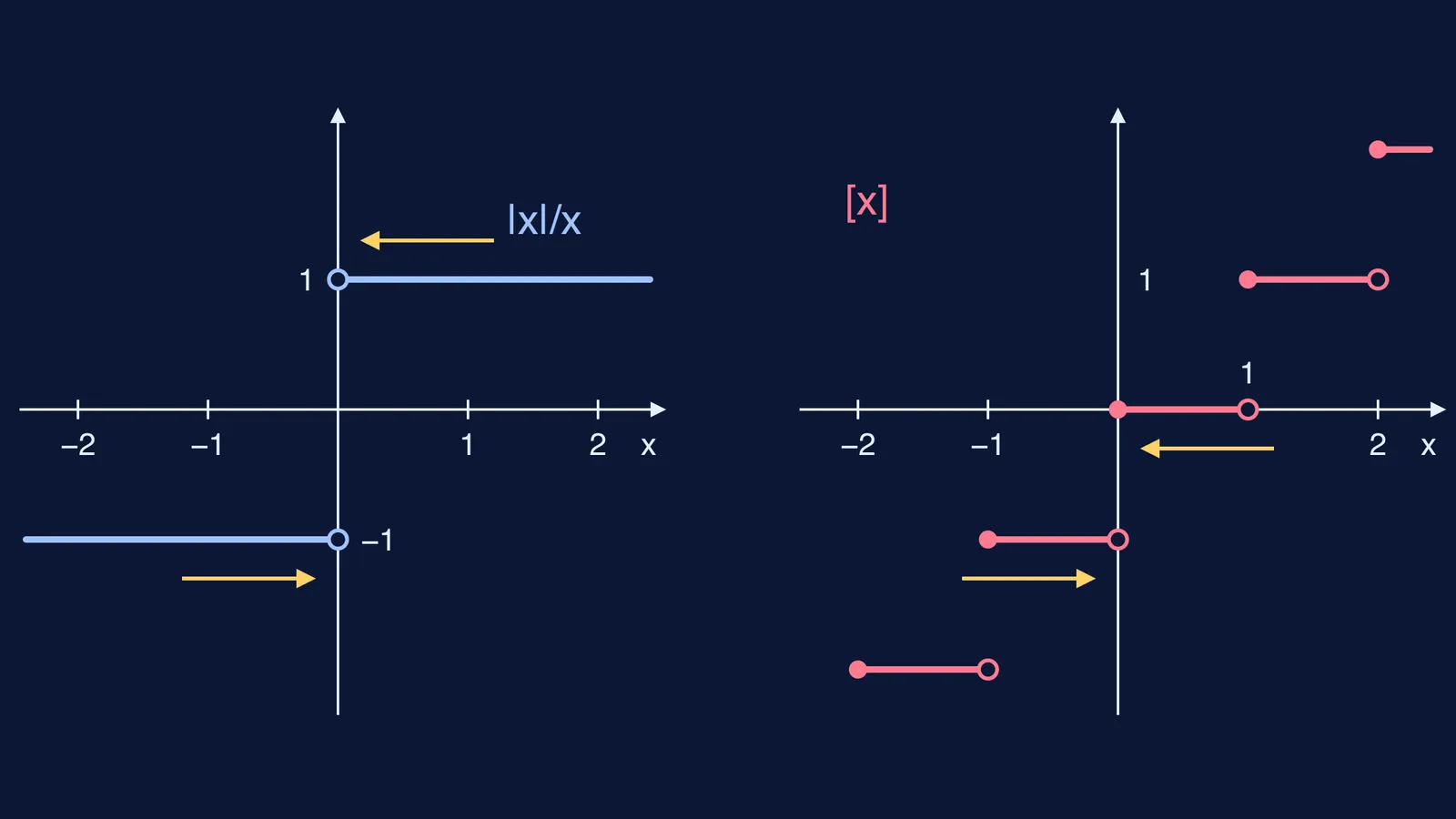
So the left hand limit is −1 and the right hand limit is 1. Since −1 ≠ 1, the limit of |x|/x as x → 0 does not exist. OpenStax works the same idea with |x − 2|/(x − 2) at x = 2 and gets −1 and 1.
The graph tells the story: two flat rays at heights −1 and +1, each ending in an open circle above and below the origin. (|x|/x is the signum function with the point x = 0 removed; our post on the signum function's graph and properties covers that function.)
What are the left and right hand limits of [x] at 0?
[x] is the greatest integer less than or equal to x. So [0.5] = 0, [0.001] = 0, [−0.001] = −1 and [−0.5] = −1.
For −1 ≤ x < 0, [x] = −1. The left hand limit at 0 is −1.
For 0 ≤ x < 1, [x] = 0. The right hand limit at 0 is 0.
The two disagree, so the limit of [x] as x → 0 does not exist.
Notice the trap: [0] = 0 is defined, so it is tempting to substitute and write "limit = 0". The value at a point and the limit at that point are different questions. The same reasoning gives a general result: at any integer n, the left hand limit of [x] is n − 1 and the right hand limit is n. At a non-integer such as 2.5, both sides give 2, so the limit exists. Our post on the limit of the greatest integer function takes this further.
How do you check a limit with a table of values?
NCERT uses the table method in its Limits and Derivatives chapter: for f(x) = x + 10 at x = 5, it takes x values closing in from each side (4.9, 4.95, 4.99, 4.995 and then 5.001, 5.01, 5.1) and watches where f(x) heads. OpenStax recommends the same check, then confirming on a graph.
For |x|/x near 0:
x = −0.1, −0.01, −0.001 gives −1, −1, −1.
x = 0.001, 0.01, 0.1 gives 1, 1, 1.
For [x] near 0:
x = −0.1, −0.01, −0.001 gives −1, −1, −1.
x = 0.001, 0.01, 0.1 gives 0, 0, 0.
Two sides, two different numbers: no limit. Never put x = 0 itself in the table.
What should you practise next?
Try these before you look anything up. Answers are at the end.
Left and right hand limits of |x − 3|/(x − 3) at x = 3.
Left and right hand limits of [x] at x = 2.
Limit of [x] at x = 1.7.
Left and right hand limits of x + |x|/x at 0.
A quick checklist for every one-sided limit question:
Where does the formula change? (Zero of the modulus, integer for [x].)
Write the simplified formula on each side.
Find each one-sided limit separately.
Compare: equal means the limit exists; unequal means it does not.
If you get one wrong and cannot see why, the Fermi Problem Library has worked problems with a step-by-step solver that explains the reasoning rather than printing an answer. For the idea behind it, the Fermi Concept Library covers every concept in mathematics, each with its own lesson. And for subtler cases where a limit fails, read when a limit does not exist.
Answers: (1) −1 and 1, no limit. (2) 1 and 2, no limit. (3) 1. (4) −1 and 1, no limit.