

On this page
For a mathematical limit to exist as x approaches a specific point, the function must settle on a single, predictable real number. In the current CBSE Class 12 mathematics exam, calculus accounts for 35 out of 80 marks CBSE Syllabus 2024-25. A core part of that foundational calculus knowledge is knowing exactly when a limit fails to exist, which is often written simply as "DNE" in textbooks and exam marking schemes.
When does a limit not exist?
According to OpenStax Calculus Volume 1, if the functional values do not approach a single real-number value, the limit does not exist.
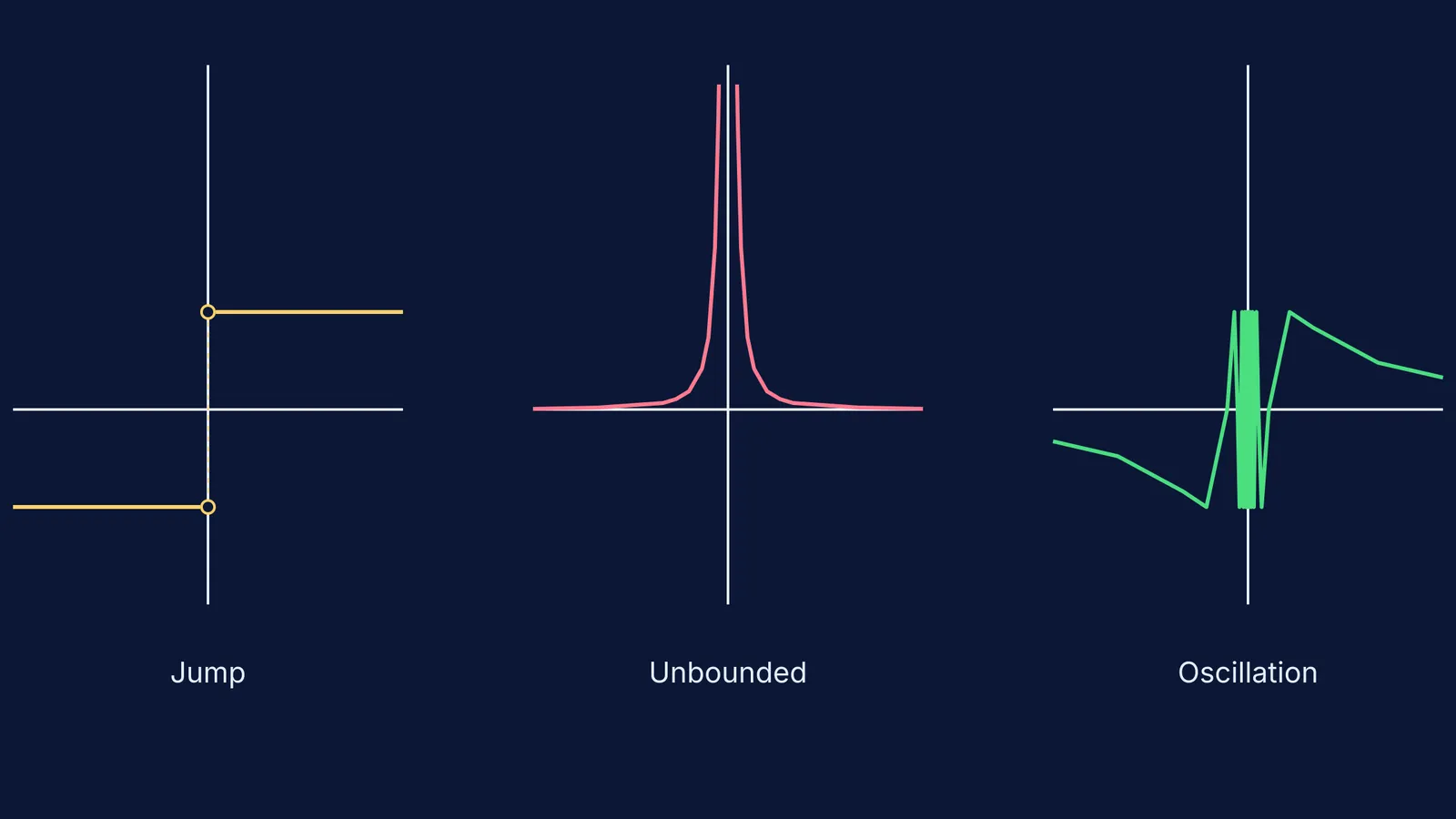
This mathematical breakdown typically happens in one of three ways: the function jumps abruptly from one value to another, it grows infinitely large in the positive or negative direction, or it oscillates endlessly without ever settling. Knowing which one you are looking at is the very first step in evaluating limits, because if you try to apply standard algebraic tricks to a limit that fundamentally does not exist, you will waste valuable time during an exam.
What are examples of unequal one-sided limits?
A standard two-sided limit only exists if the left-hand limit and the right-hand limit are strictly equal. If a function approaches one value as you come in from the left and a completely different value as you come in from the right, the overall limit does not exist.
The classic textbook example of this behaviour is the function f(x) = |x|/x evaluated at x = 0.
For any negative number, no matter how close it is to zero, the expression |x|/x simplifies exactly to -1. Therefore, the left-hand limit is -1.
For any positive number, the expression simplifies exactly to 1. Therefore, the right-hand limit is 1.
Because -1 is not equal to 1, the function has a severe jump discontinuity at zero. You will also see this in piecewise functions. For instance, if a tax rate changes at exactly ₹500,000, the graph jumps, and there is no single limit at that exact boundary. If you are struggling to picture these kinds of abrupt jumps, check the Fermi Concept Library for every concept in physics, chemistry, biology, mathematics and computing, each with its own lesson and its place in the map.
You can also read more about this specific behaviour in our guide on Removable and jump discontinuities: telling them apart.
Why does unbounded growth mean the limit does not exist?
When a function's values increase or decrease without bound as x approaches a point, the vertical line at that point is defined as a vertical asymptote.
Consider the function f(x) = 1/x² as x approaches 0. As you plug in smaller numbers like 0.1, 0.01, or 0.001, the output explodes to 100, 10,000, and 1,000,000. The closer your input gets to zero, the larger the function grows, shooting upwards forever. It is often written as lim (x→0) 1/x² = ∞ as a shorthand to describe this dramatic, explosive behaviour.
However, infinity is a direction of growth, not a real number. Because the function does not settle on a finite, numerical value, the limit technically does not exist. The same principle applies if the function plunges towards negative infinity, such as f(x) = -1/x².
How does endless oscillation break a limit?
Some mathematical functions never settle down, no matter how microscopic your view of the target point becomes. Instead, they vibrate violently between two extremes. The most famous example taught in advanced calculus classes is f(x) = sin(1/x) as x approaches 0.
As x gets closer and closer to 0, the value of 1/x grows incredibly rapidly. Because the standard sine function repeats a full wave every 2π, this rapidly growing input forces the sine wave to complete full cycles faster and faster. Between x = 0.1 and x = 0, the function oscillates between -1 and 1 infinitely many times. Because it never homes in on a single, stable number—and you cannot trap its output in a small window—the limit simply does not exist.
How to check limits in your exam?
When you face a difficult limit problem in JEE Main, JEE Advanced, or a board exam, run this quick diagnostic checklist before you start attempting heavy algebra or applying L'Hôpital's rule:
Test both sides: Try plugging in numbers from both the left and the right sides. Do they point to the exact same target? If not, you have a jump discontinuity, and the limit does not exist.
Check for division by zero: Does the numerator stay a non-zero number while the denominator shrinks to zero? That indicates unbounded growth. The graph has a vertical asymptote, and the limit will not exist as a real number.
Look for wild periodic behaviour: Does the function involve a trigonometric term like a sine or cosine of a fraction that explodes as you approach the limit point? That indicates endless oscillation.
If your exam throws an unfamiliar mathematical expression at you, targeted practice helps you spot these specific patterns. The Fermi Problem Library features worked problems with a step-by-step solver that explains the reasoning rather than printing an answer. This helps you identify these three failure cases long before you lose marks in a high-pressure test. Finally, do not forget to learn the standard algebraic shortcuts for cases where limits do exist, such as Limits of the form 1^∞: the e-power shortcut for JEE.


