On this page
India's operating power reactors come in three designs, and two of them share a single site. NPCIL says it operates 24 power reactors with an installed capacity of 8,780 MW (NPCIL projects overview). In NPCIL's table of all plants, 20 of those 24 are pressurised heavy water reactors (PHWRs). The other four are the odd ones out, and they are a good lesson in how the same physics can be plumbed in different ways.
What type of reactor is Kudankulam?
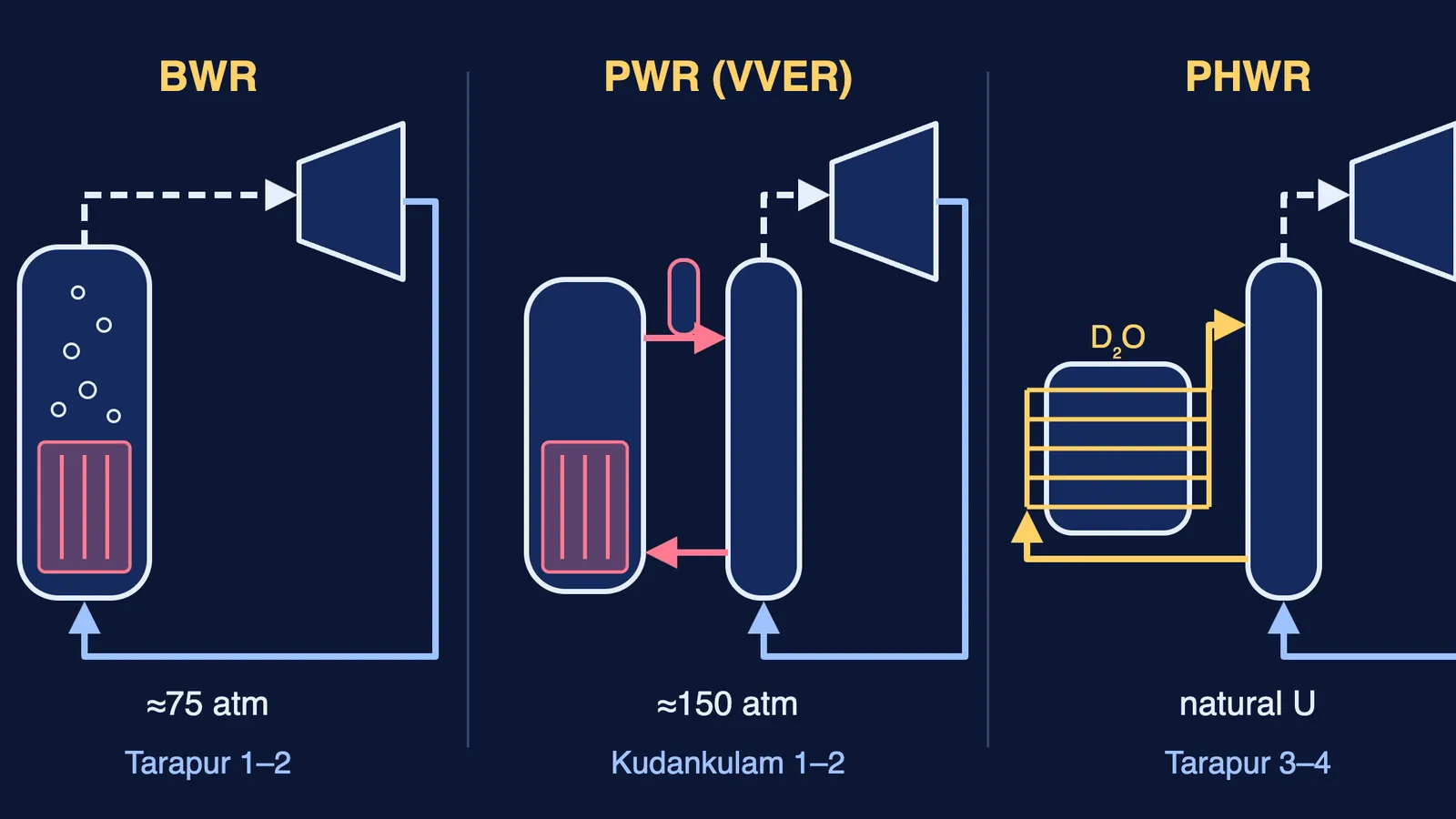
Kudankulam runs pressurised water reactors (PWRs) of the Russian VVER-1000 design. NPCIL lists Unit 1 and Unit 2 as VVER-1000 PWRs of 1,000 MWe each, in commercial operation from 31 December 2014 and 31 March 2017 (NPCIL, Kudankulam operating performance). The same page spells out VVER as a water-cooled, water-moderated energy reactor.
The project grew from an intergovernmental agreement on nuclear plant construction signed on 20 November 1988, according to a press release from Rosatom's digital press office, which also reported in July 2024 that the first two units had delivered 100 billion kWh to India's grid. NPCIL lists four more 1,000 MW units, Kudankulam 3 to 6, as under construction (NPCIL projects overview).
In a PWR, ordinary water carries heat out of the core and is kept at about 150 times atmospheric pressure so it does not boil, even at about 325°C (World Nuclear Association, nuclear power reactors). That hot water flows through a steam generator, where it boils the water in a second, separate circuit, and that steam drives the turbine.
Why does Tarapur boil its water?
Tarapur Units 1 and 2, in Maharashtra, are boiling water reactors (BWRs) of 160 MWe each, in commercial operation since 28 October 1969 (NPCIL, Tarapur operating performance). The World Nuclear Association's India country profile says they were built by GE on a turnkey contract, and its table gives them the earliest grid-connection dates of any reactor operating in India. The same profile notes both units went into a long outage for refurbishment in 2020; Tarapur 1 restarted in December 2025 and Tarapur 2 received approval to restart in May 2026.
A BWR has no steam generator. Its water runs at a lower pressure, about 75 times atmospheric, so it boils in the core at about 285°C, and the steam passes through separators and then directly to the turbines (World Nuclear Association). One loop instead of two means the steam that spins the turbine has just come out of the reactor core, so the same page notes the turbine must be shielded.
If the chain reaction itself is still hazy, start with how control rods keep a chain reaction steady.
What is a pressurised heavy water reactor?
Tarapur's newer Units 3 and 4 are PHWRs of 540 MWe each, in commercial operation from 2006 and 2005 (NPCIL, Tarapur operating performance). So one site holds both ends of India's reactor history.
A PHWR uses natural uranium oxide, with 0.7% U-235, as fuel, and heavy water (D2O) as both coolant and moderator (World Nuclear Association). Light water reactors such as PWRs and BWRs use enriched uranium, commonly to 3.5-5.0%; the same page explains that natural uranium needs a more efficient moderator than ordinary water, which in a PHWR is heavy water. In a PHWR the fuel sits in several hundred horizontal pressure tubes running through a tank called the calandria, and this design lets the reactor be refuelled progressively without shutting down.
India adopted the PHWR design in 1964, and its 220 MWe units were designed and built by NPCIL based on a Canadian design (World Nuclear Association, India).
If the word moderator still feels abstract, the Fermi Concept Library has its own lesson for every concept in physics and chemistry, so you can pin down what a moderator does before comparing designs.
How can you tell India's reactor types apart?
Ask three questions, in this order:
Does the water boil inside the reactor vessel? If yes, it is a BWR.
If not, is the coolant ordinary water or heavy water? Ordinary water means a PWR, and VVER is the Russian PWR. Heavy water means a PHWR.
Is the fuel enriched or natural uranium? Enriched points to a light water reactor; natural points to a PHWR.
Worked example: Kudankulam Unit 1.
Boiling in the vessel? No. The water is held at high pressure and boils only in the steam generator.
Coolant? Ordinary water.
Fuel? Enriched uranium oxide, the fuel the World Nuclear Association lists for PWRs.
Answer: a PWR, specifically the VVER-1000 design.
Now try Tarapur 1 and Tarapur 3 yourself; you should land on a BWR and a PHWR. For a reactor squeezed into a hull, read how INS Arihant, India's nuclear submarine, works, and for heat turned into rotation without a reactor, see the gas turbine power plant and its Brayton cycle.
If you want to work through a reactor question step by step, Fermi's AI tutor can draw the figure and check your understanding as it goes.