On this page
INS Arihant is India's first indigenously built nuclear-powered submarine, and it was commissioned into service in August 2016, according to the International Panel on Fissile Materials. It is the lead boat of the Indian Navy's Arihant class of nuclear-powered ballistic missile submarines (Wikipedia: INS Arihant). What keeps it working underwater is Class 11 and 12 physics: fission, heat engines, pressure and Archimedes' principle.
How does a nuclear submarine work?
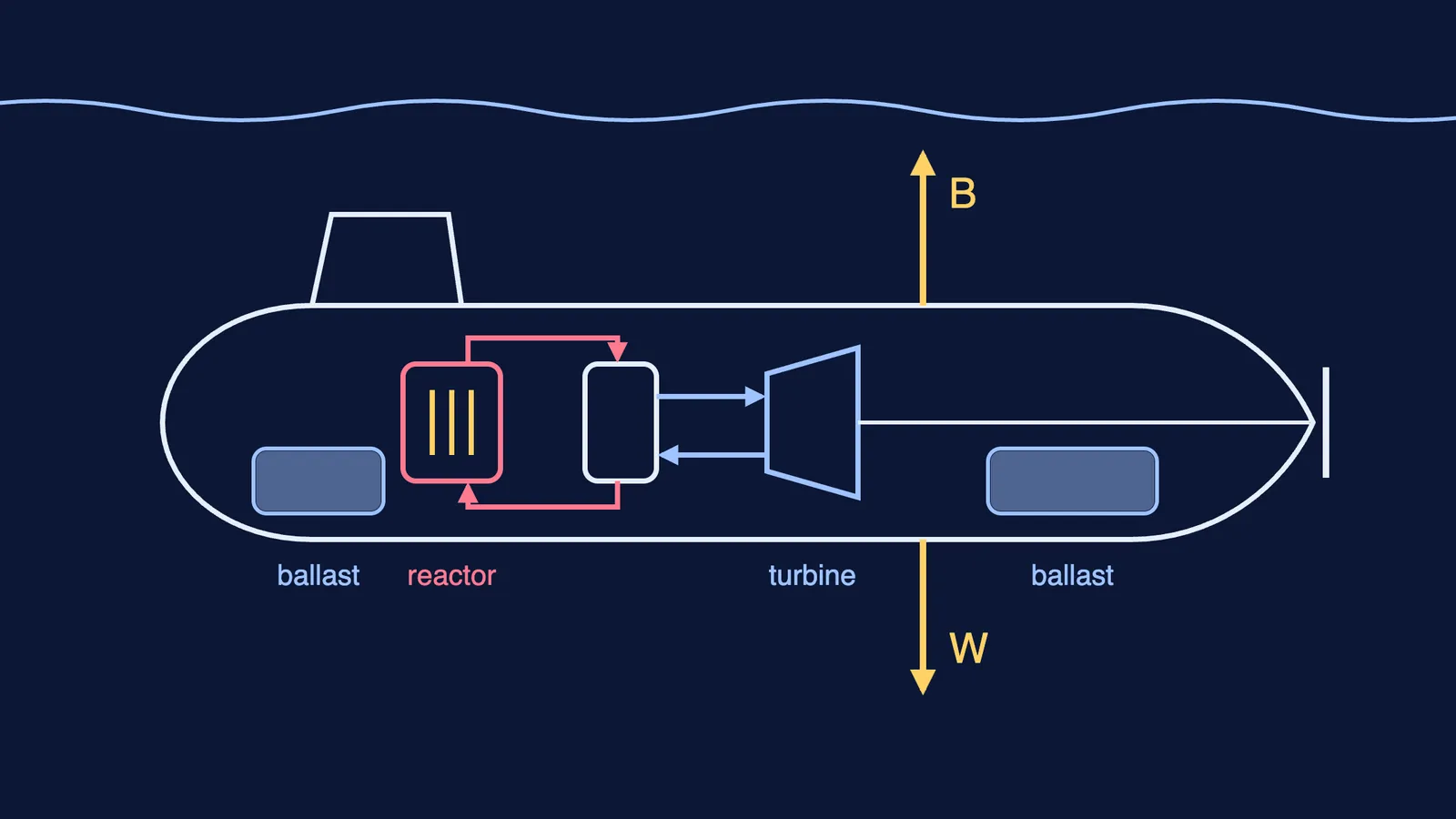
A pressurised water reactor (PWR) is a reactor in which pressurised water in a primary loop carries heat from the core to a steam generator, where it boils water in a separate secondary loop (US Nuclear Regulatory Commission). The steam then spins a turbine. Almost every naval reactor ever built has been a pressurised water type (World Nuclear Association).
In a typical power-station PWR, the primary loop is held at 15–16 megapascals, or 150–160 bar (Wikipedia: pressurised water reactor). That pressure keeps the water liquid while it heats from about 275 °C to about 315 °C on its way through the core (same source). It is the pressure-cooker idea: higher pressure, higher boiling point.
Published figures for INS Arihant's reactor differ slightly: the International Panel on Fissile Materials calls it an 83 MW pressurised water reactor, and the World Nuclear Association gives 85 MW. For the fission side, see how a nuclear reactor uses control rods and a moderator.
Why can a nuclear submarine stay underwater so long?
A diesel engine needs air; fission burns nothing, so nuclear propulsion is completely independent of air (Wikipedia: nuclear submarine).
The crew still has to breathe and drink. Nuclear submarines produce oxygen and fresh water from seawater by electrolysis and desalination (same source): 2H₂O → 2H₂ + O₂, the reaction from Class 10 chemistry.
Fuel is not the limit either. Naval reactors mostly run on highly enriched uranium and need refuelling only after 10 or more years (World Nuclear Association), and some submarines carry fuel for up to 30 years of operation (Wikipedia: nuclear submarine). What really limits time underwater is the crew's food supply and maintenance of the vessel (same source). INS Arihant's first deterrence patrol, completed in November 2018, lasted 20 days (Wikipedia: INS Arihant).
How does a submarine sink, rise and hover?
Archimedes' principle says the upward buoyant force on a body in a fluid equals the weight of the fluid it displaces. Once a submarine is fully under, its outer volume is fixed, so the buoyant force barely changes; our post on why buoyant force does not change with depth shows why. To go up or down, the boat changes its weight instead (Wikipedia: ballast tank):
To dive, the crew opens vents at the top of the main ballast tanks and valves at the bottom, and seawater floods in.
To surface, the crew shuts the vents and releases compressed air into the tanks, which pushes the water out.
To hover, depth control tanks pump water in or out for fine control, and water is moved between trim tanks to keep the boat level.
A fish does the same job with gas; compare it with how a swim bladder adjusts buoyancy at depth.
Worked example: how much water must the crew pump?
Take a round 6,000 tonnes for the submarine's mass, the surface displacement Wikipedia lists for INS Arihant. The submerged boat is heavier, but the method is the same. Average surface seawater has a density of 1,025 kg/m³, and it ranges from about 1,020 to 1,029 kg/m³ with temperature and salinity (Wikipedia: seawater).
Neutral buoyancy means buoyant force equals weight: ρVg = mg, so V = m/ρ.
V = 6,000,000 kg ÷ 1,025 kg/m³ ≈ 5,854 m³. That is the volume of water the hull displaces.
Now the boat moves into lighter water at 1,020 kg/m³.
The displaced water now has a mass of 5,854 × 1,020 ≈ 5,971 tonnes, about 29 tonnes less than the boat weighs.
So the crew must pump out roughly 29 tonnes of ballast water, or the submarine starts to sink.
Pressure rises by one atmosphere for every 10.06 m of depth (NOAA), so at 100 m the hull carries about 10 extra atmospheres. Check with p = ρgh: 1,025 × 9.8 × 100 ≈ 1.0 × 10⁶ Pa.
How do you revise this for JEE and boards?
One submarine touches four chapters:
Fluids (Class 11): Archimedes' principle and p = ρgh.
Thermodynamics (Class 11): the steam loop as a heat engine.
Nuclei (Class 12): fission, enriched uranium, control rods.
Electrochemistry: making oxygen by electrolysis.
Then explain the worked example aloud to someone at home, without notes. If you stall at step 4, the gap is Archimedes' principle, not arithmetic.
If buoyancy is hard to picture, the Fermi Simulation Lab has interactive simulations for ideas that are easier to see than to read. If you are not sure which chapter to start with, Fermi's AI tutor works out what you already know and builds a plan for the session.
Next time INS Arihant is in the news, explain in three sentences how it stays down.