On this page
No Krebs cycle reaction uses O2, yet textbooks file the cycle under aerobic respiration, and exam questions often ask students to explain why. The answer is a dependency chain, not a reaction: oxygen is needed one step later, and the cycle cannot run without that step.
Does the Krebs cycle use oxygen?
No, not directly. OpenStax Biology 2e states that the citric acid cycle produces very little ATP directly and does not directly consume oxygen.
What the cycle does make is reduced electron carriers. The same OpenStax section says each turn forms three NADH molecules and one FADH2 molecule, that the cycle releases two CO2 molecules and makes one GTP or ATP, and that it takes place in the matrix of mitochondria. If you want the full tally, our post on Krebs cycle products per turn counts them step by step.
Why is the Krebs cycle aerobic then?
OpenStax puts it in one line: the pathway is considered aerobic because the NADH and FADH2 it produces must transfer their electrons to the next pathway, which uses oxygen (OpenStax Biology 2e, section 7.3).
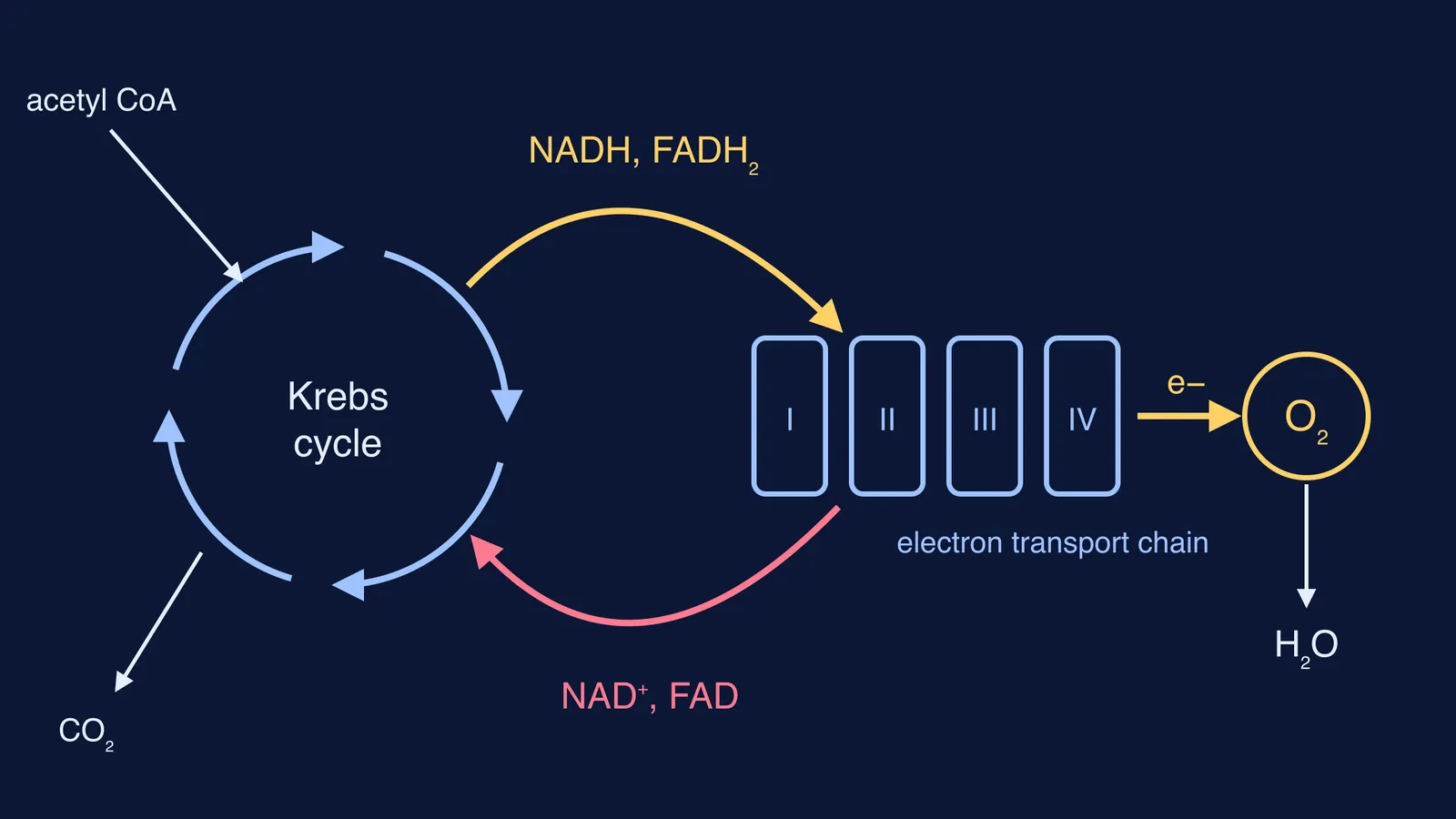
Here is the flow sketch to draw in your notes:
Krebs cycle: NAD+ and FAD pick up electrons and become NADH and FADH2.
Electron transport chain: NADH hands its electrons to complex I, and FADH2 hands its electrons to complex II.
Handing over the electrons turns NADH back into NAD+ and FADH2 back into FAD.
The electrons move down the chain to complex IV and end on oxygen, which picks up hydrogen ions to form water.
The fresh NAD+ and FAD go back to the Krebs cycle, and the next turn can start.
Oxygen is the final electron acceptor in the electron transport chain, according to OpenStax Biology 2e, section 7.4, which also describes NADH delivering electrons to complex I and complex II taking electrons from FADH2. Our explainer on the electron transport chain complexes I to IV walks through each one.
What happens to the Krebs cycle without oxygen?
It stalls. With no oxygen at the end of the chain, electrons have nowhere to go, NADH and FADH2 stay loaded, and the cycle soon runs out of NAD+ and FAD to accept new electrons.
An open biology textbook on LibreTexts says it plainly: the citric acid cycle cannot occur in the absence of oxygen because there is no way to regenerate the NAD+ it uses. The same page notes that the only part of aerobic respiration that physically uses oxygen is the electron transport chain.
Cells are not left completely stuck. OpenStax section 7.5 explains that fermentation uses an organic molecule to regenerate NAD+ from NADH, and that this lets glycolysis keep making ATP. Notice the limit: fermentation rescues glycolysis, not the Krebs cycle. Our comparison of alcoholic and lactic acid fermentation shows how yeast and muscle cells each do it.
Worked example: how much oxygen does one turn rely on?
You can put a number on the dependency using the per-turn counts from OpenStax section 7.3, the two-electron transfers in section 7.4 and the balanced equation for water formation.
One turn makes 3 NADH and 1 FADH2.
Each carrier delivers 2 electrons to the chain, so one turn sends 4 x 2 = 8 electrons.
At the end of the chain, O2 + 4 H+ + 4 electrons gives 2 H2O, so each O2 molecule takes 4 electrons.
So one turn needs 8 / 4 = 2 molecules of O2 before all four carriers are back as NAD+ and FAD.
That is the hidden oxygen bill of a cycle that never touches oxygen itself.
How do you write this answer in an exam?
For a two- or three-mark question, a four-step structure like this covers the key points:
State the fact: no reaction of the Krebs cycle uses O2 directly.
Name the products: the cycle reduces NAD+ and FAD to NADH and FADH2.
Give the link: these carriers are reoxidised only when they pass electrons to the electron transport chain, where O2 is the final electron acceptor and forms water.
Conclude: without O2, NAD+ and FAD are not regenerated, so the cycle stops. That is why it is called aerobic.
Self-check: draw the five-step flow sketch from memory. If you cannot draw the return arrow for NAD+ and FAD, that is the gap to fix.
If oxidation, electron carriers and the electron transport chain still feel separate, the Fermi Concept Library gives each biology concept its own lesson and its place in the map, so you can see how they connect. For practice, the Fermi Problem Library has worked problems with a step-by-step solver that explains the reasoning rather than printing an answer.