On this page
Every skeletal muscle can do three jobs: hold still, pull in or let out under control. Biology gives these jobs names (isometric, concentric and eccentric) and groups the last two together as isotonic. Because the words sound alike, students mix them up. Three everyday movements make the difference easy to see: a plank, a bicep curl and walking down the stairs.
What is the difference between isometric and isotonic contraction?
Ask one question: does the muscle change length while it works?
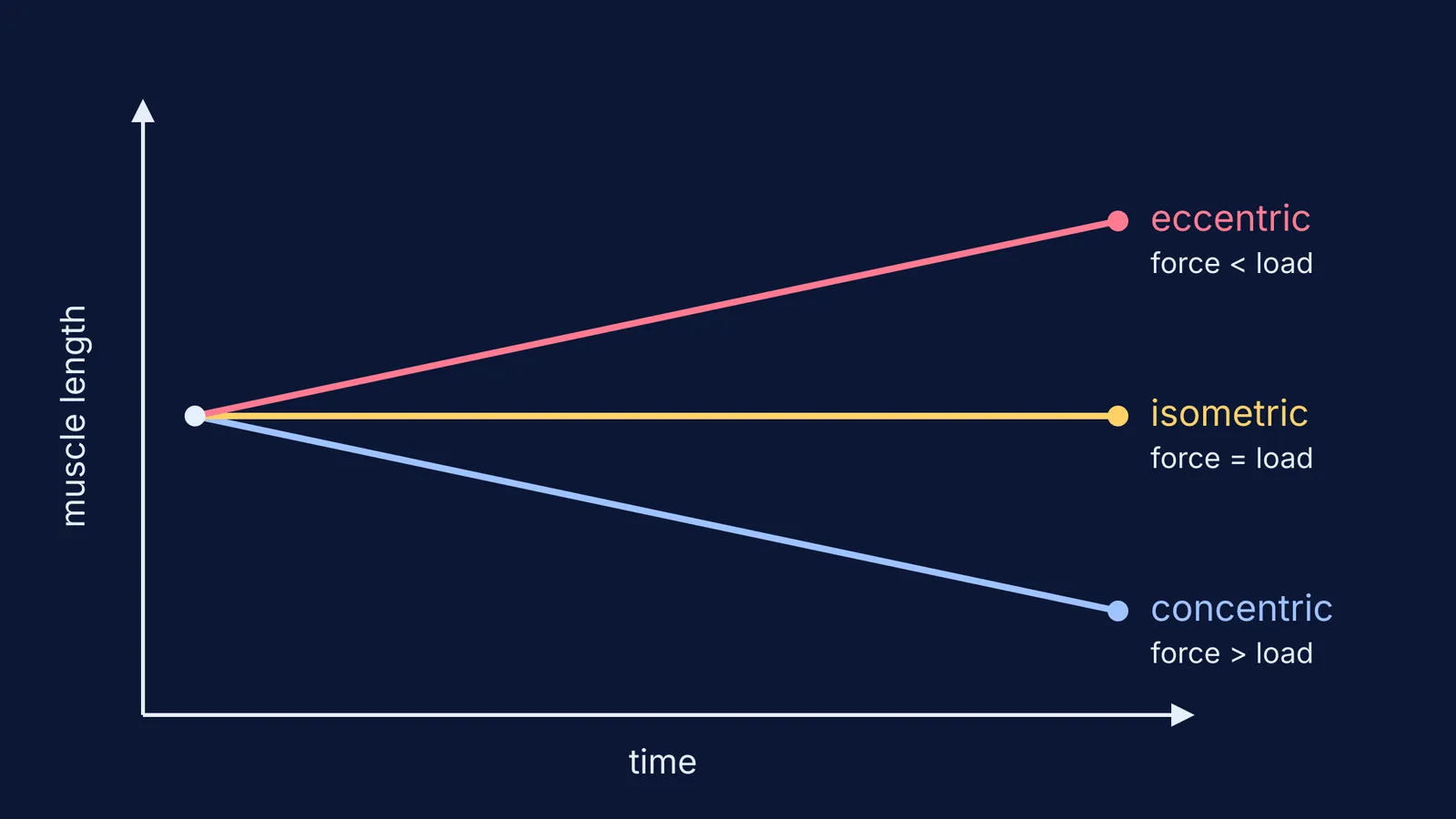
Isometric: the muscle length does not change during contraction, so the joint stays still (Padulo et al., Journal of Human Kinetics, 2013).
Isotonic: the muscle changes length while it works, and the same paper splits it into two types, concentric and eccentric.
Concentric: the muscle tension rises to meet the resistance, then the muscle shortens.
Eccentric: the muscle lengthens because the resistance is greater than the force the muscle is producing.
One honest note: isotonic literally means same tension, but in a real curl the force your biceps needs changes as your elbow angle changes. Padulo and colleagues point out that when A. V. Hill defined the terms in 1925, isotonic tension could stay the same or vary while the length changed. For your exams, read isotonic as length changes and the joint moves.
Plank, curl and stairs: which contraction is which?
The plank is isometric
In a plank your body is a straight line from head to heels. Your abdominal and hip muscles are working hard, which is why you start to shake, but nothing moves. The force of the muscles balances the pull of gravity on your hips, so their length stays the same. In physics terms they do no work on your body, because nothing is displaced, yet you still tire because the fibres keep using energy to hold tension.
The bicep curl is concentric, then eccentric
Lifting the dumbbell, your biceps shortens and pulls the forearm up: concentric, with muscle force greater than the load. Lowering it slowly, the biceps is still switched on but getting longer: eccentric. The common mistake is to say the triceps lowers the weight. Gravity does the lowering; the biceps is the brake. Our post on how the biceps and triceps work as an antagonistic pair explains which muscle relaxes when.
Walking downstairs is eccentric
Going up, the quadriceps at the front of your thigh shortens to straighten the knee and lift you: concentric. Going down, the same muscle lengthens as the knee bends, braking your body against gravity. A review in Frontiers in Physiology uses downhill running and walking down the stairs as the classic illustration of eccentric work by the knee extensors (Hody et al., 2019).
Why does walking downstairs feel easier but leave you sorer?
The same review gives three facts worth remembering (Hody et al., Frontiers in Physiology, 2019):
Muscles generate greater forces during eccentric contraction than in other contraction types at a given speed of movement.
The metabolic cost of eccentric exercise is approximately fourfold lower than the same exercise done concentrically.
Soreness after unaccustomed eccentric exercise typically appears 12 to 24 hours later, peaks between 24 and 72 hours, and fades within 5 to 7 days.
That is why a trek down a hill can leave your thighs aching two days later. Our explainer on why muscles ache the day after exercise covers what is going on.
How do you tell which type of contraction it is?
Use this three-step test on any movement:
Is the joint moving? If not, the contraction is isometric.
If it is moving, find the muscle working against the load: the one that would give way if it switched off.
Is that muscle getting shorter (concentric) or longer (eccentric)?
The length change you see at the joint comes from filaments sliding inside each sarcomere; our walk-through of the steps of muscle contraction follows it from nerve signal to cross-bridge. If sliding filaments are hard to picture, the Fermi Simulation Lab has interactive simulations for ideas that are easier to see than to read.
Quick quiz: sort these examples
Label each one isometric, concentric or eccentric for the main working muscle.
Holding a full school bag still at your side.
Standing up from a chair.
Sitting down slowly onto a chair.
Pulling your chin up to a bar.
Holding a wall-sit.
Running down a steep hill.
Slowly straightening your bent elbow to lower a heavy shopping bag.
Carrying a bucket of water up a flight of stairs.
Answers:
Isometric: 1 (grip and arm muscles) and 5 (quadriceps).
Concentric: 2 (quadriceps), 4 (biceps and back muscles) and 8 (quadriceps).
Eccentric: 3 (quadriceps), 6 (quadriceps) and 7 (biceps).
If you got a few wrong, the Fermi Concept Library gives every biology concept its own lesson and its place in the map, so you can go back to muscle structure before trying again.