On this page
On 1 October 2022, the Prime Minister launched 5G services in India at the India Mobile Congress, according to the Press Information Bureau release from that day. Each 5G band is also a physics lesson: a higher frequency means a shorter wavelength, more room for data and less reach.
Which frequency bands does 5G use in India?
In the 2022 spectrum auction, the government put 72,098 MHz of spectrum up for sale and sold 51,236 MHz, 71% of the total, for bids of Rs 1,50,173 crore, according to the Ministry of Communications release of 2 August 2022. The bands on offer were 600, 700, 800, 900, 1800, 2100, 2500 and 3300 MHz, plus 26 GHz.
For 5G, the same release picks out three bands and says what each is for:
Low band, 700 MHz: a large cell size, "a large range and good coverage", and less infrastructure needed. Reliance Jio bought a pan-India 10 MHz block here.
Mid band, 3300 MHz (3.3 GHz): "crucial in providing high throughput". All three existing operators bought spectrum in this band.
Millimetre wave, 26 GHz: "high throughput but very short range". The release expects it to serve captive or non-public networks, and notes that fixed wireless access, an alternative to fibre in crowded cities, is becoming popular in this band worldwide. All four bidders bought some.
The release adds that bids in the 800 to 2500 MHz bands were mainly to add 4G capacity and coverage, and that nobody bid for 600 MHz, whose device ecosystem it says is not yet developed for mobile phones.
What is the wavelength of each 5G band?
Every radio wave obeys the rule you already use for sound: speed equals frequency times wavelength, so λ = c/f. The speed of light in vacuum is exactly 299,792,458 m/s (NIST CODATA value). Our explainer on how wave speed, frequency and wavelength fit together walks through v = fλ step by step.
The worked example:
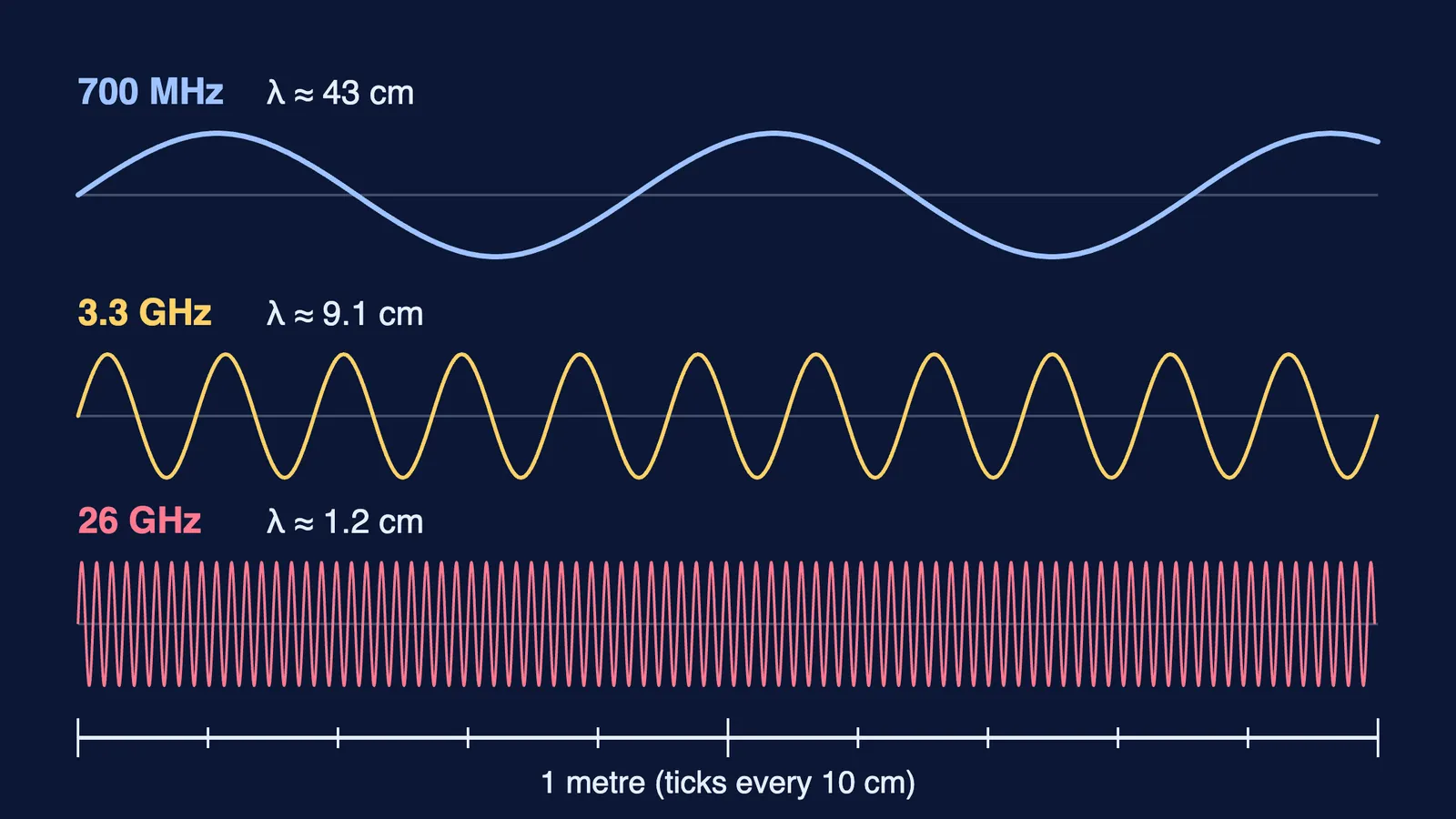
700 MHz: λ = 299,792,458 ÷ 700,000,000 ≈ 0.428 m, about 43 cm.
3.3 GHz: λ = 299,792,458 ÷ 3,300,000,000 ≈ 0.091 m, about 9 cm.
26 GHz: λ = 299,792,458 ÷ 26,000,000,000 ≈ 0.0115 m, just over 1 cm.
The 700 MHz wave is about 37 times longer than the 26 GHz wave. A wavelength of around ten millimetres is why 26 GHz is called a millimetre-wave band.
Why does a higher 5G band give more speed but less range?
Start with range. The International Telecommunication Union gives the free-space loss between two isotropic antennas (ideal antennas that send and receive equally in every direction) as Lbf = 20 log10(4πd/λ) dB, which it also writes as 32.4 + 20 log10 f + 20 log10 d, with f in MHz and d in km (ITU-R Recommendation P.525-5).
Put d = 1 km into that formula:
700 MHz: about 89.3 dB of loss.
3.3 GHz: about 102.8 dB.
26 GHz: about 120.7 dB.
The gap between 700 MHz and 26 GHz is 31.4 dB, so over the same kilometre, between isotropic antennas, the 26 GHz signal arrives about 1,400 times weaker. Between 700 MHz and 3.3 GHz the gap is 13.5 dB, about 22 times.
The ITU defines free space as a perfect vacuum, so these figures leave out everything in the way. Real streets add walls, trees and people; for an everyday example, see why mobile signal drops inside a lift.
Now speed. A channel carries more bits per second when it is wider, like a road with more lanes, and there is far more room higher up. A 1% slice of the spectrum around 26 GHz is 260 MHz wide; a 1% slice around 700 MHz is only 7 MHz. That fits the government release, which calls 3300 MHz crucial for throughput and 26 GHz high-throughput. Channel width also separates two radios that share one band, as in Bluetooth vs Wi-Fi range and power.
How do you explain 5G bands in a physics answer?
Use these four steps for any question that compares radio bands:
Convert each frequency to a wavelength with λ = c/f, keeping hertz and metres.
Compare wavelengths as a ratio, not a difference.
For range, use free-space loss from ITU-R P.525: at a fixed distance between isotropic antennas, every tenfold rise in frequency adds 20 dB, a factor of 100 in power.
For data rate, talk about bandwidth, not frequency alone.
Airtel bought spectrum in the 900 MHz band, according to the auction release. Work out its wavelength and its extra free-space loss compared with 700 MHz. You should get about 33 cm and about 2.2 dB.
If inverse-square spreading is hard to picture, the Fermi Simulation Lab has interactive simulations for ideas that are easier to see than to read. If waves feel shaky in general, Fermi's AI tutor can work out what you already know and build a plan for the session, so you start at the step you are missing.
Next time your phone switches to 5G, work out which band it might be on, and what its wavelength would be.