

On this page
You step into a lift mid-call, the doors slide shut, and by the third floor the line has gone silent. Your network is not having a bad day. You have walked into a metal box, and metal is very good at keeping radio waves out.
Why does mobile signal drop inside a lift?
Your phone talks to the tower with radio waves, which are electromagnetic waves like light, only with far longer wavelengths. In India's 2022 spectrum auction, operators bought spectrum in bands from 700 MHz to 3300 MHz, plus 26 GHz, according to the Press Information Bureau release on the auction.
A Faraday cage is an enclosure made of a continuous conducting sheet or a conducting mesh that blocks some electromagnetic fields (Faraday cage, Wikipedia). The same article notes that lifts and rooms with metal frames and walls behave like Faraday cages, creating dead zones for mobile phones and radios.
What happens when a radio wave hits a metal wall?
Reflection. The wave's electric field pushes on the free electrons in the metal. Their currents make a field that cancels the wave inside and sends most of its energy back out.
Absorption. The small part that does get in dies away quickly, and its energy ends up as heat in the metal.
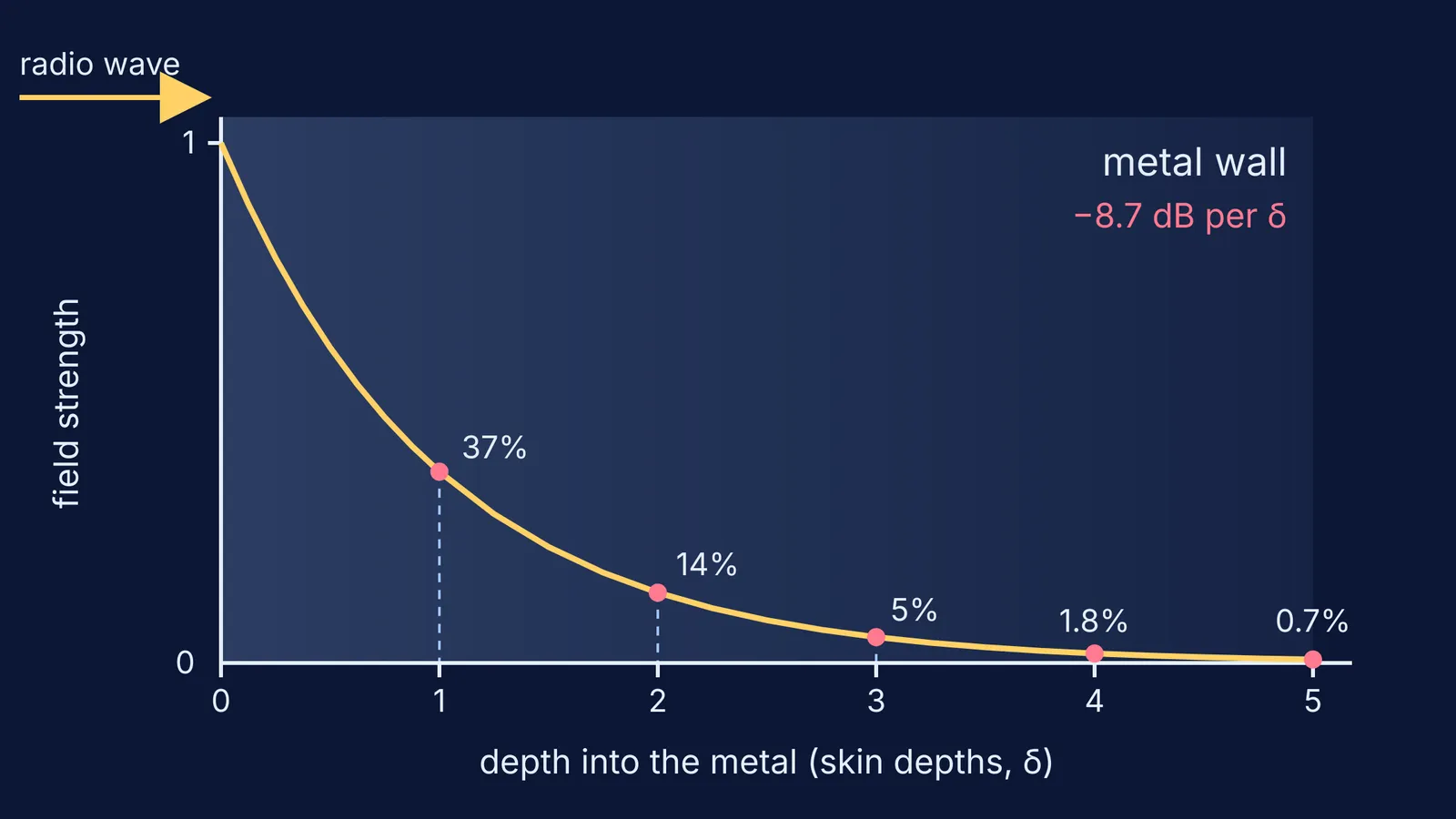
Skin depth is the distance over which a wave's electric or magnetic field inside a material falls to 1/e, about 37%, of its value (Ellingson, Electromagnetics II, LibreTexts/03%3A_Wave_Propagation_in_General_Media/3.12%3A_Skin_Depth)). For a good conductor it is δ ≈ 1/√(πfμσ), where f is the frequency, μ the permeability and σ the conductivity. A higher frequency or a better conductor means a thinner skin.
Each skin depth cuts the field to 37% of what it was, a loss of about 8.7 decibels (that is 20 × log₁₀ e). After five skin depths, less than 1% of the field is left. The diagram at the top of this page plots this curve.
How thick does the metal need to be?
Let us put numbers on it with aluminium, whose conductivity of about 3.7 × 10⁷ S/m is the value Ellingson uses in the same skin depth chapter/03%3A_Wave_Propagation_in_General_Media/3.12%3A_Skin_Depth).
Wavelength. λ = c/f, with c = 299,792,458 m/s (NIST). At 700 MHz, λ ≈ 43 cm. At 3300 MHz, λ ≈ 9 cm.
Skin depth. The chapter gives about 26 micrometres for aluminium at 10 MHz. Skin depth scales as 1/√f, and 700 MHz is 70 times higher, so δ ≈ 26 ÷ √70 ≈ 3.1 micrometres.
Count the skins. A 1 mm sheet is 1000 ÷ 3.1 ≈ 320 skin depths thick.
Add up the loss. 320 × 8.7 dB is roughly 2,800 dB. Absorption alone cuts the field that crosses the sheet to about 10⁻¹³⁹ of the field just inside its surface. In practice, that is zero.
Copper does even better: its skin depth at 1 GHz is about 2 micrometres (skin effect, Wikipedia). Through solid metal walls, nothing useful arrives.
Then why do you sometimes keep one bar?
A real lift is not a sealed box: it has gaps around the doors, ceiling vents, and sometimes glass or wooden panels. For a Faraday cage to work at high frequencies, its holes must be smaller than the wavelength of the wave (Faraday cage, Wikipedia). Gaps and openings let some signal leak in, and that leak is what can keep your phone clinging to a bar. Open the doors and you open a gap as wide as the doorway, so the signal usually returns.
The same physics explains why Wi-Fi is weaker through some walls and why you are safe inside a car during lightning. For the electrostatics side of the story, read why the field inside a Faraday cage is exactly zero.
Try it at home: a 10-minute Faraday cage test
You need two phones, kitchen aluminium foil and a steel dabba with a tight lid.
Note how many signal bars phone A shows in the open.
Wrap phone A in two layers of foil with no gaps and call it from phone B. Does it ring?
Open one corner of the foil about a finger's width and call again.
Put phone A in the steel dabba, press the lid on firmly and call. Then leave the lid slightly open and repeat.
Write down what happened each time in your notebook.
A call that fails when sealed but rings once you open a gap shows that gaps matter as much as the metal. Do not wrap a phone while it is charging, since it cannot shed heat, and never put a phone in a microwave oven.
Then explain your results in three sentences using the words reflection, absorption and skin depth. The Fermi Simulation Lab has interactive simulations for ideas that are easier to see than to read, and the Fermi Concept Library covers every concept in physics, chemistry, biology, mathematics and computing, each with its own lesson.
Next time the bars vanish at the lift door, you will know where they went: bounced off the walls, or turned to heat in the first few micrometres of metal.


