

On this page
If you place a hollow conductor in a strong uniform electric field, you might naturally expect the electrical force to push its way through the material. Instead, the interior of the cavity remains completely unaffected.
This effect, known as electrostatic shielding, is the reason passengers inside an airplane are perfectly safe from lightning strikes, and why sensitive medical scans require specially built rooms lined with copper [[1]](https://en.wikipedia.org/wiki/Faraday_cage). It is a direct consequence of how charges behave in a conductor when they reach equilibrium.
Why is the electric field zero?
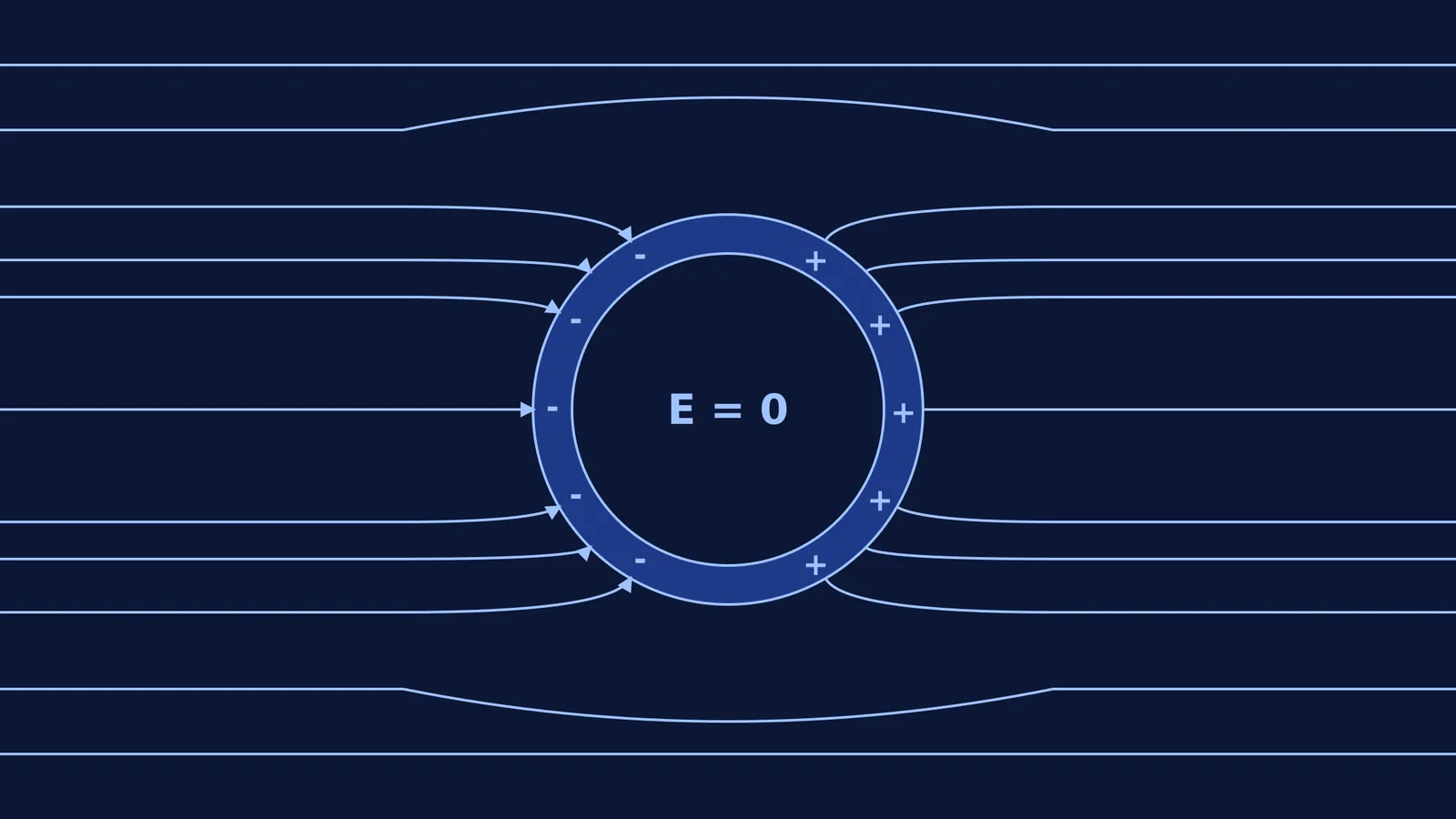
When a conducting shell is placed in an external electric field, the free electrons inside the metal immediately begin to move. If the external field points to the right, electrons, which carry a negative charge, are pulled to the left surface of the shell.
This migration of electrons leaves the right surface with a corresponding net positive charge. This redistribution of charge creates its own internal electric field, pointing from right to left, which directly opposes the original external field. The electrons will continue to move until the net force acting on them is zero. Therefore, the induced field perfectly cancels the external field everywhere inside the solid conductor.
Because the field inside the metal itself is zero, the entire shell acts as an equipotential surface. As you learn in Finding E from V: using E = −dV/dx with graphs and formulas, when the electrical potential is constant across a region, its gradient is zero. By definition, this means the electric field inside the hollow cavity is also exactly zero.
How did Faraday prove it in 1836?
While Benjamin Franklin had noticed in 1755 that an uncharged cork ball was unaffected inside a charged metal can, it was Michael Faraday who formally tested the limits of this shielding [[1]](https://en.wikipedia.org/wiki/Faraday_cage).
In 1836, Faraday built a room coated entirely in metal foil. He physically stepped inside the room with an electroscope and allowed high-voltage discharges from an electrostatic generator to strike the outside of the room [[1]](https://en.wikipedia.org/wiki/Faraday_cage). Despite the massive electrical activity outside, the electroscope detected absolutely no charge within the room. Faraday had conclusively proved that excess charge resides only on the outside surface of a conductor, leaving the interior shielded.
For a related physics problem dealing with potentials and multiple interacting shells, you can read our guide on Concentric spherical shells: charges, potentials and earthing one.
How do field lines cancel?
It can be difficult to picture exactly how thousands of surface charges arrange themselves to perfectly nullify an external force across a three-dimensional volume. In the Fermi Simulation Lab, you can drag a hollow conductor into a strong uniform field and watch the field lines respond in real time.
The interactive simulation shows how the external field lines bend to hit the outer boundary of the conductor at exactly 90 degrees, while the interior space goes completely blank as the induced charges form on the surface. If you get stuck on the underlying math or have trouble setting up the integrals for Gauss's law, Fermi's AI tutor can work out what you already know and build a plan for the session, allowing you to master the concept from first principles.
Where are Faraday cages used today?
The fundamental principle of the 1836 experiment is used everywhere to protect people, hardware, and critical data from electromagnetic interference:
MRI rooms: Magnetic resonance imaging scanners are incredibly sensitive devices. They are built inside complete Faraday cages to block stray external radio frequencies from corrupting the medical imaging data [[1]](https://en.wikipedia.org/wiki/Faraday_cage).
Aircraft and cars: A metal vehicle acts as a mobile Faraday cage. It guides the massive electrical currents of a lightning strike around the exterior hull, discharging them safely rather than passing them through the passenger cabin [[1]](https://en.wikipedia.org/wiki/Faraday_cage).
Microwave ovens: The metal grid embedded on the glass door acts as a partial Faraday shield. Because the holes in the mesh are much smaller than the wavelength of the microwaves, it keeps the radiation safely contained inside the cooking chamber [[1]](https://en.wikipedia.org/wiki/Faraday_cage).
Digital forensics: Police use specialized Faraday bags to store seized mobile phones, preventing remote wiping signals from reaching the devices [[1]](https://en.wikipedia.org/wiki/Faraday_cage).
Understanding this zero-field effect is a staple of JEE and NEET physics because it beautifully connects Gauss's law, potential gradients, and the physical behaviour of conductors in a single, highly testable concept.


