On this page
Bluetooth and Wi-Fi both carry data on radio waves, and both can use the same radio band. They still behave very differently, because they were built for different jobs. Bluetooth links a few nearby gadgets on very little battery. Wi-Fi builds a local network that moves a lot of data and connects you to the internet. Here is the physics, with a worked example.
What is the difference between Bluetooth and Wi-Fi?
Bluetooth uses the 2.4 GHz ISM band, from 2400 to 2483.5 MHz, according to the Bluetooth SIG's range guide.
The Bluetooth SIG's technology overview says Bluetooth Classic uses 79 channels spaced 1 MHz apart and Bluetooth Low Energy (LE) uses 40 channels spaced 2 MHz apart, with both hopping between channels. The same page lists data rates of 1 to 3 Mb/s for Classic and 125 kb/s to 2 Mb/s for LE.
Wi-Fi uses three bands, 2.4 GHz, 5 GHz and 6 GHz, and the Wi-Fi Alliance says Wi-Fi 7 works across all three. It adds that Wi-Fi 7's 320 MHz channels in the 6 GHz band give twice the throughput of Wi-Fi 6.
A 320 MHz Wi-Fi channel is 160 times as wide as a 2 MHz Bluetooth LE channel, and a wider channel can carry more bits each second. Bluetooth trades that capacity for low power: a narrow channel over a short link is enough to send audio to your earphones. For the step-by-step version, see how Bluetooth earphones get music from your phone.
Which has more range, Bluetooth or Wi-Fi?
Neither has one fixed range. The Bluetooth SIG says Bluetooth's reliable range runs from more than a kilometre down to less than a metre, depending on the radio, receiver sensitivity, transmit power, antenna gain and path loss.
Bluetooth supports transmit power from -20 dBm (0.01 mW) to +20 dBm (100 mW), according to the same Bluetooth SIG page.
The radio rules allow more than Bluetooth's 100 mW ceiling. In the United States, the rules for the 2400 to 2483.5 MHz band allow up to 1 watt of peak conducted output for digitally modulated systems such as Wi-Fi, under 47 CFR 15.247. India and other countries set their own limits.
So a Wi-Fi router can be built to transmit more power than any Bluetooth radio, but the range gap is smaller than the power gap.
Worked example: 100 times the power, 10 times the range
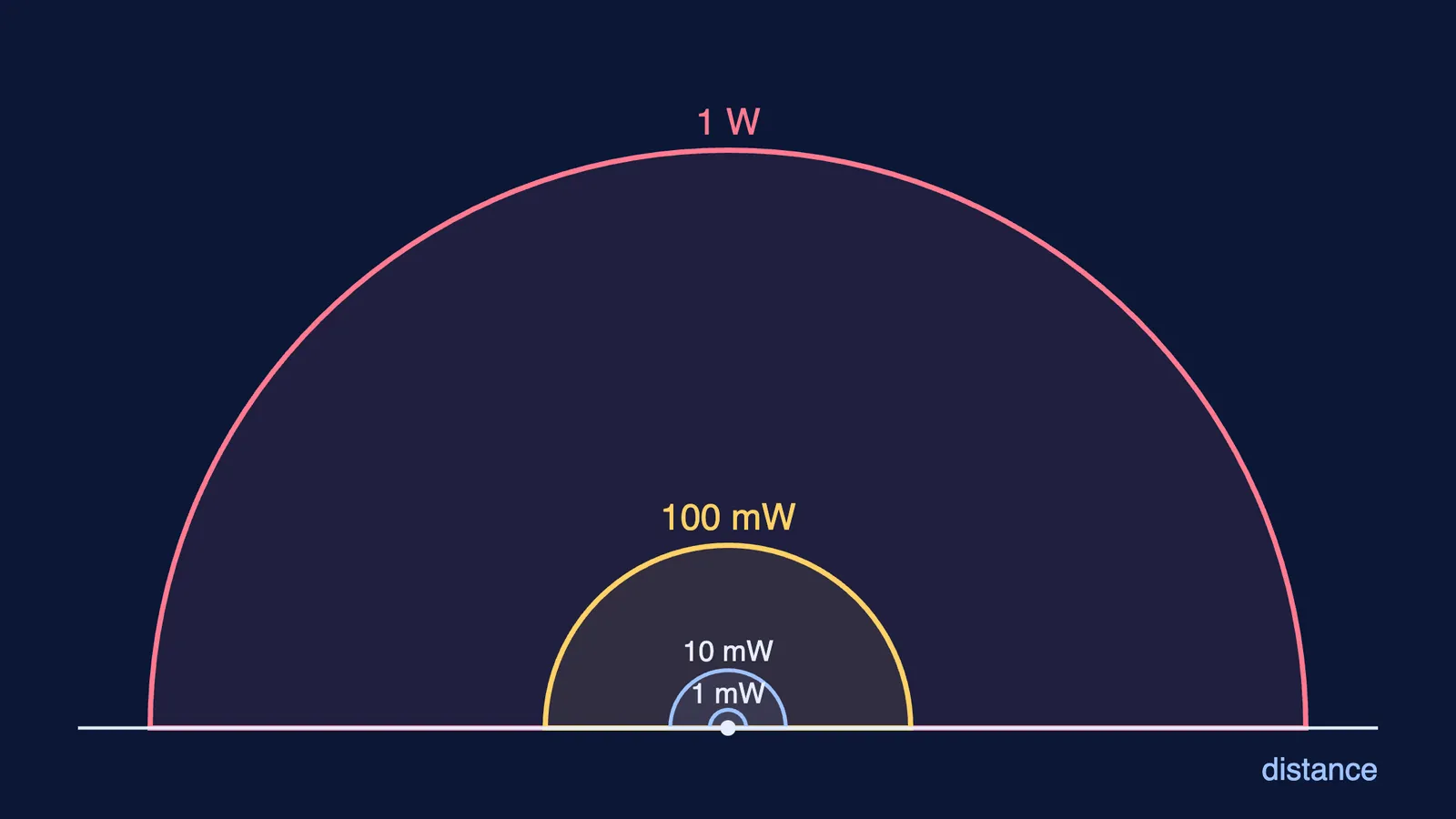
HyperPhysics states the inverse-square law: for a point source spreading equally in all directions, the intensity at radius r is the source strength divided by the area of the sphere.
Intensity at distance r is I = P / (4πr²).
A receiver needs some minimum intensity, I_min, to decode the signal.
Set P / (4πr²) = I_min and solve: r = √(P / 4πI_min). Range grows as the square root of power.
Going from 1 mW to 100 mW is 100 times the power, so range grows by √100 = 10 times.
Going from 100 mW to 1 W is 10 times the power, so range grows by √10, about 3.2 times.
This is the free-space ideal, drawn in the diagram above. Walls, furniture and bodies cut real range well below it. That is why earphones stutter when your phone sits in a back pocket, as we explain in why Bluetooth drops when your phone is behind your body.
Does frequency change how far a signal goes?
Yes. The speed of light is exactly 299 792 458 m/s (NIST), so λ = c / f gives:
2.4 GHz: about 12.5 cm
5 GHz: about 6.0 cm
6 GHz: about 5.0 cm
The Bluetooth SIG notes that lower frequencies give longer range but lower data rates. That is why a 5 GHz or 6 GHz network is usually faster near the router, while 2.4 GHz reaches further. The 2.4 GHz band is also crowded: Bluetooth, Wi-Fi and even microwave ovens share it, as our post on whether a microwave oven can disturb Wi-Fi explains.
If waves, wavelength and intensity are hard to picture from formulas alone, the Fermi Simulation Lab has interactive simulations for ideas that are easier to see than read.
Bluetooth or Wi-Fi: which should you use?
Match the link to the job:
Earphones, smartwatch, fitness band, wireless keyboard: Bluetooth. Small, steady data, and battery life matters most.
Online classes, video lectures, downloading mock tests: Wi-Fi. You need high data rates and internet access.
Weak signal in a far room: try the 2.4 GHz Wi-Fi network, because lower frequencies reach further, or move the router higher and away from thick walls.
Earphones cutting out: keep the phone on the same side of your body as the earphones.
To revise electromagnetic waves and the inverse-square law, the Fermi Concept Library covers every concept in physics, chemistry, biology, mathematics and computing.