

On this page
Phone in your back pocket, and the song in your earbuds stutters. Nothing is broken: you have put a lot of water between two antennas, and water soaks up the frequency Bluetooth uses.
Why does Bluetooth cut out when the phone is behind your body?
Bluetooth Classic and Bluetooth Low Energy both use the 2.4 GHz band, from 2.402 to 2.480 GHz, according to the Bluetooth SIG technology overview. Divide the speed of light by 2.4 GHz and you get a wavelength of about 12.5 cm.
Up to 60% of an adult human body is water, according to the US Geological Survey. That matters because, as a 2013 study of human tissue in the journal Sensors puts it, the dielectric properties and penetration depth of tissue at these frequencies are "strongly correlated with its water content."
The effect has been measured. In a 2018 paper in Sensors, Łukasz Januszkiewicz reported that when a human body is close to a 2.4 GHz wireless sensor, path loss may increase by 10 dB up to 20 dB and could exceed the fading margin of the link. In his indoor measurements, one person standing between the antennas raised the median path loss from 53 dB to 63 dB, and two people raised it to 68 dB.
Every 10 dB is a factor of ten in power, so 20 dB of extra loss leaves your earbud about one hundredth of the power it had a moment ago.
Why does water absorb 2.4 GHz radio waves?
A water molecule is a tiny electric dipole, slightly positive at one end and slightly negative at the other. In his article Physics of the microwave oven in Physics Education, Michael Vollmer explains that at GHz frequencies the molecules' inertia and their interactions with neighbours make them lag behind the oscillating electric field, and that lag absorbs power from the wave. Physicists call this dielectric loss due to dipole relaxation.
Vollmer's graph shows this loss in pure water at 20 °C peaking around 20 GHz, and he notes that dissolved salt ions also react with the field and add heating of their own. The wave's energy is turned into heat, the same physics we explain in how a microwave oven heats food from the inside.
Not all tissue is equal. The 2013 Sensors study lists muscle at 2.4 GHz with a relative permittivity of 52.7 and a conductivity of 1.77 S/m, but fat at only 5.3 and 0.11 S/m. Fat holds less water, so radio waves cross it more easily.
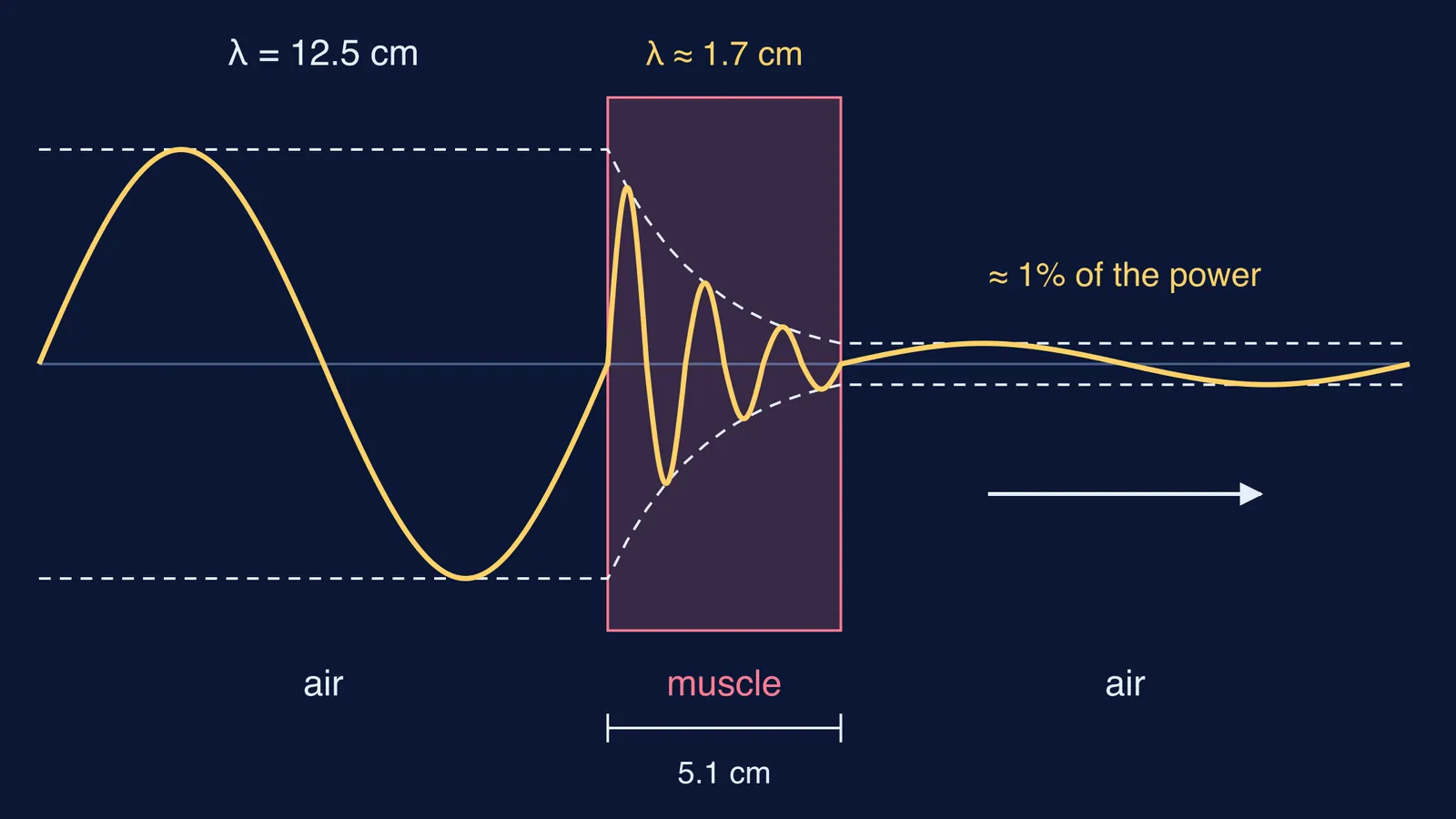
Worked example: how much does 5 cm of muscle weaken the signal?
Take the muscle values from the 2013 Sensors study: relative permittivity εr = 52.7, conductivity σ = 1.77 S/m, frequency f = 2.4 GHz.
Angular frequency: ω = 2πf ≈ 1.51 × 10¹⁰ rad/s.
Loss tangent: σ / (ωε₀εr) = 1.77 / (1.51 × 10¹⁰ × 8.85 × 10⁻¹² × 52.7) ≈ 0.25.
Attenuation constant: α = (ω/c) × √(εr/2) × √(√(1 + 0.25²) − 1) ≈ 50.3 × 5.13 × 0.177 ≈ 46 per metre.
The field falls to 1/e (about 37%) every 1/α ≈ 2.2 cm. In decibels that is 8.69 × α ≈ 4 dB per centimetre.
Through 5 cm of muscle the loss is about 20 dB, so roughly 1% of the power that entered gets out.
Run the same steps for fat and you get about 0.8 dB per centimetre and a 1/e depth of about 11 cm, close to the 113 mm penetration depth the study gives for fat at 2.45 GHz.
A torso holds far more than 5 cm of water-rich tissue, so a wave going straight through would be almost entirely absorbed. Yet the measured extra loss is only 10 to 20 dB. That suggests most of the signal reaching your ear goes around your body or bounces off walls, not through you.
Exponential decay inside a material is hard to picture from a formula. The Fermi Simulation Lab has interactive simulations for the ideas that are easier to see than to read. If permittivity or dielectric still feel fuzzy, the Fermi Concept Library has a lesson for every concept in physics.
How do you stop your earbuds cutting out?
Keep the phone in a front or shirt pocket, so less of your body sits on the direct path to your ears.
If one earbud drops more than the other, carry the phone on that side.
In a crowded metro coach, other people add loss too: in the 2018 Sensors study, two people between the antennas raised the median path loss by 15 dB.
Wi-Fi shares the 2.4 GHz band and follows the same rules, as we explain in why Wi-Fi is weaker through walls.
To see what happens to the music before it leaves your phone, read how Bluetooth earphones get music from your phone.


