

On this page
When you press play, your phone does not send sound to your earbuds. It sends numbers, squeezed small, carried on a radio wave about 12 cm long. Each step is Class 12 electromagnetic waves.
How do Bluetooth earphones receive music without wires?
Think of it as five hand-offs:
Digital audio. The song is stored as a list of numbers, one for each moment of the sound wave.
Compression. A codec shrinks that list so it fits through the radio link. Classic Bluetooth audio uses SBC; the newer LE Audio uses LC3, which the Bluetooth SIG's technical overview of LC3 describes as giving higher quality at the same data rates as SBC.
Radio. The phone's chip turns the bits into a radio wave. Classic Bluetooth uses Gaussian frequency shift keying (GFSK), according to MathWorks' comparison of Bluetooth BR/EDR and LE. In this scheme, each bit nudges the wave's frequency slightly up or down.
Reception. In the earbud, the wave's changing electric field pushes electrons back and forth in a tiny antenna. A receiver tuned to the right channel reads those small frequency shifts as 1s and 0s.
Sound. A decoder rebuilds the numbers, a converter turns them into a changing current, and a tiny speaker turns that into pressure waves. Our explainer on how a speaker turns electricity into sound covers that last step.
What frequency does Bluetooth use, and how long are the waves?
Bluetooth uses the 2.4 GHz ISM band, with channels from 2.402 to 2.480 GHz, according to the Bluetooth SIG's technology overview. Classic Bluetooth splits this into 79 channels spaced 1 MHz apart; Bluetooth Low Energy uses 40 channels spaced 2 MHz apart. The overview lists a maximum transmit power of 100 mW (+20 dBm).
Wavelength is speed divided by frequency: λ = c / f. The speed of light in vacuum is exactly 299,792,458 m/s, according to NIST's CODATA value.
At 2.402 GHz: λ = 299,792,458 / 2,402,000,000 ≈ 0.1248 m, or about 12.5 cm.
At 2.480 GHz: λ ≈ 0.1209 m, or about 12.1 cm.
It is the band from our post on why a microwave oven can disturb Wi-Fi at 2.4 GHz. For the full spectrum, see our guide to electromagnetic waves, the spectrum, and E and B.
Why doesn't Wi-Fi drown out your music?
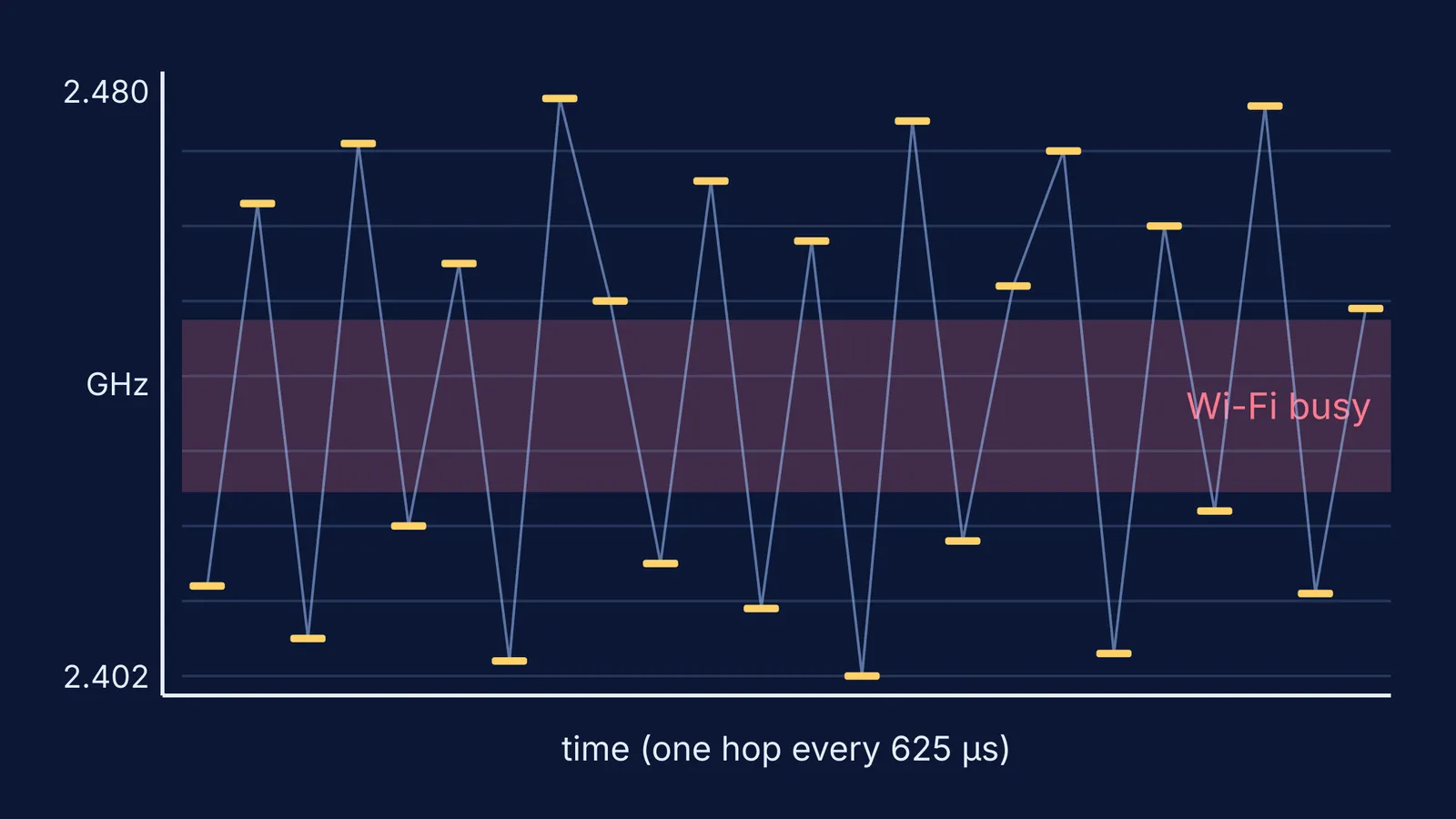
Wi-Fi and microwave ovens share that band, so Bluetooth keeps moving. Each channel's centre frequency is 2402 MHz plus k times 1 MHz, where k runs from 0 to 78, according to a Rohde & Schwarz application note on adaptive frequency hopping. Once connected, a classic Bluetooth link can hop between channels up to 1,600 times a second, the same note says.
At that top rate, there is one hop every 1/1,600 s, or 625 microseconds, the length of one time slot in the note. Adaptive frequency hopping, added in Core Specification version 1.2, watches for busy or poor channels and drops them from the pattern, keeping at least 20 channels in use, the note adds. If a Wi-Fi router is filling part of the band, your earbuds mostly stop landing there.
How much does the music get squeezed?
The Bluetooth SIG's LC3 overview gives the formula: uncompressed bit rate = sampling rate × bit depth × number of channels. Try it for stereo sound sampled at 48 kHz, one of the rates LC3 supports, at 16 bits per sample:
48,000 × 16 × 2 = 1,536,000 bits per second, or about 1.5 Mbps.
In the same LC3 overview, SBC at 345 kbps scored just above 4.0 on the ITU-R listening scale, and LC3 scored higher at 160 kbps, less than half the bit rate. Dividing gives you the squeeze:
SBC: 1,536 ÷ 345 ≈ 4.5 times smaller.
LC3: 1,536 ÷ 160 ≈ 9.6 times smaller.
Why bother? The basic classic Bluetooth radio carries 1 Mb/s and the faster LE mode carries 2 Mb/s, according to MathWorks' comparison. Raw 1.5 Mbps audio would not fit the first and would fill most of the second, leaving little room to resend lost data.
Try it: five questions to test your understanding
Answer these on paper, using figures from the Rohde & Schwarz note and MathWorks. Answers follow.
What is the centre frequency of channel k = 39?
What is its wavelength, to the nearest millimetre?
At the top hop rate, how long does one hop last?
At that rate, how many hops happen in a 3-minute song?
Why do earbuds need a codec at all?
Answers: 1. 2402 + 39 = 2441 MHz. 2. 299,792,458 / 2.441 × 10⁹ ≈ 0.1228 m, so 123 mm. 3. 625 microseconds. 4. 180 s × 1,600 = 288,000 hops. 5. Uncompressed stereo at 48 kHz and 16 bits needs about 1.5 Mbps, more than the basic classic radio's 1 Mb/s.
A hopping wave is easier to grasp when you can see it move. The Fermi Simulation Lab has interactive simulations for ideas that are easier to see than to read.


