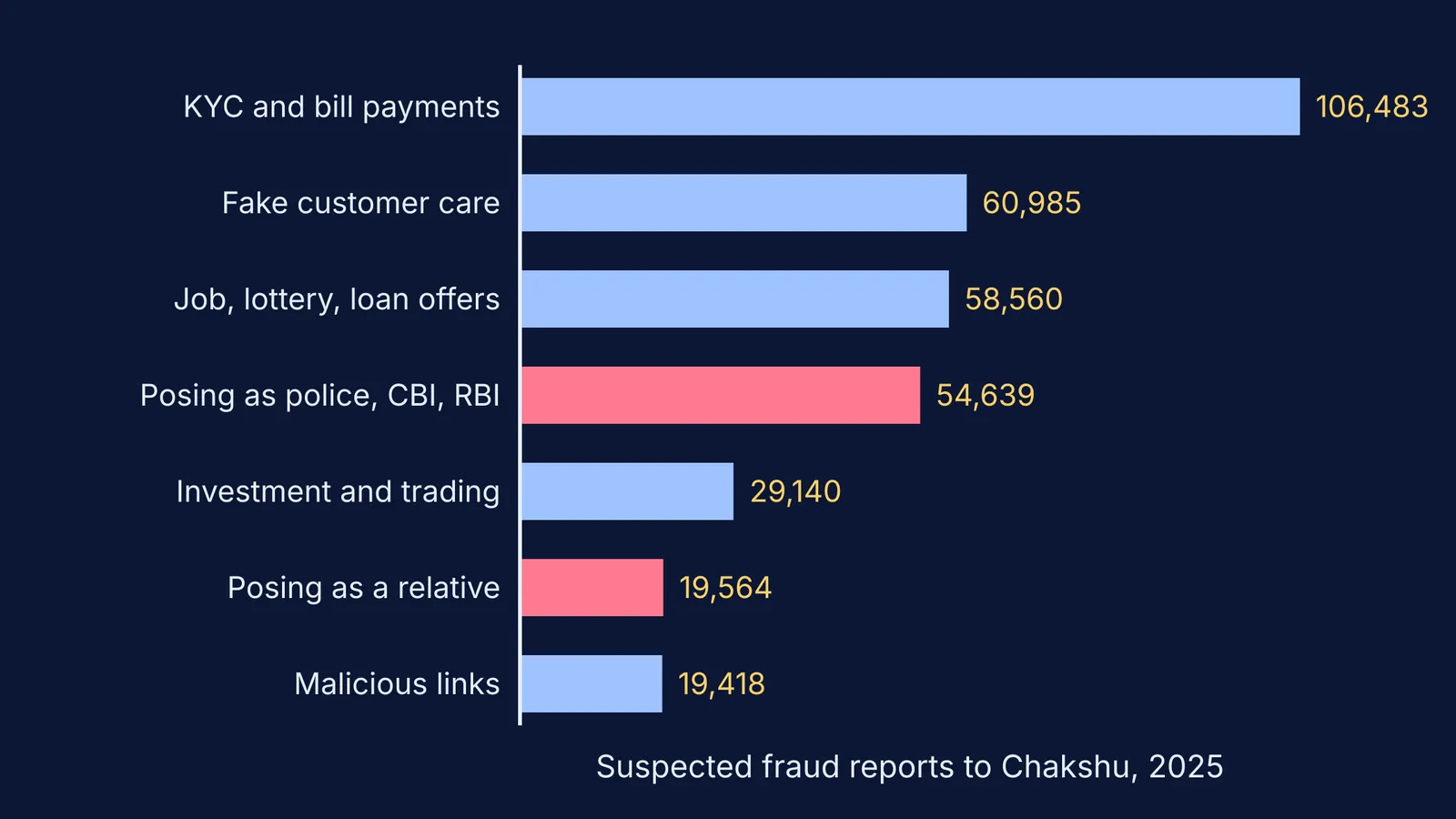
On this page
If your online class freezes whenever someone heats milk, you are not imagining it. A microwave oven and a 2.4 GHz Wi-Fi router send radio waves of almost the same frequency.
Why does a microwave oven interfere with Wi-Fi?
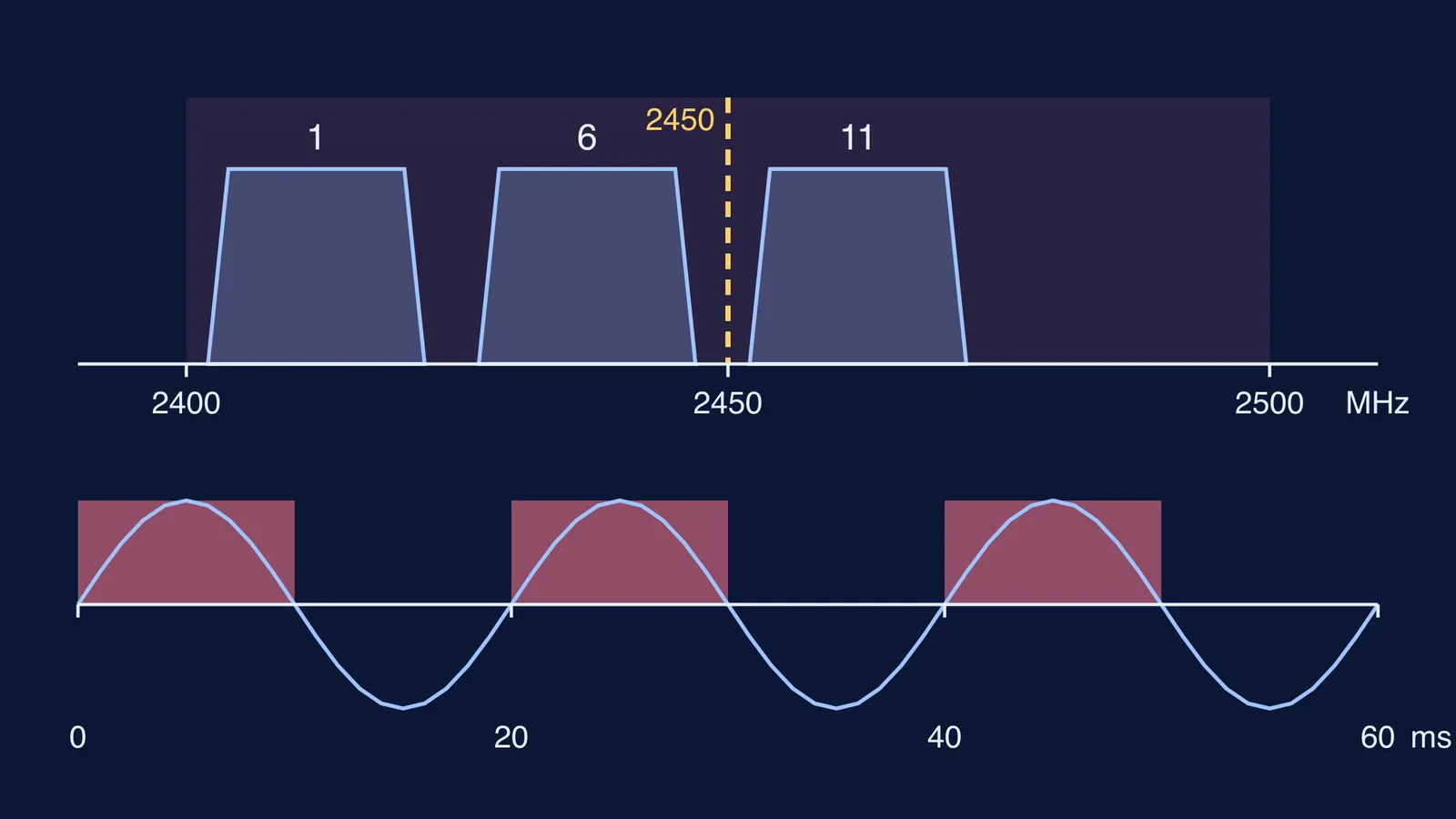
US rules for industrial, scientific and medical (ISM) equipment such as ovens set aside 2,450 MHz ± 50 MHz, which covers 2,400 to 2,500 MHz (FCC rules, 47 CFR Part 18). The rules permit such equipment "unlimited radiated energy in the band specified for that frequency".
2.4 GHz Wi-Fi sits right inside that range. Channel 1 is centred on 2,412 MHz, channel 6 on 2,437 MHz and channel 11 on 2,462 MHz, each with a nameplate width of 20 MHz (list of WLAN channels).
The oven's metal box and mesh door keep almost all of its microwaves inside, but not all. A US federal standard limits leakage to 5 milliwatts per square centimetre at about 2 inches (5 cm) from the oven surface (US FDA). That limit is set for human safety. A Wi-Fi receiver is built to pick out very faint signals, so a small leak on its own frequency is like a shout while you strain to hear a whisper.
For what happens inside the oven, see how a microwave oven heats food from the inside.
Why does Wi-Fi slow down instead of cutting out?
Partly because the oven is not really on all the time. In a 1998 paper for the IEEE 802.11 group that writes the Wi-Fi standard, Jim Zyren of Harris Semiconductor summarised US government (NTIA) measurements of fourteen ovens (IEEE 802.11-98/240). The interference had roughly a 50% duty cycle with a 16.7 ms period on US 60 Hz power, because the magnetron that makes the microwaves runs during only half of each mains voltage cycle. The oven's frequency also sweeps across typically about 50 MHz of the band. For the frequency-hopping radios of the time, the paper found that short packets could still get through between bursts.
Wi-Fi responds by waiting, resending and slowing down, so you see buffering or a blocky call.
Bhaskaran Raman, a scientist at AirTight Networks writing on the CWNP blog, describes large throughput drops "usually starting from channel 6 and getting worse towards channel 11", effects felt as far as 100 feet (about 30 m) from a running oven, and newer inverter ovens that can disturb the whole 2.4 GHz band, including channel 1 (CWNP).
India's grid runs at a nominal 50 Hz (National Grid of India), so the rhythm here is slightly slower.
What does this have to do with the electromagnetic spectrum?
Both are electromagnetic waves travelling at c = 3 × 10^8 m/s, so λ = c/f gives the wavelength:
Oven: λ = (3 × 10^8) / (2.45 × 10^9) ≈ 0.122 m, about 12 cm.
Wi-Fi channel 6 (2,437 MHz): λ = (3 × 10^8) / (2.437 × 10^9) ≈ 0.123 m.
The two wavelengths differ by less than a millimetre, so a receiver tuned to one hears the other. Wavelength also shapes how Wi-Fi travels indoors; see why Wi-Fi is weaker in some rooms and through walls.
A caution for exams: "interference" here means unwanted noise in a receiver, not the fringes of Young's double-slit experiment, where two coherent waves add and cancel.
If waves, frequency and wavelength still feel abstract, the Fermi Simulation Lab has interactive simulations for ideas that are easier to see than to read.
How can you test it at home?
Write down your prediction first.
Connect a phone to your router's 2.4 GHz network, stand about 1 m from the oven and run a speed test with the oven off.
Put a cup of water inside (some ovens should not run empty) and run the oven for one minute. Repeat the test.
Repeat at about 3 m, and in another room.
If your router has a 5 GHz network, switch to it and repeat steps 1 and 2.
If 2.4 GHz slows near the running oven but 5 GHz stays steady, you have seen the shared band at work.
How do you stop a microwave from disturbing Wi-Fi?
Use the 5 GHz network near the kitchen, as the CWNP article recommends.
Keep the router out of the kitchen, so the oven is not between router and desk.
Stuck on 2.4 GHz with a conventional oven? Try channel 1, which that article says avoids conventional (not inverter) ovens.
Do not start a timed mock test or live class when the family heats lunch.
A healthy door matters for safety too (US FDA advice).
Metal inside the oven is a different problem; see why metal sparks inside a microwave oven.