On this page
How to Tell Wild Animals is a short comic poem by the American writer Carolyn Wells, and it is one of the ten poems listed under First Flight in the CBSE English Language and Literature syllabus for 2026-27. You can read it in Chapter 3 of the NCERT First Flight textbook. It looks like a field guide to seven animals in six stanzas, but it is really one joke told six times.
What is How to Tell Wild Animals about?
The speaker pretends to teach you how to identify, or "tell", dangerous animals. Each stanza names an animal and gives you a simple test. The catch is that most of the tests work only once the animal is already attacking you. You recognise the lion by its roar while you are dying, and the tiger by whether it eats you. The advice is useless, and that is the point.
How does the poet tell each animal apart?
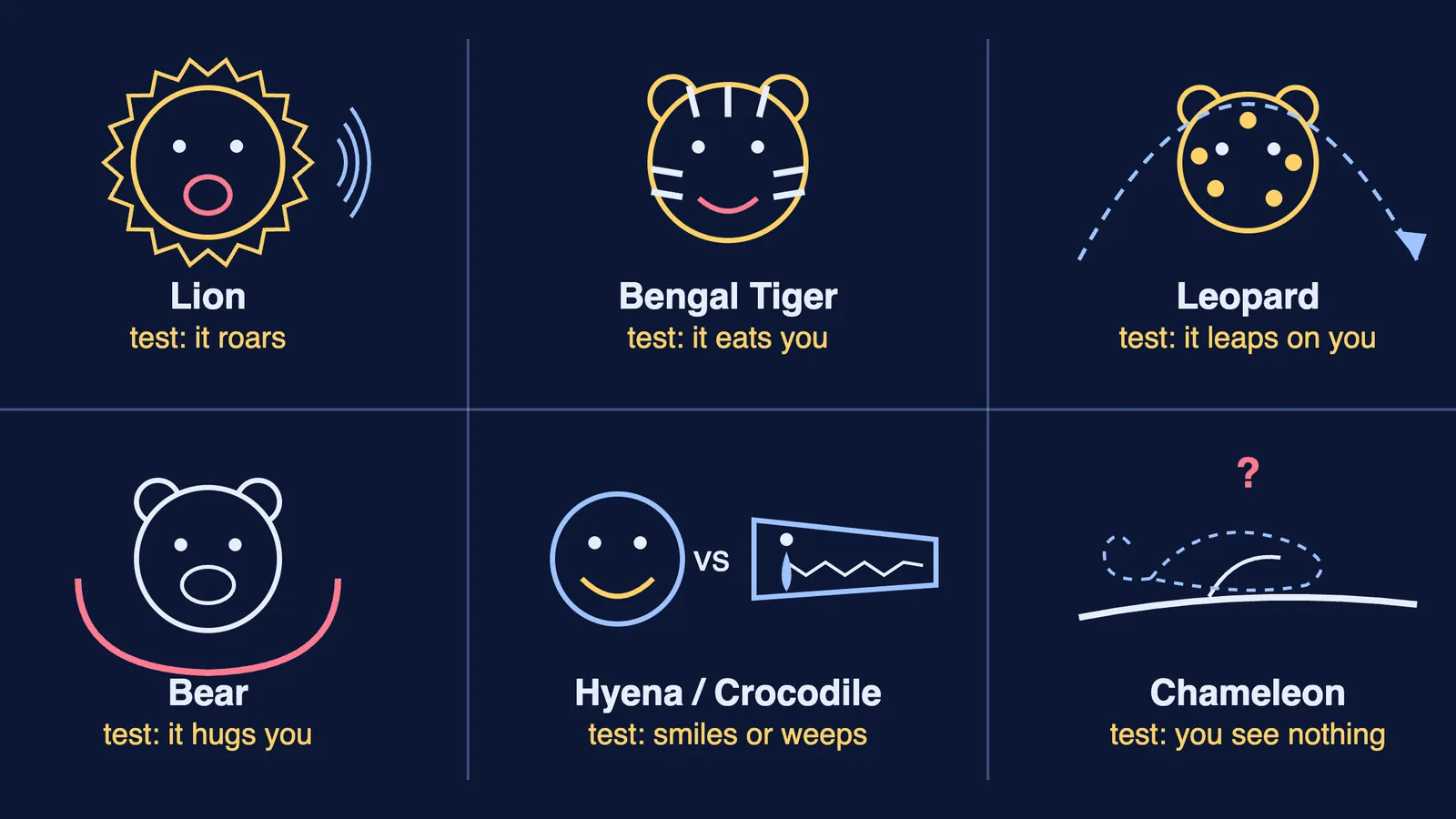
Here is the poem's "test" for each animal, in plain words:
Asian Lion: a big tawny animal comes at you in an eastern jungle. If it roars as you die, it was the lion.
Bengal Tiger: a striped animal greets you. Check whether it eats you.
Leopard: a spotted animal jumps on you. Crying out will not help; it simply jumps again.
Bear: something in your yard hugs you very hard. If you are unsure, it will hug you once more, which the poet calls a "caress".
Hyena or Crocodile: hyenas arrive smiling; if the animal is crying, it is a crocodile.
Chameleon: a small lizard with no ears and no wings. If you look at a tree and see nothing, that is the chameleon.
What poetic devices are in How to Tell Wild Animals?
Rhyme scheme: each six-line stanza rhymes ababcc. The closing couplet carries the punchline, like the last line of a joke.
Poetic licence: Wells bends English to fit rhyme and rhythm. She shortens "dying" to "dyin'" so it sounds closer to "lion", spells leapt as "lept" and leap as "lep", so both echo the sound of Leopard. The line "A novice might nonplus" bends grammar (the usual form is "a beginner might be puzzled") so that it rhymes with "thus".
Irony and dark humour: the tone is calm and helpful, but the advice gets you killed. The bear's crushing hug is called a gentle touch.
Repetition: the leopard will "lep and lep again", which makes the attack feel endless.
To check device names in your notes, our guide on checking AI's figures of speech in NCERT poems shows how. The neighbouring poem A Tiger in the Zoo treats a big cat seriously, which makes a good contrast question.
Which parts are jokes and which are real biology?
The poem is comedy, not zoology, so never use it in a science answer. Still, some jokes touch things scientists have studied.
Crocodile tears: In a 2007 study reported by the University of Florida, five of seven captive caimans and alligators (close relatives of crocodiles) shed tears while eating. They were not sad; the cause is still uncertain.
The laughing hyena: The spotted hyena's "giggle" is a real call, and a 2010 study in BMC Ecology found it can carry information about a hyena's age, identity and social rank. The study suggests the call matters in social interactions, not that the hyena is amused.
The invisible chameleon: Chameleons do not vanish. A 2015 Nature Communications study showed panther chameleons change colour by tuning a layer of tiny guanine crystals in their skin, mainly during contests and courtship.
The Asian Lion: India's wild Asiatic lions live in Gujarat, where the 2025 count put the population at 891, according to Mongabay India.
If one of these makes you curious, the Fermi Concept Library covers every concept in physics, chemistry, biology, mathematics and computing, so you can read the real science separately from the poem.
How do you answer exam questions on this poem?
In the 2026-27 CBSE paper, a poetry extract carries 5 marks and each First Flight short answer (40-50 words) carries 3. Questions usually ask about the humour, one animal's "rule", or why the poet bends the language. Use three steps:
Point: name the device or idea in one sentence.
Proof: give the animal or line it appears in, in your own words, with at most a few quoted words.
Purpose: say what effect it creates (surprise, comedy, rhythm).
Worked example. Question: what effect do the odd spellings in the leopard stanza have? Answer: Wells uses poetic licence, spelling words the way they might be spoken (point). In the leopard stanza the clipped forms echo the sound of Leopard, and the second one returns in the final couplet (proof). The odd spelling adds to the sing-song tone, so the attack feels comic rather than frightening (purpose).
For a comparison question, read our explanation of Amanda!, another poem built on a repeated pattern.