On this page
A Tiger in the Zoo is the poem that comes right after the Nelson Mandela chapter in NCERT's Class 10 English textbook First Flight. It was written by Leslie Norris (1921–2006), a Welsh poet and short story writer. Its whole point is one contrast: the tiger the zoo shows you, and the tiger nature made.
What is A Tiger in the Zoo about?
The poem has five stanzas of four lines each, and NCERT's note above the poem says it moves from the zoo to the jungle and back to the zoo. Stanzas 1, 4 and 5 describe the tiger in his cage. Stanzas 2 and 3 use "He should be..." to imagine where he belongs. That "should" is the poem's argument: the cage is wrong.
What does each stanza mean in simple words?
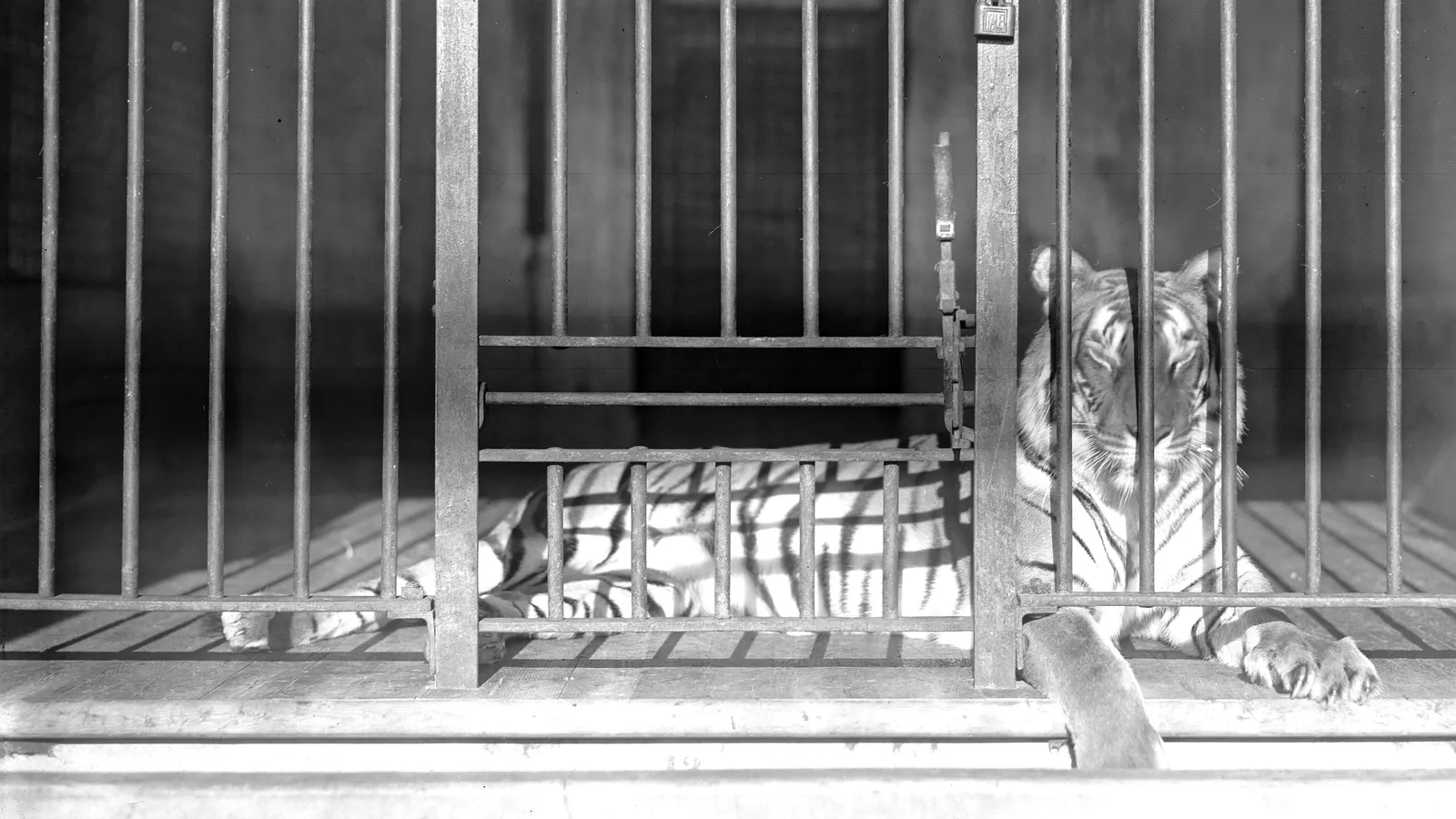
Stanza 1, the tiger in the cage. The tiger "stalks", walking slowly and with purpose, but only the short length of his cage. His paws are soft ("pads of velvet quiet"), yet he is full of "quiet rage". Simple meaning: a powerful animal paces a small cage, silent but angry.
Stanza 2, where he should be. In the wild he would be "lurking in shadow", sliding through long grass and waiting near a water hole for deer. These are a patient hunter's skills, and the cage takes them away.
Stanza 3, the tiger the village fears. At the jungle's edge he would snarl around houses, bare his white fangs and claws, and terrorise the village. In the wild, people fear him. In the zoo, people come to look at him.
Stanza 4, locked in. Now he is shut in a concrete cell, his "strength behind bars". He stalks the length of his cage and ignores the visitors. Ignoring them is the one choice he still has, a silent protest.
Stanza 5, night in the zoo. At night he hears "the last voice" and "the patrolling cars", and stares up at the bright stars with eyes just as bright, something free that he can still see. The poem ends on longing, not anger.
How is the caged tiger different from the tiger in the wild?
In the exam, set the contrast out point by point:
Movement: caged, he stalks the short length of his cage; wild, he lurks, slides and snarls.
Place: caged, a "concrete cell" behind bars; wild, shadow, long grass, a water hole, the jungle's edge.
Power: caged, his strength is wasted "behind bars"; wild, he hunts deer and bares fangs and claws.
People: caged, visitors watch him and he ignores them; wild, he terrorises the village.
Feeling: caged, "quiet rage" and then longing at the stars; wild, he simply lives as a tiger.
Which poetic devices are used in A Tiger in the Zoo?
Imagery: "plump deer" and "white fangs" let you see the jungle.
Repetition: "quiet" (stanza 1) and "brilliant" (stanza 5) each appear in two lines in a row.
Oxymoron: "quiet rage" joins calm and fury, the tiger's state in one phrase.
Metaphor: "pads of velvet quiet" compares his soft paws to velvet.
Alliteration: "stalks... stripes", "behind bars".
Enjambment: sentences run across lines, as in the opening two lines, where the sentence about his striped walk runs on into the next line.
Rhyme: in stanzas 1, 2 and 5 the second and fourth lines rhyme (cage/rage, grass/pass, cars/stars).
For practice, see checking figures of speech in a poem with AI and how to read and appreciate a poem.
What questions come in the exam on A Tiger in the Zoo?
Questions 1 and 4 below come from the "Thinking about the Poem" section of the NCERT chapter; questions 2 and 3 are common short-answer questions on the same lines. Short model answers:
What is the effect of repeating "quiet" and "brilliant"? It stresses contrast. "Velvet quiet" and "quiet rage" show silence hiding anger. "Brilliant eyes" and "brilliant stars" link the tiger to the free night sky, showing he still belongs to the wild.
Why does the tiger ignore the visitors? He does not want to be a show. Ignoring them is his silent protest and the only freedom left to him.
Why does the poet say "his strength behind bars"? The power meant for hunting has no use in a cage; the bars waste it.
Are zoos necessary? Give both sides: zoos can protect rare species and teach the public, but cages limit natural behaviour. India's tiger census with pug marks and faecal pellets shows how tigers are studied in the wild, a useful point for the conservation side.
A quick revision plan:
Without looking, write the five-point contrast above.
Write the theme in one sentence, and three devices with an example of each.
Answer question 1 or 4, then check every quote against the poem.
If your wider board revision in science and maths needs a starting point, Fermi's AI tutor can work out what you already know and build a plan for the session, so you sit down to a clear next step.