On this page
A common question gives you a curve and asks where its tangent is parallel to the x-axis or the y-axis. Each case has a one-line rule, and the second is easy to miss because it hides in a slope that does not exist.
When is a tangent parallel to the x-axis or the y-axis?
The slope of the tangent at a point is the value of dy/dx there. A line parallel to the x-axis has slope zero. A line parallel to the y-axis has no slope at all, so you cannot set dy/dx equal to anything. Turn the derivative over instead:
Parallel to the x-axis (horizontal tangent): solve dy/dx = 0.
Parallel to the y-axis (vertical tangent): solve dx/dy = 0.
In practice, write dy/dx as one fraction. Horizontal tangents come from the numerator being zero, and vertical tangents from the denominator being zero, as long as the other part is not zero at the same point.
Worked example 1: the circle x² + y² = 25
Differentiate both sides with respect to x: 2x + 2y(dy/dx) = 0, so dy/dx = −x/y. OpenStax Calculus Volume 1 gets the same derivative for this circle by implicit differentiation and uses it to find the tangent at (3, −4).
Horizontal: −x/y = 0 gives x = 0. Putting x = 0 into the circle gives y² = 25, so the points are (0, 5) and (0, −5).
Vertical: dx/dy = −y/x = 0 gives y = 0, so x = ±5, and the points are (5, 0) and (−5, 0).
This matches the picture of the circle: flat at the top and bottom, upright at the far left and right. Written parametrically as x = 5 cos t, y = 5 sin t, the same circle gives the same four points in OpenStax Calculus Volume 2, which puts it this way: "On the left and right edges of the circle, the derivative is undefined, and on the top and bottom, the derivative equals zero."
For the tangent lines themselves, the tangent to a circle at (x₁, y₁), xx₁ + yy₁ = a² gives y = ±5 and x = ±5. The geometry agrees, because a tangent is perpendicular to the radius: at (5, 0) the radius is horizontal, so the tangent is vertical.
How do you find horizontal and vertical tangents of a parametric curve?
For a curve x = x(t), y = y(t), Theorem 7.1 in OpenStax Calculus Volume 2 gives dy/dx = (dy/dt)/(dx/dt), provided dx/dt is not zero. That leads to three cases:
Horizontal tangent: dy/dt = 0 while dx/dt is not zero.
Vertical tangent: dx/dt = 0 while dy/dt is not zero.
Both zero at the same t: the formula tells you nothing. Look at the curve near that point, because it may be a sharp corner (a cusp) rather than a smooth tangent.
Worked example 2: x = t² + 1, y = t³ − 3t
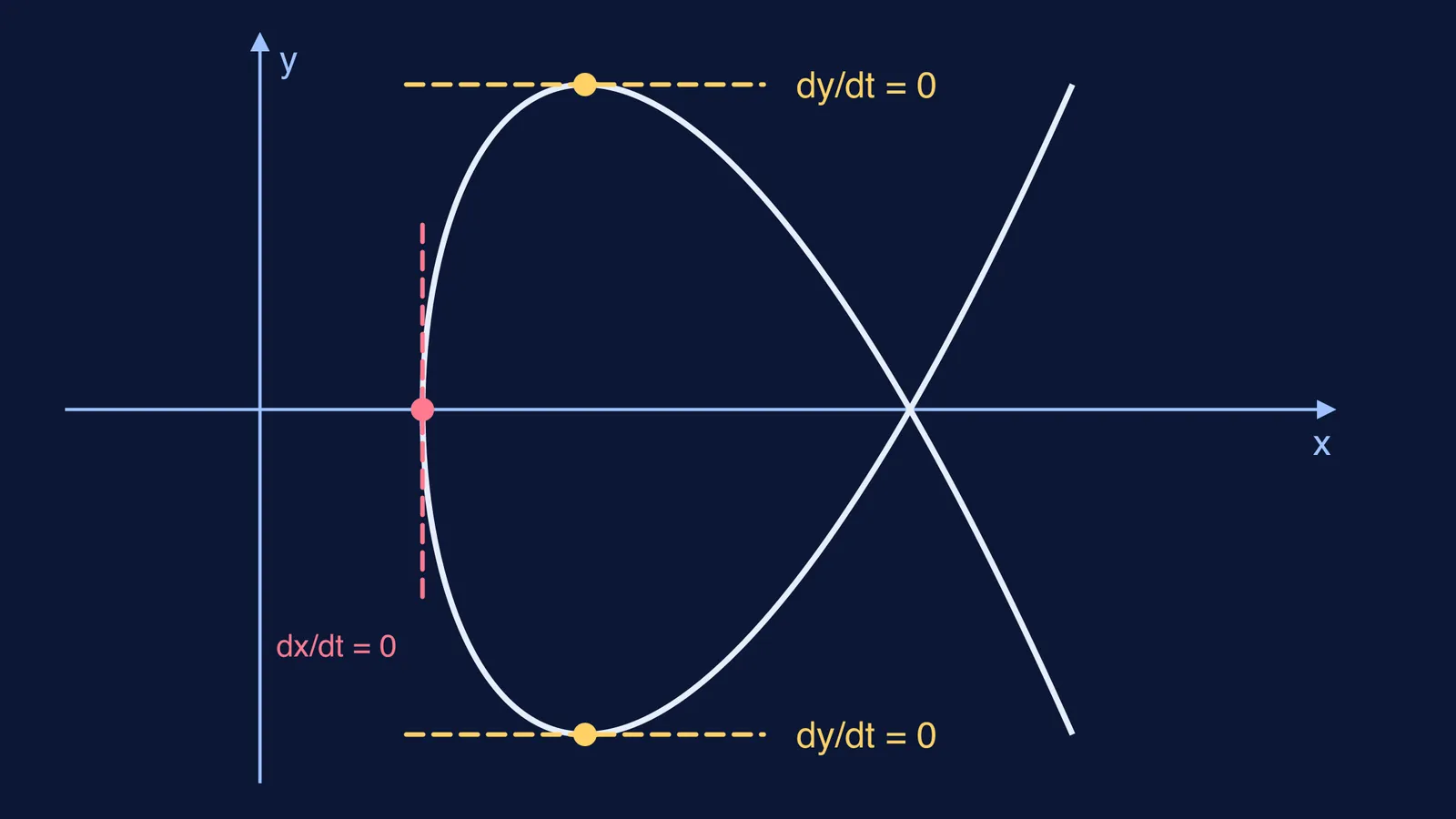
This is the curve in the diagram at the top of this post.
Differentiate: dx/dt = 2t and dy/dt = 3t² − 3.
Horizontal: 3t² − 3 = 0 gives t = ±1. At t = 1 the point is (2, −2); at t = −1 it is (2, 2). Since dx/dt = ±2 there, which is not zero, both are genuine horizontal tangents.
Vertical: 2t = 0 gives t = 0, where dy/dt = −3, which is not zero. The point is (1, 0).
Here is the trap. Write dy/dx = (3t² − 3)/(2t), set it equal to zero, find t = ±1, and stop. That gives two points when the answer has three. The missing point (1, 0) is the leftmost point of the curve, because x = t² + 1 is never less than 1, and wherever a smooth curve reaches its leftmost point, the tangent there has to be upright.
The curve also crosses itself at (4, 0), where t = ±√3. Its two tangents there have slopes √3 and −√3, so neither is horizontal or vertical.
A checklist for any curve
Find dy/dx (directly, implicitly or from the parameter) and write it as one fraction.
Set the numerator to zero: these are the candidates for horizontal tangents.
Set the denominator to zero: these are the candidates for vertical tangents. Do this step even if the question only says "parallel to the axes".
Set aside any point where both are zero and check it on its own.
Substitute back to get coordinates, and confirm that each point satisfies the curve's equation.
If your derivative keeps coming out wrong at step 1, the Fermi Problem Library has worked problems with a step-by-step solver that explains the reasoning rather than printing an answer. If the slope of a tangent itself still feels shaky, the Fermi Concept Library gives each mathematics concept its own lesson.
Tangents drawn from a point that is not on the curve are a different question, covered in how to find tangents to y = x² from an external point.