On this page
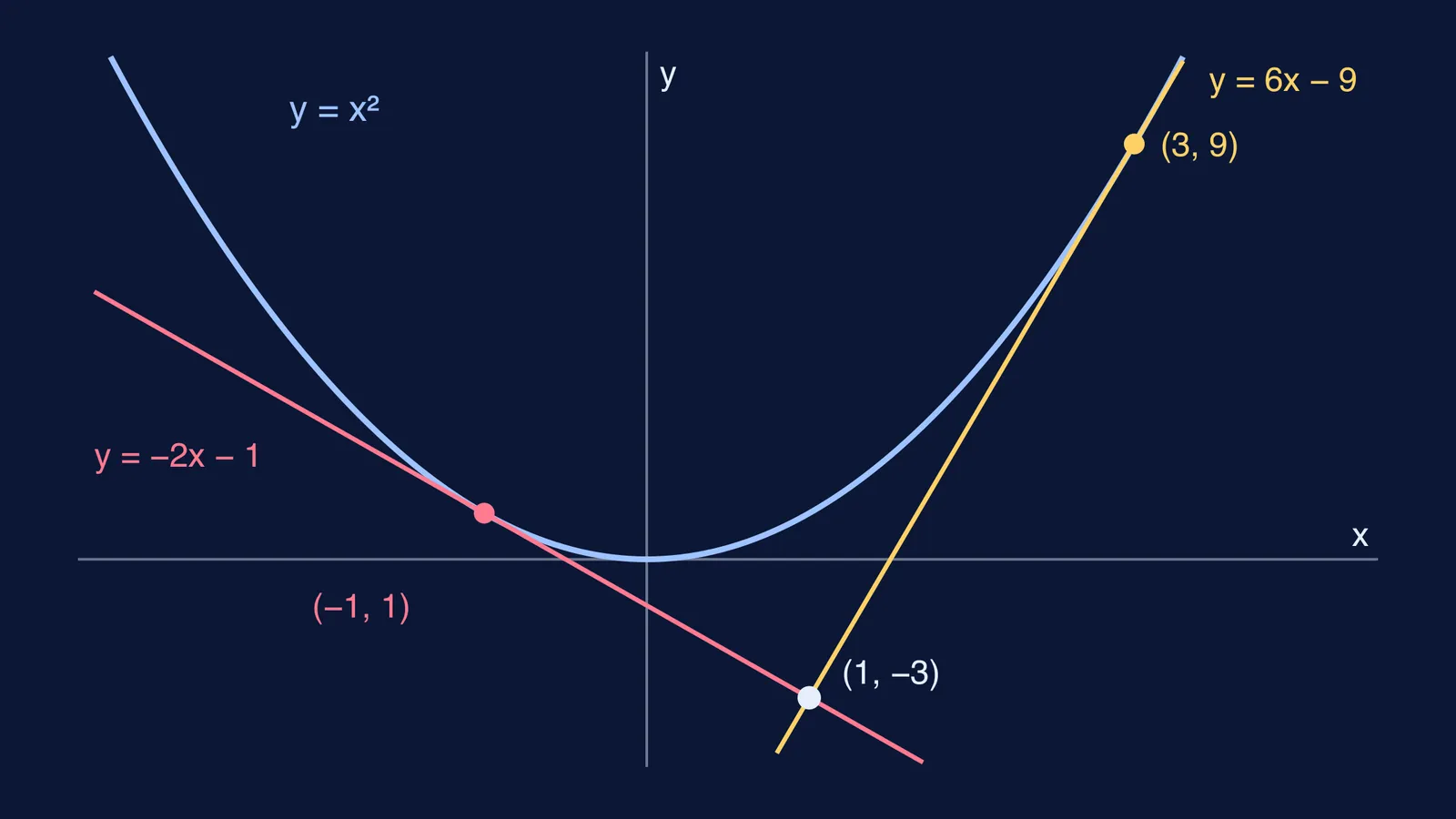
Most textbook tangent questions give you the point where the line touches the curve. The harder version gives a point off the curve, like (1, −3) for y = x², and asks for every tangent through it. You can't start where you usually would, because that point is not where the line touches.
The fix is a single habit. Name the unknown point of contact, write its tangent, and make that tangent pass through the given point. Below are the method, a worked example and a quick test for how many tangents to expect.
What is the tangent to a curve at a point?
OpenStax Calculus defines the tangent line to f(x) at a as the line through (a, f(a)) whose slope is the limit of [f(x) − f(a)]/(x − a) as x approaches a (OpenStax Calculus Volume 1, section 3.1). That limit is the derivative f′(a), so in point-slope form the tangent is y − f(a) = f′(a)(x − a).
For y = x², the derivative is 2x. At a general point (t, t²), the tangent is y − t² = 2t(x − t), which simplifies to y = 2tx − t². This one line stands for every tangent the parabola has, and t tells you which one.
Why can't you use the slope at the given point?
The usual mistake is to put the external point straight into the derivative. For (1, −3) that gives slope 2 and the line y + 3 = 2(x − 1). But 2x is the slope only at points on the curve, and (1, −3) is not on y = x². That line misses the parabola completely: x² = 2x − 5 has no real roots.
How do you find the tangent to y = x² from an external point?
Here it is for the point (1, −3).
Name the point of contact: (t, t²).
Write the tangent there: y = 2tx − t².
Make it pass through (1, −3): −3 = 2t(1) − t², so t² − 2t − 3 = 0.
Solve: (t − 3)(t + 1) = 0, so t = 3 or t = −1.
Put each t back in. For t = 3 the tangent is y = 6x − 9, touching at (3, 9). For t = −1 the tangent is y = −2x − 1, touching at (−1, 1).
Check one before you move on. Put y = 6x − 9 into y = x² and you get (x − 3)² = 0. A repeated root means the line touches the curve and doesn't cross it. The same line is the tangent at x = 3 in OpenStax's own worked example (OpenStax Calculus Volume 1, section 3.1).
How many tangents can you draw from a point to y = x²?
For a general point (h, k), step 3 gives t² − 2ht + k = 0. Its discriminant is 4(h² − k), so you can read off the answer before solving:
k < h² (the point is below the parabola, outside it): two tangents.
k = h² (the point is on the parabola): one tangent, the ordinary one.
k > h² (the point is above the parabola, inside the cup): no tangent at all.
For (1, −3), h² − k = 4, which is positive, so we expect two tangents. The same quadratic also gives t₁ + t₂ = 2h and t₁t₂ = k for the two contact points. That helps when a question asks about the chord joining them.
Does the same method work for other curves?
Yes. Only the tangent equation changes. For y = x³ from the point (2, 0), the tangent at (t, t³) is y = 3t²x − 2t³. Making it pass through (2, 0) gives 0 = 6t² − 2t³, or 2t²(3 − t) = 0. So t = 0 gives the tangent y = 0, and t = 3 gives y = 27x − 54, touching at (3, 27).
The y = 0 tangent is a trap. It crosses y = x³ at the origin, but it is still the tangent there, so keep that root. Every real root of the contact equation is a tangent.
A checklist for your next problem
Did I name the point of contact with a letter?
Did I write the tangent there before putting in the given point?
Did I keep every real root?
Does one tangent give a repeated root when substituted into the curve?
If a step on this list keeps going wrong, try a few similar problems in the Fermi Problem Library. Its step-by-step solver explains the reasoning rather than printing an answer, so you can see where your working went a different way. If derivatives feel shaky, the Fermi Concept Library gives each mathematics concept its own lesson and its place in the map.
Then try it yourself: find both tangents to y = x² from (0, −4). You should get t = ±2, with tangents y = 4x − 4 and y = −4x − 4.