On this page
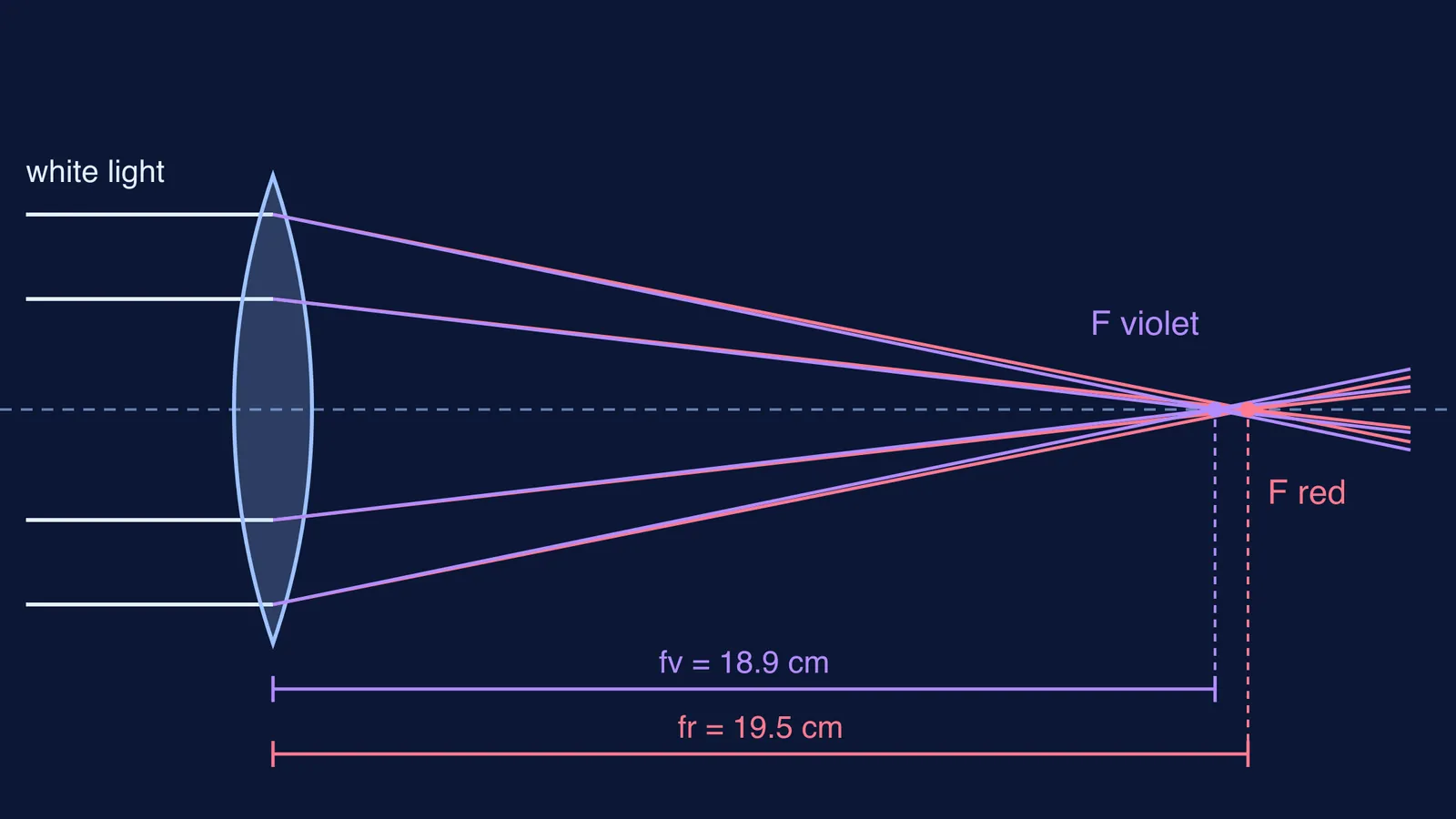
Shine white light through a convex lens and the colours do not meet at one point: red reaches the axis a little farther from the lens than violet. The reason is one number in the lens maker's formula.
Why is focal length greater for red light than violet?
Glass bends violet light more than red light. OpenStax University Physics puts it plainly: for a given medium, n "increases as wavelength decreases and is greatest for violet light" (OpenStax, Dispersion). The same chapter lists crown glass at n = 1.512 for red light (660 nm) and n = 1.530 for violet light (410 nm).
A lens focuses light by bending it. Bend a ray less and it travels farther before it reaches the axis. So red, the colour glass bends least, has the longest focal length, and violet has the shortest. This splitting of colours by wavelength is dispersion, the same effect that makes a prism fan white light into a spectrum; our post on how a prism splits white light into colours works through it with numbers.
How does the lens maker's formula show fr > fv?
For a thin lens in air, the lens maker's formula is 1/f = (n − 1)(1/R1 − 1/R2), where R1 and R2 are the radii of curvature of the two surfaces (OpenStax, Thin Lenses). Because f depends on n, it also depends on wavelength, which is why a single lens shows chromatic aberration.
The radii belong to the lens, so they are the same for every colour. Only n changes. That gives a short proof:
The bracket (1/R1 − 1/R2) is fixed for a given lens. Call it K.
For a convex lens K is positive, so 1/f = (n − 1)K.
n for red is less than n for violet, so (n − 1) is smaller for red.
A smaller 1/f means a larger f. Therefore fr > fv.
Divide the red equation by the violet one and K cancels: fr/fv = (nv − 1)/(nr − 1). The shape of the lens drops out; the ratio depends only on the glass.
If signs trip you up, our guide on how to assign signs in the lens maker's formula goes through each lens shape.
Worked example: a crown glass lens with 20 cm radii
Take an equiconvex crown glass lens with both surfaces of radius 20 cm, and use the OpenStax indices nr = 1.512 and nv = 1.530 (OpenStax, Dispersion).
Signs. With light coming from the left, R1 = +20 cm and R2 = −20 cm. The bracket is 1/20 + 1/20 = 1/10 per cm.
Red. 1/fr = (1.512 − 1)(1/10) = 0.0512 per cm, so fr = 19.53 cm.
Violet. 1/fv = (1.530 − 1)(1/10) = 0.0530 per cm, so fv = 18.87 cm.
The gap. fr − fv = 0.66 cm, about 6.6 mm. The ratio agrees: 0.530/0.512 = 1.035, so the red focal length is about 3.5% longer.
Sanity check. The gap is roughly f × (nv − nr)/(n − 1). With an average n of 1.521 and f of 19.2 cm, that is 19.2 × 0.018/0.521 ≈ 0.66 cm.
The last line is worth remembering for exams: the colour gap is the focal length times the spread in n, divided by (n − 1).
Does real optical glass give the same answer?
A common real crown glass is SCHOTT N-BK7, listed with nd = 1.5168 and an Abbe number of 64.17 on refractiveindex.info's N-BK7 page. Putting SCHOTT's published dispersion coefficients (N-BK7 data file) into their formula, we get n = 1.5143 at 656.3 nm (red) and n = 1.5302 at 404.7 nm (violet). For the same 20 cm lens that gives fr = 19.44 cm and fv = 18.86 cm, a gap of 0.58 cm. The real glass tells the same story to within a millimetre.
What mistakes do students make with this question?
Saying violet has the longer focal length because it carries more energy. Photon energy is not in the formula; n is.
Saying red is faster in glass and stopping there. Speed matters only because it sets n, and n is what enters 1/f.
Assuming a concave lens reverses the order. Both focal lengths are negative, but the size is still larger for red: |fr| > |fv|.
Mixing up power. Power is 1/f, so violet has the larger power even though red has the larger focal length.
To practise on fresh numbers, the Fermi Problem Library has worked problems with a step-by-step solver that explains the reasoning rather than printing an answer. If dispersion and refraction feel shaky underneath, the Fermi Concept Library covers every concept in physics, chemistry, biology, mathematics and computing.
To see how two lenses of different glass cancel the gap, read our post on the achromatic combination of two lenses.