On this page
What is Father to Son about?
Father to Son is the last poem in NCERT's Class 11 English reader Hornbill, and you can read the full text in the NCERT Hornbill chapter 6 PDF. It was written by Elizabeth Jennings, a British poet who lived from 1926 to 2001 (Wikipedia)). It has four six-line stanzas, all spoken by a father.
In simple words: a father and son have shared one house for years, yet the father knows almost nothing about the young man. They talk like strangers. The father half wishes the son would fail and come home, so he could forgive him. At the end both reach out, with nothing to give.
NCERT's note at the end of the chapter describes the poem as autobiographical. In answers, call the voice "the father" or "the speaker".
What does each stanza of Father to Son mean?
Stanza 1: a stranger at home. Years under one roof have not brought understanding, so the father tries to build a relationship from the son's childhood, the only version he knew.
Stanza 2: same design, different loves. The question finishes with a farming image: has the father killed "the seed I spent", or sown it on land that is now the son's alone? They speak "like strangers". The son is "built to my design", which shows pride and a sense of ownership, yet the son's loves are his own.
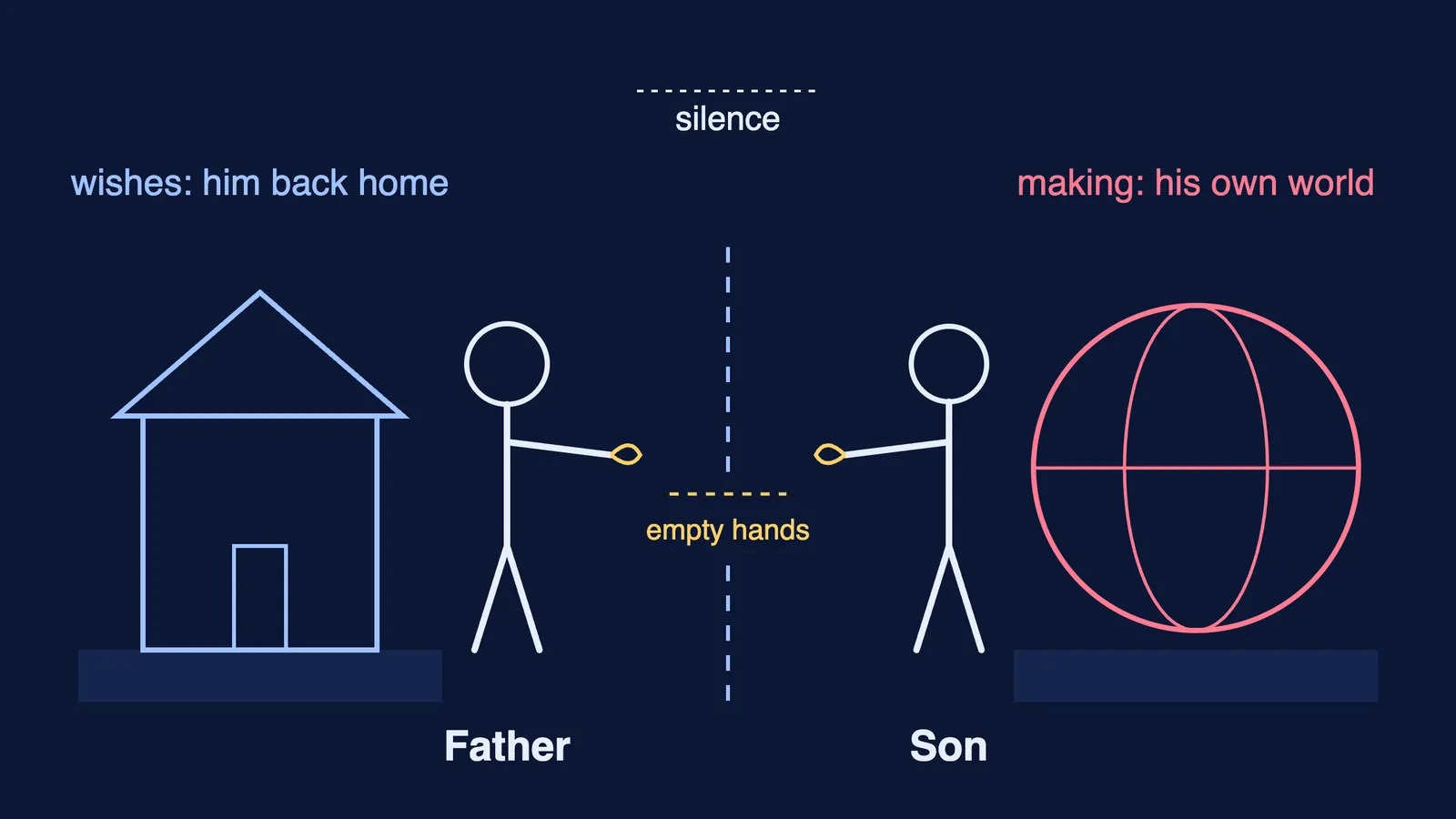
Stanza 3: the prodigal wish. Silence fills the house. The father would rather see his son come back defeated, like the son in the parable of the prodigal son in Luke 15, than watch him build his own world. Then he could forgive him.
Stanza 4: two empty hands. Both must share the same world. When the son speaks, the father admits he cannot understand even himself, or why his grief turns into anger. Each holds out an "empty hand", hoping for something to forgive.
What is the theme of Father to Son?
The central theme is the generation gap: love exists on both sides, but understanding does not.
Love without communication. Nobody shouts and nobody is cruel. The trouble is silence.
Control versus independence. The father sees the son as his creation; the son is building a life without him.
Grief turning into anger. The father notices his own anger and is puzzled by it.
Does the poem speak only for one family? It is one father's story, but many Indian families know a parent who remembers a child at ten and struggles to know the person at seventeen. If that sounds like your house, our guide for when a teen says parents only care about marks has words both sides can use.
Which poetic devices are used in Father to Son?
Rhyme scheme: each stanza follows the same pattern, roughly ABBABA, mixing full rhymes with half-rhymes (have, move, love), and the pattern holds in all four stanzas.
Metaphor: the seed and the land stand for what the father invested and the son's separate life.
Allusion: the prodigal son, who wastes his inheritance and returns to a forgiving father.
Enjambment: sentences run over line breaks, so the poem sounds like halting, unsure speech.
Alliteration: "Silence surrounds" and "grows from grief".
Irony: longing to forgive when no wrong has been done.
How do you answer Father to Son questions in the CBSE exam?
The CBSE English Core (301) syllabus for 2026-27 can test this poem in three ways: a Hornbill poetry extract worth 3 marks; a poetry short answer of 40-50 words for 3 marks; and a long answer from Hornbill prose or poetry, 120-150 words, for 6 marks.
For a short answer, use point, proof, so what: a claim, one detail from the poem, then what it shows.
Worked example. Question: why would the father prefer his son to fail and return home?
Model answer (46 words): The father feels shut out of his son's new world. If the son failed and came home, like the prodigal son, the father would be needed again and could forgive him. The wish is selfish but honest: he prefers dependence to a distance he cannot cross.
For a 6-mark long answer on the generation gap, plan five short moves:
Name the poem, the poet and the theme (about 20 words).
Show the distance: strangers at home, silence (about 35 words).
Explain the prodigal wish and its irony (about 35 words).
Read the ending: both hold out empty hands, so neither is the villain (about 30 words).
Close with one line on families today (about 15 words).
For a comparison, The Portrait of a Lady, also in Hornbill, shows a grandmother and grandson drifting apart as he grows up. For another poem about growing up, see our guide to The Ball Poem.
If a science subject, not English, is what is piling up this term, Fermi's AI tutor can work out what you already know and build a plan for the session, so you sit down to a clear next step.