On this page
If you are revising the light reactions for NEET-UG or CBSE Class 11, two odd results explain why the chapter has a PS I and a PS II at all: a fall and a boost.
What is the red drop in photosynthesis?
Robert Emerson and Charlton Lewis measured the quantum yield of the green alga *Chlorella*, meaning how much photosynthesis it does for each unit of light it absorbs, across the spectrum (Emerson and Lewis, American Journal of Botany, 1943).
The red drop is the fall in the quantum yield of photosynthesis beyond 680 nm, where chlorophyll a is the only pigment absorbing the light (Veena et al., Physiology and Molecular Biology of Plants, 2023).
A 2021 review puts it plainly: photons above 700 nm "have minimal photosynthetic activity when applied alone" (Zhen, van Iersel and Bugbee, Frontiers in Plant Science, 2021).
The key word is *yield*: each far-red photon the leaf does absorb achieves less. That gap between what is absorbed and what gets done is why the absorption and action spectra do not match at the red end.
What is the Emerson enhancement effect?
In 1957 Emerson, Ruth Chalmers and Carl Cederstrand reported new experiments on the long-wave limit of photosynthesis (Emerson, Chalmers and Cederstrand, PNAS, 1957).
The Emerson enhancement effect is that "the photosynthetic rate under simultaneous illumination with photons above 680 nm and shorter-wavelength light was greater than the sum of the rates from applying each light separately" (Zhen, van Iersel and Bugbee, 2021).
Why does adding shorter light boost photosynthesis?
Because the light reactions use two photosystems in a chain. Photosystem I is most reactive at 700 nm and Photosystem II at 680 nm (Photosystem, Wikipedia). Electrons taken from water at PS II pass along a transport chain to PS I, which sends them on to make NADPH (OpenStax Biology 2e).
Far-red photons preferentially excite PS I, at wavelengths at least up to 732 nm (Zhen, van Iersel and Bugbee, 2021). So under far-red light alone, PS II runs slowly, few electrons come from water, and little oxygen is released. Add shorter light and PS II starts feeding PS I. The review describes enhancement as restoring the excitation balance between PS I and PS II, and notes that it only occurs up to the point where that balance is reached. Think of two pumps in series on one pipe: running only the second moves almost nothing.
How did this show there are two photosystems?
A single light reaction is hard to square with two beams being worth more than their sum; two cooperating systems explain it. Looking back, Veena and colleagues write that "the existence of two photosystems and two light reactions was a new concept and was Emerson's major contribution" (Veena et al., 2023).
In 1960 Robin Hill and Fay Bendall reached a similar idea from the chemistry of cytochromes (Hill and Bendall, Nature, 1960). They argued that the system "must require more than one light-driven reaction", and their hypothesis became the Z scheme (Anderson, Philosophical Transactions of the Royal Society B, 2012). You can follow that chain step by step in our guide to the Z-scheme of electron flow and see what the two reaction centres do in P680 and P700 explained.
How do you work out the enhancement in an exam question?
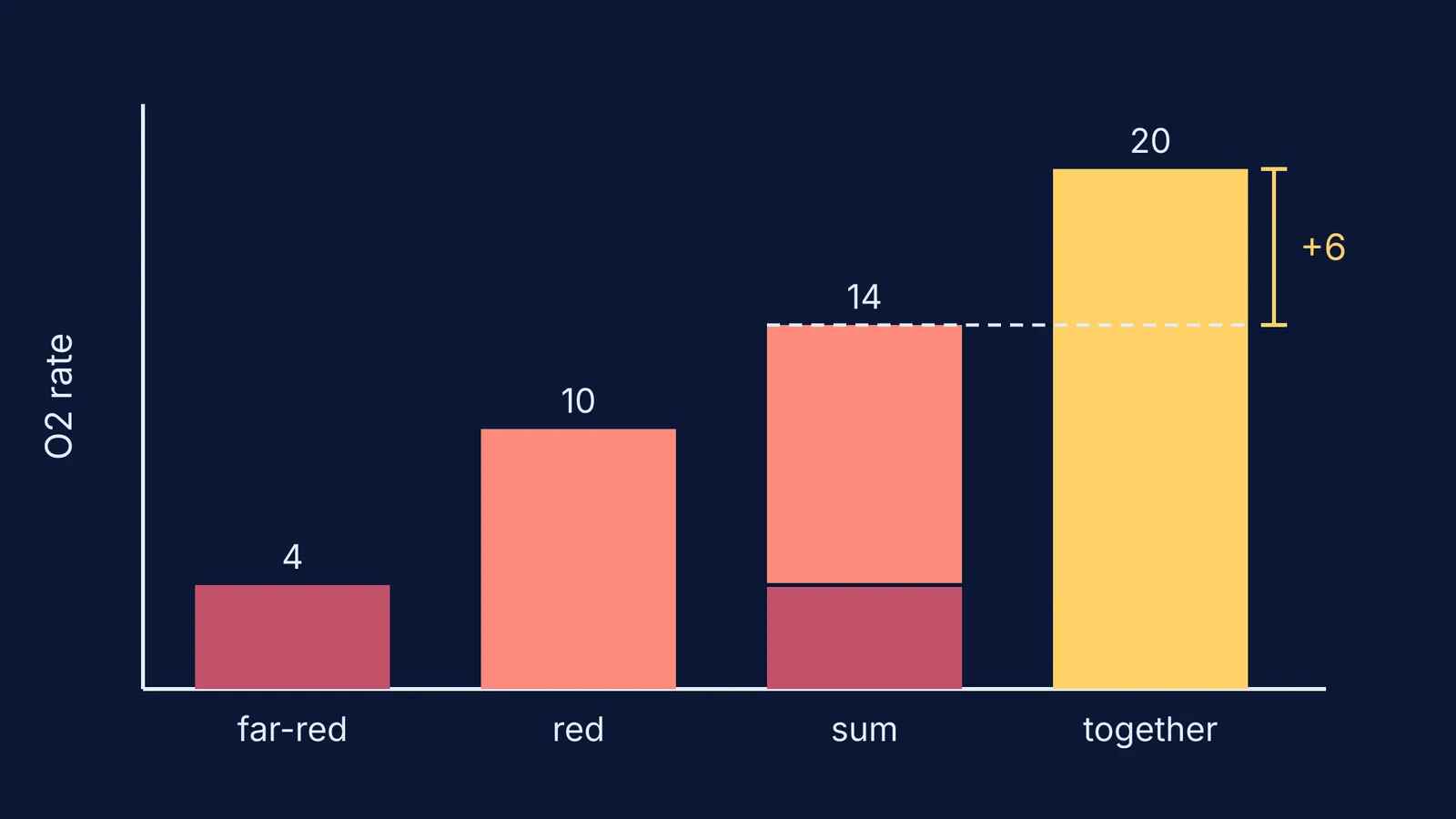
Practice example with made-up numbers (not real data). Oxygen release, in arbitrary units:
Far-red light (above 680 nm) alone: 4
Red light (around 650 nm) alone: 10
Both beams at the same time: 20
The separate rates add to 4 + 10 = 14. The combined rate, 20, beats that sum by 6 units (ratio 20 / 14, about 1.43), so this is enhancement. A combined rate of 14 or less would show no enhancement.
A short answer you can adapt: "Beyond 680 nm the quantum yield of photosynthesis falls (red drop). Far-red plus shorter-wavelength light together give a rate greater than the sum of each alone (Emerson enhancement). So two photosystems work in series: far-red light mainly drives PS I, while PS II needs shorter wavelengths."
Check these traps before you write:
Red drop is a fall in quantum yield, not just in absorption.
Enhancement needs both beams at the same time; the test is "more than the sum".
PS I (P700) handles far-red light; PS II (P680) needs shorter light. Some notes swap them.
Oxygen comes from water split at PS II, which is why far-red light alone releases so little.
If absorption and action spectra still blur together, the Fermi Concept Library gives each concept its own lesson and its place in the map. For practice, the Fermi Problem Library has worked problems with a step-by-step solver that explains the reasoning rather than printing an answer.
Next step: redo the worked example with your own three numbers and explain the answer aloud.