On this page
This question tests two skills at once: predicting electrode products from standard electrode potentials, and turning a current and a time into a mass. The cathode answer is the same for both electrode types; the anode answer is not.
What forms at the cathode when aqueous AgNO3 is electrolysed?
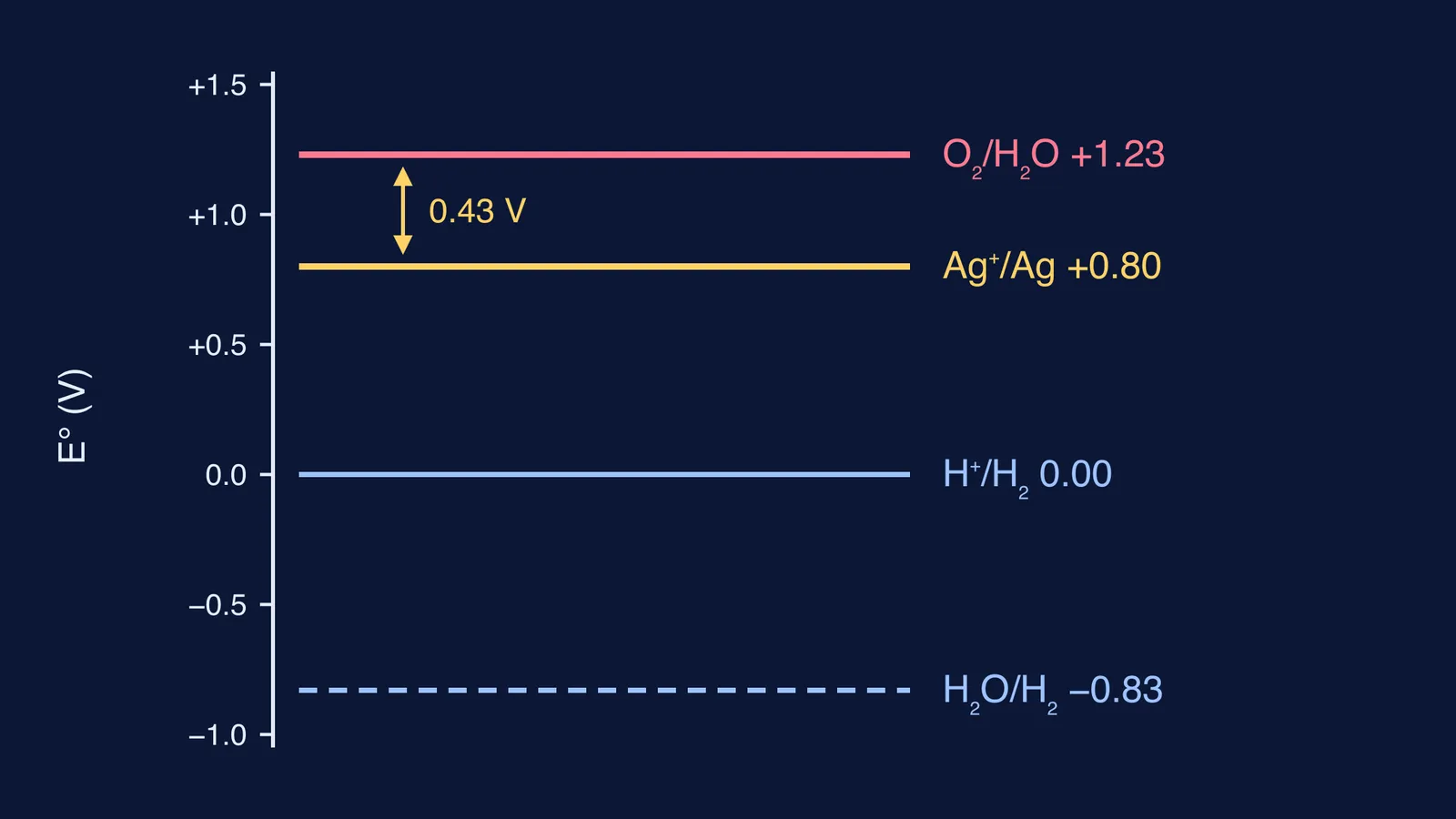
The solution holds Ag⁺, NO₃⁻ and water. The NCERT Class 12 electrochemistry chapter gives the rule: at the cathode, the reduction with the higher E° is preferred. Its Table 2.1 supplies the values.
Ag⁺ + e⁻ → Ag(s) has E° = +0.80 V.
2H⁺ + 2e⁻ → H₂(g) has E° = 0.00 V.
2H₂O + 2e⁻ → H₂(g) + 2OH⁻ has E° = −0.83 V.
Silver wins by a wide margin, so silver is deposited on the cathode, whether that cathode is silver or platinum.
Why does the anode change the answer?
At the anode the rule runs the other way: the oxidation whose couple has the lower E° is preferred (NCERT, section 2.5.1). Nitrate drops out, because its nitrogen is already at +5, its highest state. That leaves water and, if it can react, the anode itself. NCERT notes that an inert electrode such as platinum or gold acts only as a source or sink for electrons, while a reactive electrode takes part. Our explainer on why platinum is used as an inert electrode goes into the reasons.
With silver electrodes, the silver anode can be oxidised: Ag(s) → Ag⁺(aq) + e⁻. The Ag⁺/Ag couple sits at +0.80 V, below the +1.23 V of the O₂/H₂O couple, so the silver gives up electrons before water does. For every Ag⁺ plated at the cathode, one enters the solution at the anode, so the AgNO3 concentration stays essentially the same; silver just moves across. NCERT describes the same pattern for copper electrodes in copper sulphate, the basis of copper refining.
With platinum electrodes, the anode does not react, so water is oxidised: 2H₂O → O₂(g) + 4H⁺(aq) + 4e⁻. Overall, 4Ag⁺ + 2H₂O → 4Ag + O₂ + 4H⁺. Ag⁺ is used up and H⁺ builds up beside the nitrate, so the solution slowly becomes dilute nitric acid. Once the Ag⁺ is nearly gone, the cathode moves to the next reduction in line and hydrogen appears.
Here is the whole prediction in one list:
Cathode, silver or platinum: silver is deposited.
Anode, silver: the silver dissolves; no gas is given off.
Anode, platinum: oxygen gas is given off.
Solution with silver electrodes: stays AgNO3 at essentially the same concentration.
Solution with platinum electrodes: Ag⁺ falls and the solution becomes acidic (HNO3).
If the signs of the electrodes still feel slippery, our post on electrolytic vs galvanic cells and the anode trap sorts them out.
How do you calculate the mass of silver deposited?
Faraday's first law says the amount of chemical reaction at an electrode is proportional to the quantity of electricity passed (NCERT, section 2.5). The Faraday constant, the charge on one mole of electrons, is 96 485.332 12 C mol⁻¹ (NIST CODATA). The standard atomic weight of silver is 107.8682 (CIAAW). For the history, see Faraday's first and second laws of electrolysis.
Worked example: 2.00 A is passed through aqueous AgNO3 for 30.0 minutes. Find the mass of silver deposited.
Time in seconds: t = 30.0 × 60 = 1800 s.
Charge: Q = It = 2.00 A × 1800 s = 3600 C.
Moles of electrons: 3600 ÷ 96 485 = 0.03731 mol.
Ag⁺ + e⁻ → Ag needs one electron per atom, so moles of silver = 0.03731 mol.
Mass of silver: 0.03731 mol × 107.87 g mol⁻¹ = 4.02 g.
The mass is 4.02 g with either electrode type, because the cathode reaction is the same. With a silver anode, the anode loses 4.02 g. With a platinum anode, four electrons release one O₂, so 0.03731 ÷ 4 = 0.00933 mol of oxygen is given off.
In one line, m = (M × I × t) ÷ (n × F), where n is electrons per ion. NCERT rounds F to 96 500 C mol⁻¹ for quick work; with silver as 108 g mol⁻¹ that gives 4.03 g, so use the values your paper states.
How should you practise this type of question?
List every species that could be reduced or oxidised, including water and the electrodes.
Cathode: pick the highest E°. Anode: pick the lowest E°, checking first whether the anode metal can react.
Write the net change to the solution, then calculate with Q = It and the electrons per ion.
When a calculation goes wrong and you cannot see where, the Fermi Problem Library has a step-by-step solver that explains the reasoning rather than printing an answer. Then try the same steps on aqueous CuSO4 with copper and with platinum electrodes.