On this page
A doublet means both dice show the same number. The first question is quick, but exams attach two follow-ups: the chance of at least one doublet in several throws, and how many doublets to expect. Here is each one, worked out.
What is the probability of getting a doublet when two dice are thrown?
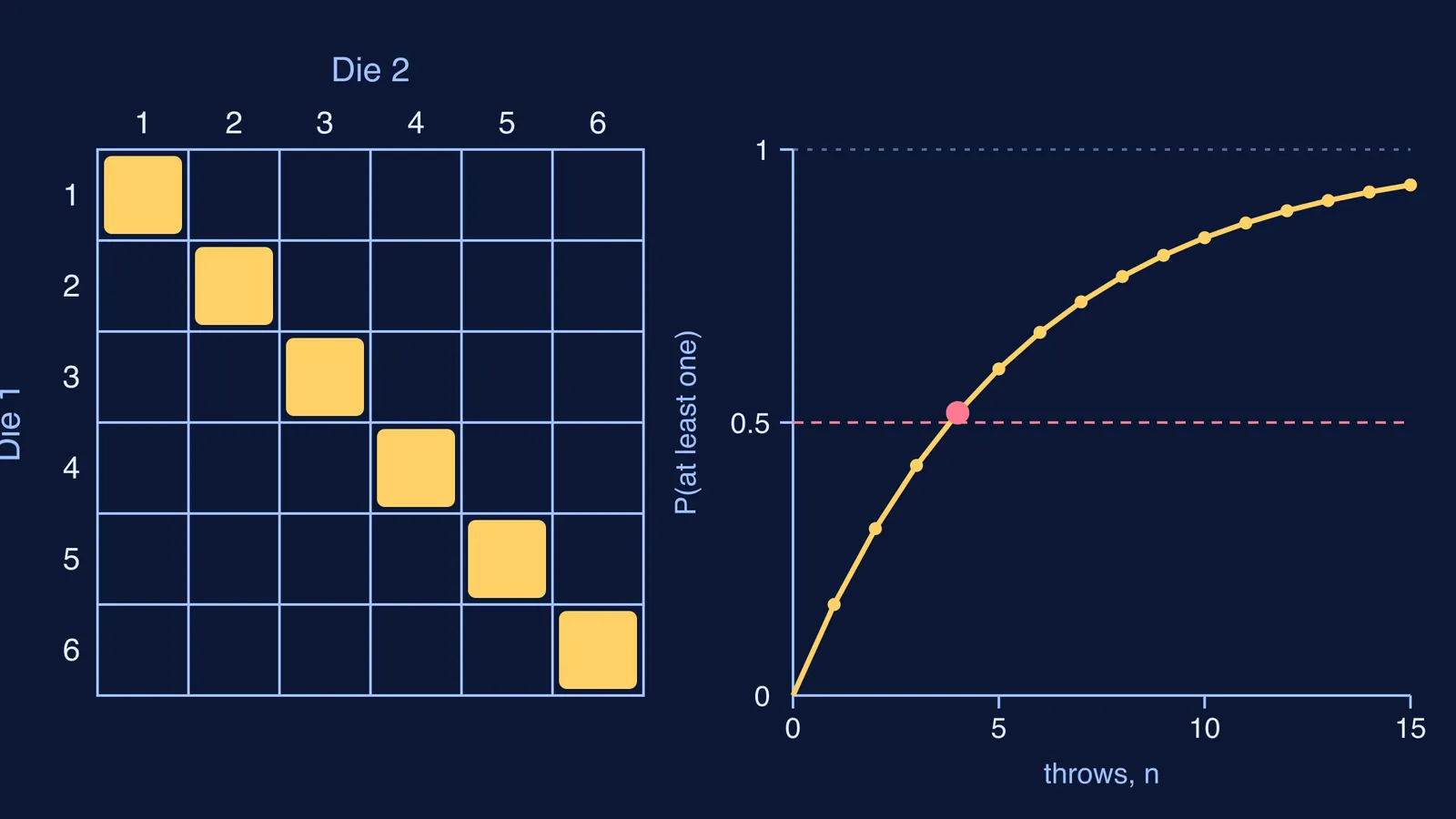
Treat the dice as different, say red and blue, and write each result as an ordered pair. A pair of six-sided dice has 6 × 6 = 36 equally likely outcomes, laid out as a full grid in Bill McNeill's dice probability tutorial (University of Washington). The same tutorial lists the event "both dice are the same" as exactly six outcomes: (1,1), (2,2), (3,3), (4,4), (5,5) and (6,6).
So the probability of a doublet is 6/36 = 1/6, about 16.7%. The probability of no doublet on one throw is 5/6.
The doublets sit on the diagonal of the 6 × 6 grid. The same counting habit scales up: three dice give 216 rolls, as in our post on counting all 216 rolls for a sum of 10.
What is the probability of at least one doublet in n throws?
Each throw has the same chance of a doublet, 1/6, and throws do not affect each other. That makes repeated throws Bernoulli trials: independent trials with two outcomes and the same probability of success each time. The binomial formula P(x) = nCx pˣ (1 − p)ⁿ⁻ˣ, as given in the NIST/SEMATECH e-Handbook of Statistical Methods, gives the chance of no doublet at all when you put x = 0: (5/6)ⁿ.
"At least one" is everything except "none", so:
P(at least one doublet in n throws) = 1 − (5/6)ⁿ
Worked values:
n = 1: 1 − 5/6 = 1/6 ≈ 0.167
n = 2: 1 − 25/36 = 11/36 ≈ 0.306
n = 3: 1 − 125/216 = 91/216 ≈ 0.421
n = 4: 1 − 625/1296 = 671/1296 ≈ 0.518
n = 6: 1 − 15625/46656 = 31031/46656 ≈ 0.665
n = 10: 1 − (5/6)¹⁰ ≈ 0.838
Four throws is the first point where a doublet is more likely than not. Six throws does not make one certain, even though 6 × 1/6 = 1: you can only add probabilities of events that cannot happen together.
To find the smallest n for a 90% chance, solve (5/6)ⁿ ≤ 0.1. Taking logs, n ≥ log 10 / log 1.2 ≈ 12.6, so you need 13 throws. Check: 1 − (5/6)¹³ ≈ 0.907. The same move works for any "at least one" question; our post on the 1 − qⁿ shortcut for at least one success has more examples.
How many doublets should you expect in n throws?
The number of doublets X in n throws follows a binomial distribution, and the mean of a binomial distribution is np, per the NIST handbook's binomial page. With p = 1/6:
E(X) = n/6
4 throws: 4/6 = 2/3 of a doublet on average
6 throws: 1 doublet on average
12 throws: 2 doublets on average
"Expect" means the long-run average. The dice tutorial describes an expectation value as a weighted average in which more likely values get a higher weight. So in 6 throws you expect one doublet, yet there is about a 33.5% chance, (5/6)⁶, of none; runs with two or three doublets pull the average up.
How do you check a doublet answer in an exam?
An NCERT Class 12 exercise question (Ex 13.5, Q2), reproduced on Teachoo, asks: a pair of dice is thrown 4 times; if getting a doublet is a success, find the probability of two successes. With n = 4 and p = 1/6, P(X = 2) = 4C2 × (1/6)² × (5/6)² = 6 × 25/1296 = 25/216.
Before you write the final answer, run this checklist:
Did I count ordered pairs out of 36, not 21 kinds?
Does the question say "exactly", "at least" or "at most"? "At least one" is 1 − P(none).
Is my probability between 0 and 1? n/6 is an expected count, not a probability, and it can exceed 1.
Did I add overlapping events? 4 × 1/6 is not the chance of a doublet in 4 throws.
Does my formula give 1/6 when n = 1?
If a question adds a condition, such as "given the sum is even", shrink the sample space first; our conditional probability example with two dice shows how.
If you keep reaching for the wrong method on questions like these, the Fermi Problem Library has worked problems with a step-by-step solver that explains the reasoning rather than printing an answer. For the ideas underneath, such as sample spaces, Bernoulli trials and expectation, the Fermi Concept Library gives each concept its own lesson.