

On this page
Three-dice questions turn up in Class 11 probability and JEE practice. A common slip is counting 4 + 3 + 3 once, when the dice can show it in three orders. Here is a method that counts every roll exactly once, with two quick checks.
How many outcomes are there when you roll three dice?
Each die has 6 faces, so three dice give 6 × 6 × 6 = 216 outcomes. This is the multiplication principle, as shown in this introduction to counting from a university probability course.
The key word is ordered. Imagine the dice are red, green and blue. Then (2, 4, 4), (4, 2, 4) and (4, 4, 2) are three different outcomes, and all 216 ordered triples are equally likely. Unordered combinations are not. If that feels shaky, our post on why the sum of two dice is not equally likely goes through the two-dice version.
How many ways can three dice add up to 10?
Count in two stages. First, list each set of faces once, largest first. Then count how many orders each set can appear in:
all three faces different: 3! = 6 orders
two faces the same: 3 orders
all three the same: 1 order
For a sum of 10, the sets, written largest first, are:
6, 3, 1: all different, 6 orders
6, 2, 2: one pair, 3 orders
5, 4, 1: all different, 6 orders
5, 3, 2: all different, 6 orders
4, 4, 2: one pair, 3 orders
4, 3, 3: one pair, 3 orders
That gives 6 + 3 + 6 + 6 + 3 + 3 = 27 ordered outcomes. So P(sum = 10) = 27/216 = 1/8. The same count, 27, appears in the OEIS sequence for three-dice sums.
Cross-check with stars and bars. a + b + c = 10 with each value at least 1 has C(9, 2) = 36 solutions. Remove those where one die shows 7 or more: take 6 from that die to get a' + b + c = 4, with C(3, 2) = 3 solutions, for each of 3 dice. That leaves 36 − 9 = 27. New to the method? Read stars and bars explained with sweets.
Why does 10 come up more often than 9?
Galileo wrote a short work on exactly this question: how often the totals 9 and 10 turn up with three dice. It was first published in 1718. The puzzle was that both totals can be made from six sets of faces, yet the person who posed it had noticed 10 turning up more often. This account of the three-dice problem gives the answer: 10 can appear in 27 ways but 9 in only 25.
You can check this with the 6-3-1 rule. The sets for 9 are 6, 2, 1 (6 orders), 5, 3, 1 (6), 5, 2, 2 (3), 4, 4, 1 (3), 4, 3, 2 (6) and 3, 3, 3 (1). That adds to 25. The gap comes from 3, 3, 3, which has only one order.
Why is the three-dice distribution symmetric around 10.5?
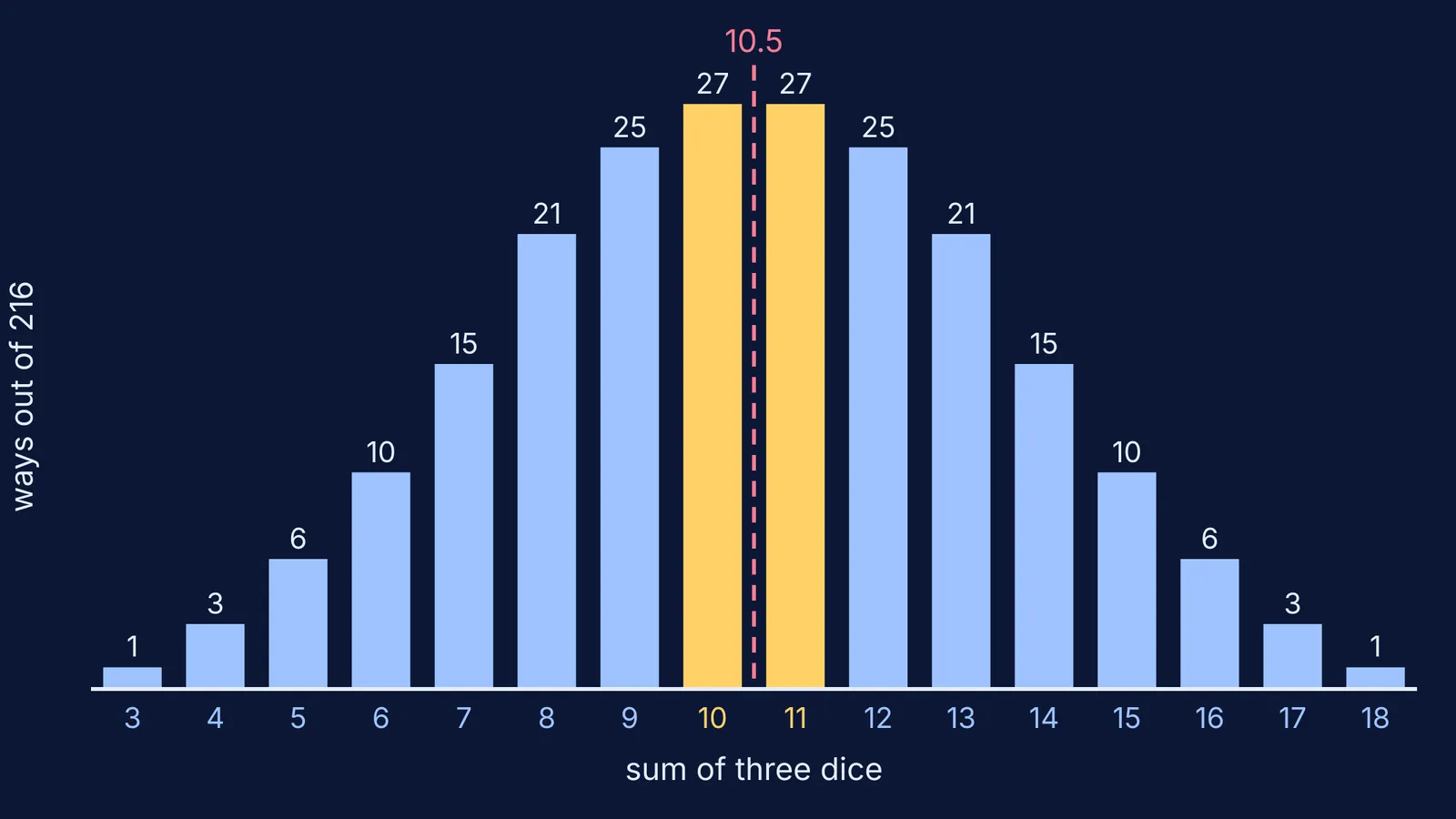
Swap every face x for 7 − x. This turns a total s into 21 − s and pairs every outcome with exactly one partner. So s and 21 − s always have the same number of ways, and the distribution is a mirror image around 21/2 = 10.5.
The OEIS list for three dice gives the counts for sums 3 to 18 as 1, 3, 6, 10, 15, 21, 25, 27, 27, 25, 21, 15, 10, 6, 3, 1. Sums 10 and 11 tie at 27, and the counts for sums 3 to 10 add to 108, exactly half of 216. So P(sum ≤ 10) = 1/2, and if you count 9 as 25 ways, 12 must also be 25: a free check.
To see where this bell-like shape comes from, start with why 7 is the most common sum with two dice.
A checklist for any three-dice sum question
Write the sample space as 216 ordered triples, never as unordered combinations.
List each set of faces once, largest first, so none are repeated or missed.
Put 6, 3 or 1 beside each set, then add.
Check with symmetry: the count for s must equal the count for 21 − s.
For a sum with many sets, check with stars and bars or with the complement.
Try it on a total of 8. The sets are 6, 1, 1; 5, 2, 1; 4, 3, 1; 4, 2, 2; and 3, 3, 2, giving 3 + 6 + 6 + 3 + 3 = 21. Symmetry says 13 must also have 21 ways, and the OEIS counts confirm both.
If you keep getting the method wrong, the Fermi Problem Library has worked problems with a step-by-step solver that explains the reasoning rather than printing an answer. To go over sample spaces and counting from the start, use the Fermi Concept Library.


