On this page
A classic permutations and combinations question asks: in how many ways can 12 different objects be divided into 3 equal groups? A common first answer is 34,650. The textbook answer is 5,775. The gap between the two is one factor, 3!, and once you see where it comes from you can handle every version of the question, including the one where the groups are handed out to people.
How many ways can 12 objects be divided into 3 equal groups?
Start the natural way. Choose 4 of the 12 objects for a first group, then 4 of the remaining 8 for a second group, and the last 4 form the third group. That gives 12C4 × 8C4 × 4C4 = 495 × 70 × 1 = 34,650.
That product is the multinomial coefficient 12!/(4! × 4! × 4!). The multinomial coefficient counts the ways of putting n distinct objects into m distinct bins with a fixed number in each bin, as the multinomial theorem article on Wikipedia explains. The key word is distinct: the bins are treated as first, second and third.
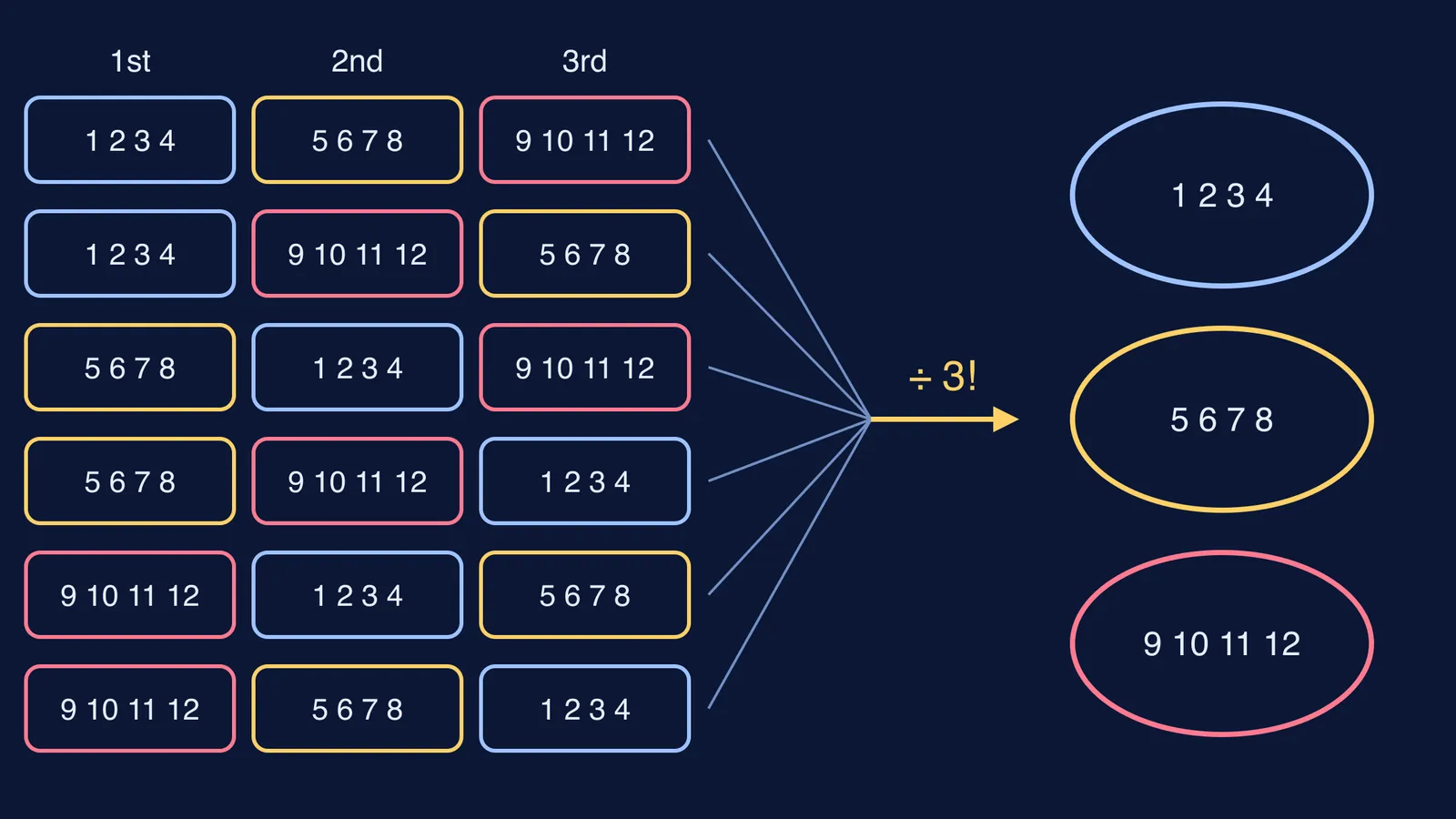
In the question as asked, the groups have no names. So divide by 3!, the number of orders three groups can be listed in: 34,650 ÷ 6 = 5,775.
The number of ways to split 12 objects into 3 unlabelled groups of 4 is 5,775, matching the n = 3 term of OEIS sequence A025036, which counts partitions of {1, 2, ..., 4n} into sets of size 4 using the formula (4n)!/(n! × (4!)^n).
Why do you divide by 3! when the groups are equal?
Label the objects 1 to 12 and take one split: {1, 2, 3, 4}, {5, 6, 7, 8} and {9, 10, 11, 12}. The choosing method above reaches this split once for each of the 3! = 6 orders in which the three groups can be picked. The diagram at the top shows those six rows collapsing into one split.
Every split is overcounted by exactly the same factor, 6, so dividing by 3! is safe. That is the whole idea.
Now compare groups of unequal size. Split 12 objects into groups of 5, 4 and 3. Here the sizes already tell the groups apart: the group of 5 can never be confused with the group of 3. Nothing is overcounted, so the answer is just the multinomial coefficient 12!/(5! × 4! × 3!) = 27,720, with no extra division.
The rule that follows: divide by k! for every group size that repeats k times.
What changes when the groups are given to 3 people?
Suppose the 12 objects are books, and Aarav, Meera and Kabir each get 4. Now swapping whole groups matters: Aarav getting {1, 2, 3, 4} is a different outcome from Meera getting it. So take the 5,775 unlabelled splits and hand each one out in 3! ways: 5,775 × 6 = 34,650. That is the multinomial count again, which makes sense, because naming the people turns the groups into distinct bins.
The same pattern holds for cards. Dealing 12 different cards to 4 players, 3 each, gives 12!/(3!)^4 = 369,600 ways. Without the players, splitting 12 objects into 4 unlabelled groups of 3 gives 15,400 ways, the n = 4 term of OEIS sequence A025035. And 15,400 × 4! = 369,600, as it should.
A four-question check before you divide
Run through these in order on any grouping question. If you are unsure whether order matters at all, start with our permutation or combination decision test.
Are the objects different from each other? This method assumes they are. Identical objects need a different method.
Do the groups have names, such as people, numbered boxes or named teams? If yes, use the multinomial coefficient and stop.
If the groups have no names, which sizes repeat? Divide by k! for each size that appears k times.
Can you check a tiny case by hand? Four objects into two pairs gives 4!/(2! × 2! × 2!) = 3. List them: {1,2 | 3,4}, {1,3 | 2,4}, {1,4 | 2,3}. Three, as the formula says.
If you like seeing counting rules as branches, our post on how to build a conditional probability tree diagram uses the same multiply-along-the-path idea.
Where to practise grouping problems?
Work a few mixed questions where you have to decide labelled or unlabelled before you calculate. The Fermi Problem Library has worked problems with a step-by-step solver that explains the reasoning rather than printing an answer, so you can see where a 3! comes in or drops out. If factorials and combinations still feel shaky, the Fermi Concept Library gives each concept its own lesson.
If you are preparing for JEE Main, it also helps to know how your marks are turned into a score; see JEE Main normalisation explained.